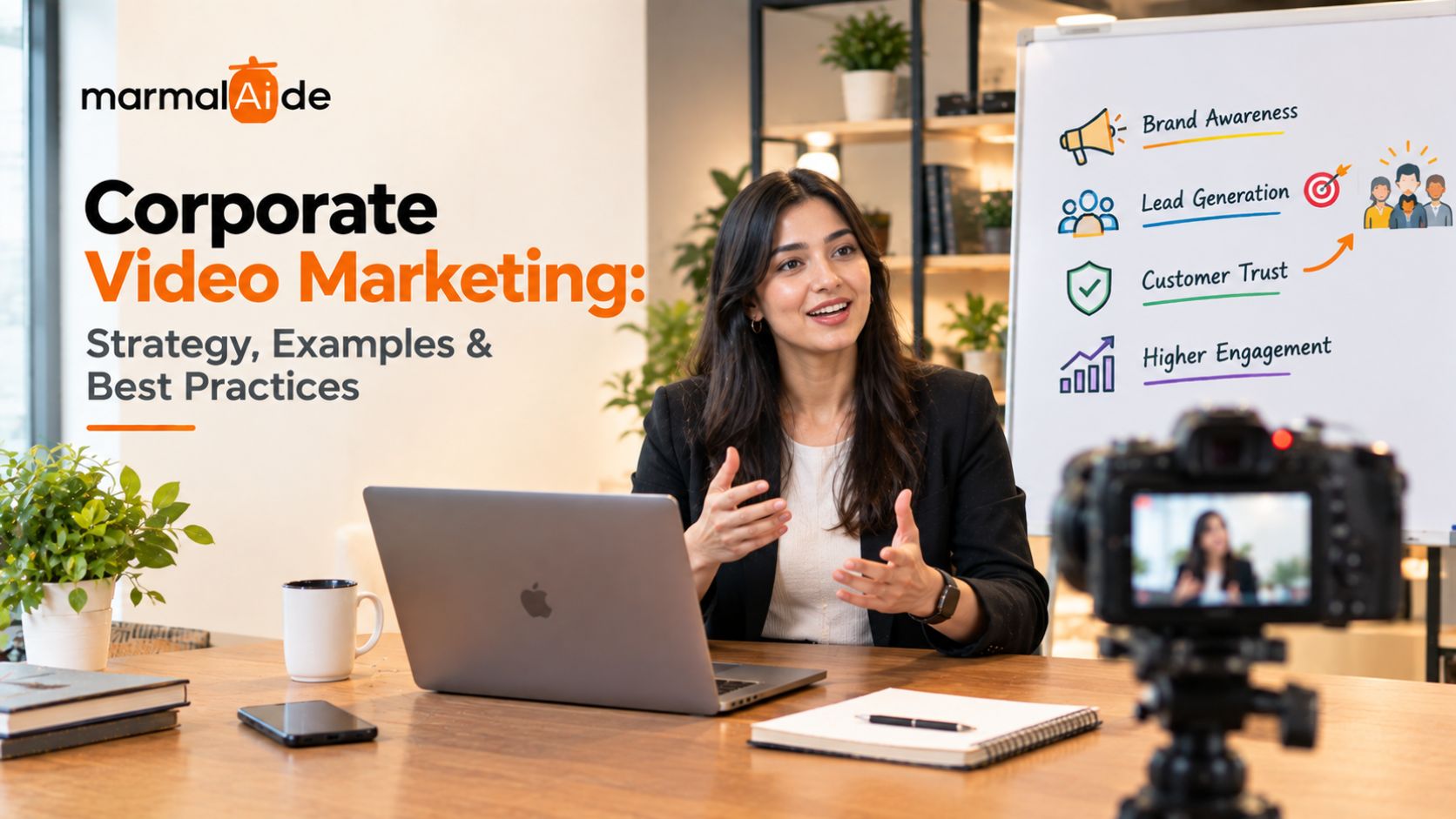
After producing hundreds of these corporate videos, something we’ve noticed is, almost every request starts with “We need a video about our company.” But the ones that actually perform start with a completely different question: “What do we need our audience to believe after watching this?” Trust us, that’s where things change for real. Corporate video marketing is now the business strategy. Finance teams that once treated video as a “nice to have” now treat it as a line item they cannot afford to cut. A 90-second video can do something a 40-page deck never will. Just get watched start to finish, understood by your buyers, and forwarded around.
However, the catch is that most professional corporate videos are still made to satisfy an internal stakeholder instead of an actual viewer; a talking head, a stock soundtrack, and a call to action nobody remembers and that’s where they fail.
We’re Marmalaide, and we spend our days with filmmakers using generative AI to make business videos based on what we watch happen inside real campaigns. As we move through this guide, you’ll learn how it works.
What Is Corporate Video Marketing?
Corporate video marketing is not all about shooting an “About Us” film with a stiff executive reading a script in front of a bookshelf, set to royalty-free piano music. Instead, it’s the use of video content to connect a company’s brand, products, culture, or expertise with the audiences that matter most to its business (prospects, customers, employees, partners, and investors).
Unlike a single product ad, it can cover everything from a founder’s story and a customer case study to an internal onboarding film, a 45-second product demo, or an executive update to investors. Wherever your brand needs to be understood quickly and remembered longer, video does that job now.
Why Does Corporate Video Marketing Matter Now?
Video stopped being optional a while ago, and buyers’ behavior has already moved past text. According to HubSpot research, adoption of video marketing among businesses is around 89%, with 93% of marketers calling it a central part of their overall roadmap. What’s more, companies publish videos on their websites ahead of social feeds. Your homepage is doing more selling than your feed.
LinkedIn’s own Business of Influence research, a survey of over 1,700 tech buyers across the US, UK, and India, found that 63% say short-form video content helps them decide whether to buy, and 80% of those who consume video say it’s one of the most trusted content formats. Buyers aren’t reading your one-pager first anymore; rather, they’re watching something.
Video icepacks turn your value proposition into something a CFO, a procurement lead, and a technical evaluator can all watch in the same three minutes and walk away with the same understanding.
The Behavior Shift Nobody Budgeted For
Content Marketing Institute’s latest research, a survey of over 1,000 business-to-business marketers conducted with MarketingProfs, found that 96% of organizations say they create thought leadership content. Still, at most companies, fewer than 5% of employees actually contribute to it. That means a lot of corporate content is a handful of people on the marketing team trying to sound smart on LinkedIn, not a company speaking with its own voice. Audiences can tell the difference, and video makes the gap between authentic and performative more obvious than text. At the same time, money is following attention in a very literal way. According to Statista, U.S. businesses now spend more on digital video advertising than on traditional TV ads: $85 billion versus $59 billion.
So, here’s what we see: the audience has changed, the money has moved, yet most corporate video hasn’t caught up. That’s the opportunity.
Building a Business Video Marketing Strategy That Survives Contact With Your Calendar
Often videos fail to do the job not because they look cheap, but because there was no structure; nobody defined what the video was supposed to do before production started. Build the strategy in this order:
Step 1: Start with the business outcome, not the video format
Decide whether the video needs to build brand awareness, shorten a sales cycle, support recruiting, or explain a product. Once the outcome is on set, decide the length: whether it should be 30 seconds or three minutes.
Step 2: Map videos to the buyer journey
A prospect discovering your brand needs a different video than one comparing you to a competitor in week six of evaluation. Awareness-stage videos should sell an idea; decision-stage videos should sell proof.
Step 3: Write the message before you write the script
One clear sentence the viewer should believe after watching should survive the entire production process, from concept to final cut. If your team can’t agree on that sentence, the script isn’t ready yet.
Step 4: Plan for distribution before you plan for production
If your video is built only for a YouTube pre-roll, it will underperform on LinkedIn, and a square social cut will look wrong embedded on a landing page. Decide where the video lives first before you shoot.
Step 5: Budget for variations
One polished 60-second film rarely does the job alone. Plan cutdowns for social, a silent version with captions for LinkedIn feeds, and a longer cut for your website or sales deck.
Step 6: Set a measurement plan before launch
Decide whether the video’s success looks like watch-through rate, form fills, meeting bookings, or sales-cycle length before the numbers come in.
What Are Some Corporate Video Marketing Ideas Worth Studying?
Some of these corporate video ideas are used in real-world scenarios and are designed to be watched, not skipped.
Founder or leadership story films
A short, cinematic piece built around the “why” behind the company. These work especially well for brand awareness and investor-facing content because they put a human face on a company narrative.
Explainer videos
A 60–90 second animated or live-action piece that breaks down a complex product or service into something a first-time visitor understands immediately. These consistently perform well on homepages and landing pages.
Customer testimonial and case study videos
A client explaining, in their own words, the problem they had and the result they got. These are among the highest-converting corporate branding videos because they replace a company’s claims with customer proof.
Employer branding and culture videos
Built for recruiting and retention, these show what it is actually like to work somewhere — useful for talent acquisition as much as for brand perception.
Product launch and demo videos
A focused look at a new feature or release, often cut into multiple lengths for email, social, and sales enablement.
Internal communications and training videos
Less visible externally but critical internally — onboarding films, safety briefings, and CEO updates that keep a distributed workforce aligned.
Also read: Performance Creative: Strategy, Examples & Best Practices for how to turn any of the above formats into testable, paid-media-ready ad creative.
Corporate Video Marketing Examples We Keep Pointing To
We’d rather show you real outcomes than made-up ones, a few from Marmalaide’s own work:
- Santa Monica Brew Works needed a full summer brand film but didn’t have the budget for a traditional shoot. Building it from existing footage plus AI-generated scenes saved them roughly $50,000 compared with a full production.
- Cadastral needed a soft-launch film that looked and felt like a full production. It came in at around 65% below what that would normally cost.
- Sevaro, a healthcare company, used an explainer built this way and saw double the watch-through of their previous creative.
None of these are “we made a nice video.” They’re a founder story, a launch film, and an explainer: three of the most common corporate video marketing ideas out there done with a plan attached.
Not every video idea belongs in the same part of the funnel, and it is important to match the idea to the stage:
| Funnel Stage | Corporate Video Marketing Idea | Primary Goal |
| Awareness | Brand story, founder film, thought-leadership clip | Introduce the company and its point of view |
| Consideration | Explainer video, product demo, comparison video | Educate on the “how” and differentiate from alternatives |
| Decision | Customer testimonial, case study, ROI walkthrough | Provide proof and reduce perceived risk |
| Retention & Advocacy | Onboarding video, customer success story, community spotlight | Reduce churn and turn customers into referrers |
| Internal/ Employer Brand | Culture video, leadership Q&A, training series | Support hiring, retention, and internal alignment |
What Corporate Video Marketing Best Practices Actually Move the Needle?
Plenty of video marketing best practices sound obvious in a meeting and get ignored in production. These are the ones that consistently perform:
Win the first three seconds
Open with the outcome, the problem, or a bold claim, never with a logo animation or a slow fade-in.
Design for sound-off viewing
Captions and on-screen text should carry the message even when the audience is scrolling silently.
Keep brand identity consistent across every cut
Color palette, typography, tone of voice, and pacing should be recognizable whether someone sees a 6-second bumper or a 3-minute film.
End with one CTA, not three
You don’t need multiple call-to-action; a single, specific next step converts better than a menu of options.
Repurpose relentlessly
Do not treat a single well-scripted shoot or AI-generated production as a one-and-done asset. Cut it down into a dozen formats: square, vertical, silent, subtitled, 15-second, 60-second to use and reuse.
What Corporate Video Solutions Should You Choose
Most marketing teams today have three broad corporate video solutions, and each comes with a real trade-off.
In-house production gives you creative control and speed for simple videos, but it demands equipment, editing skill, and most importantly time your team may not have between campaigns.
Traditional agencies and production houses deliver polished, professional corporate videos. However, shoots typically take weeks to schedule, cost thousands of dollars per finished minute, and are hard to scale when marketing calendars change mid-quarter.
AI-assisted production, which is where we at Marmalaide live, closes the gap between the two. We are an always-on creative team of filmmakers, marketers, and generative AI that scripts, produces, and edits studio-quality corporate videos without a traditional shoot or an agency retainer. Instead of choosing between “fast and rough” or “polished and slow,” teams get AI-powered video production services that deliver launch-ready assets in days, cut down into every format a campaign calendar demands.
For teams that also need the resulting films turned into paid-media-ready ad variations, Marmalaide’s AI ad creative production services extend the same footage and brand assets into testable, channel-specific cuts. We’re also part of the NVIDIA Inception Program, for anyone evaluating the technology side.
How Can Marmalaide Help You Produce Professional Corporate Videos at Scale?
Making one good corporate video is achievable for almost any team. But producing a consistent stream of professional corporate videos and branding videos across formats, campaigns, and channels is what usually breaks a marketing calendar.
Marmalaide pairs experienced filmmakers and marketers with generative AI to remove that bottleneck. For a corporate video marketing programme, our team can help produce:
- Founder and leadership story films for brand and investor communications
- Explainer and product videos that simplify complex offerings
- AI-enhanced customer testimonial and case study content
- Employer branding and culture films for recruiting
- Multi-format cutdowns for web, email, LinkedIn, and paid social
- Ongoing monthly or quarterly video output through subscription plans built for teams that need a steady content pipeline rather than a one-off shoot
Our $1,999 Pilot package is built for teams that want to test the model. It includes a 30-second master commercial, two 10–15 second cutdowns, two static ads or posts, and campaign and channel adaptations. Take a step and let’s make something worth watching!
Frequently Asked Questions
What does a professional corporate video typically cost?
Costs vary based on length, format, and production approach. Generally, a simple explainer can run a few hundred dollars, while a fully produced brand film with a traditional crew can reach five figures.
How long should a corporate marketing video be?
It depends on the goal and the platform. Social and landing-page videos tend to perform best between 30 seconds and two minutes, while in-depth explainer or training content can run longer.
What’s the difference between corporate video marketing and a traditional advertisement?
Traditional ads are usually built around a single product push within a paid media flight. Corporate video marketing includes brand storytelling, customer proof, and internal communications. It is distributed across owned, earned, and paid channels.
How is AI changing corporate video production?
AI is shortening the timeline from brief to finished cut, making it possible to produce multiple professional-quality video variations in days rather than weeks. It works best when paired with human creative direction.