
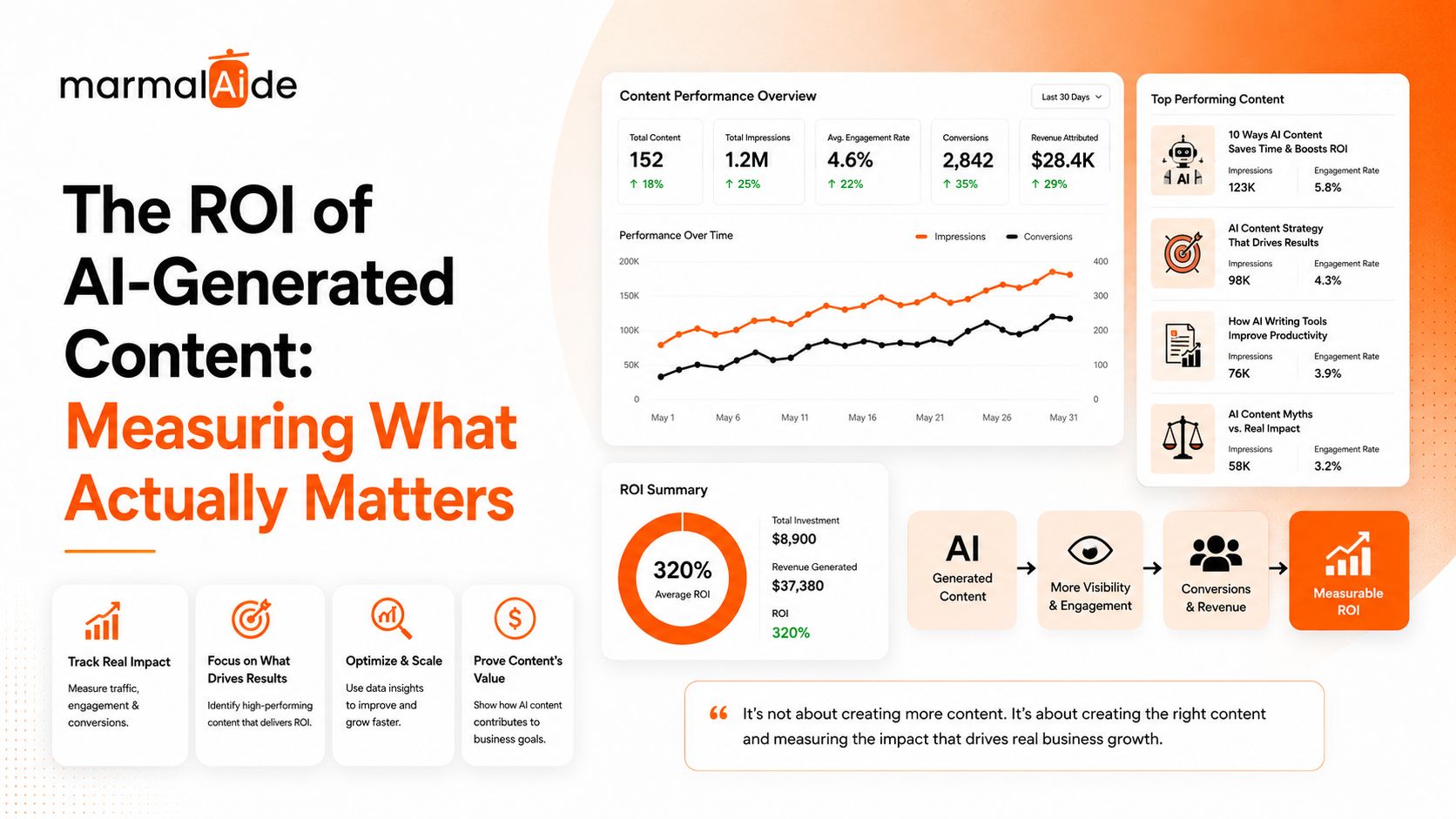
ROI of AI Generated Content is one of the biggest questions marketers are asking in 2026. You’ve heard the pitch that AI can produce content faster and at a lower cost, but speed and cost alone don’t determine success. Marketers care about measurable business results. ROI of AI-Generated Content depends on how effectively AI improves traffic, engagement, lead generation, conversions, and overall marketing performance. The short answer is yes, when implemented strategically. Understanding the right metrics and tracking them consistently is the key to maximizing the ROI of AI-Generated Content.
The ROI Question
Before investing in AI-powered content creation, you need to answer:
- Will AI-generated content drive more leads?
- Will it improve conversion rates?
- Will it increase customer lifetime value?
- Will it strengthen brand perception?
- Will the cost savings justify the investment?
These are the questions that matter. Let’s dig into the data.
The Business Case for AI-Generated Content
The financial case is compelling:
Cost Reduction:
- Traditional content: $500-$2,000 per blog post, $5,000-$50,000 per video
- AI-assisted content: $50-$300 per blog post, $100-$500 per video
- Savings: 70-90% per piece
Volume Increase:
- Traditional production: 10-50 pieces per month
- AI-assisted production: 100-500 pieces per month
- Increase: 5-10x more content
Time Savings:
- Traditional production: 1-3 weeks per piece
- AI-assisted production: 1-2 hours per piece
- Savings: 90% of production time
But cost and speed are just the foundation. The real ROI comes from business impact.
Measuring the Business Impact of AI-Assisted Content
Increasing content production capacity can create new marketing opportunities, but the actual business impact depends on content quality, audience relevance, distribution, and optimization.
Instead of evaluating success through publishing volume alone, businesses should measure how AI-assisted content contributes to the following outcomes.
1. Organic Search Growth
AI can help marketing teams research topics, develop content briefs, and produce relevant content more efficiently.
However, organic growth depends on whether published content satisfies search intent, provides useful information, and earns visibility in search results.
Measure organic clicks, qualified traffic, keyword visibility, and conversions rather than the number of articles published.
2. Qualified Lead Generation
AI-assisted content can help businesses address different customer questions and buying stages.
Educational articles, comparison guides, case studies, and industry resources can support potential customers throughout their decision-making process.
Measure marketing-qualified leads, sales-qualified leads, lead quality, and content-assisted enquiries to understand the actual impact.
3. Content Engagement and Conversions
Producing more content variations can help marketing teams test different messages, formats, and calls to action.
Track engagement rates, CTA clicks, landing page conversions, and lead submission rates to determine which content formats resonate with the intended audience.
4. Improved Marketing Efficiency
One of the measurable benefits of AI-assisted production is the ability to reduce repetitive tasks and improve workflow efficiency.
Compare production hours, cost per approved asset, revision cycles, and total campaign turnaround time.
This helps businesses understand whether AI is improving team productivity and allowing resources to be allocated more effectively.
5. Long-Term Brand and Audience Growth
Consistently publishing useful and relevant content can help businesses build stronger relationships with their audiences.
Monitor branded search growth, returning visitors, direct traffic, audience engagement, and relevant brand mentions.
These indicators provide additional context when evaluating the long-term contribution of AI-assisted content to business growth.
Ultimately, the value of AI-generated content should be measured through meaningful improvements in marketing performance, not simply through increased publishing frequency.
Measuring ROI: The Key Metrics
To measure the ROI of AI-generated content, track these metrics:
Traffic Metrics:
- Organic traffic growth (month-over-month)
- Traffic by content type
- Pages per session
- Time on page
- Bounce rate
Lead Metrics:
- Leads generated from content
- Cost per lead (CPL)
- Lead quality score
- Lead-to-customer conversion rate
Revenue Metrics:
- Revenue attributed to content
- Customer acquisition cost (CAC)
- Customer lifetime value (LTV)
- LTV:CAC ratio
Engagement Metrics:
- Email open rates
- Click-through rates
- Social shares
- Comments and engagement
Brand Metrics:
- Brand awareness (surveys)
- Brand sentiment (social listening)
- Share of voice vs. competitors
- Brand search volume
Here’s a tip:
To maximize the ROI of AI-Generated Content, set up a proper attribution model before you start producing AI generated content. Use UTM parameters consistently, implement accurate analytics tracking, and establish baseline performance metrics. This allows you to measure the ROI of AI-Generated Content across traffic, leads, conversions, and revenue with confidence. Without proper tracking, proving the ROI of AI-Generated Content becomes difficult, even when your AI powered content is delivering significant business results.
How to Measure the ROI of AI-Generated Content Step by Step
Measuring the ROI of AI-generated content requires more than comparing the cost of traditional content production with AI-assisted production. Businesses need to understand how AI affects the complete content lifecycle, from creation and publishing to audience engagement, lead generation, and revenue.
A structured measurement process helps marketing teams identify which AI-assisted content activities are delivering measurable business value.
Step 1: Establish a Baseline Before Using AI
Start by documenting your existing content marketing performance before introducing AI into your production workflow.
Record the following metrics:
- Monthly content production costs
- Number of approved and published content assets
- Average production time per asset
- Organic clicks and impressions
- Organic traffic and keyword performance
- Leads generated through content
- Content-assisted conversions and revenue
Use at least three months of historical performance data where available. This provides a comparison point for evaluating changes after adopting AI-assisted production.
Step 2: Calculate the Full Cost of AI-Assisted Content
AI subscriptions are only one part of the investment. Include all resources required to create, review, publish, and optimize content.
Consider:
- AI software and platform subscriptions
- Content strategy and research
- Employee and freelancer hours
- Human editing and fact-checking
- SEO optimization and quality assurance
- Design, video production, and revisions
- Publishing and distribution expenses
Calculate the cost per approved asset rather than the cost per AI-generated draft.
This distinction helps businesses understand whether AI is actually reducing production expenses while maintaining content quality.
Step 3: Track Content Performance Across Channels
Measure how individual AI-assisted content assets perform after publication.
For organic search, monitor clicks, impressions, average search position, organic sessions, and relevant keyword visibility.
For social media, measure reach, engagement, link clicks, and website visits.
For email marketing, track delivered emails, click-through rates, qualified traffic, and conversions.
Segment performance by content format and distribution channel to identify which activities generate the strongest results.
Step 4: Connect Content Performance to Leads and Revenue
Traffic and engagement are useful indicators, but they do not necessarily represent financial returns.
Track how visitors interact with your content and whether those interactions contribute to business outcomes.
For B2B businesses, useful metrics include:
- Marketing-qualified leads (MQLs)
- Sales-qualified leads (SQLs)
- Demo requests and enquiries
- Lead-to-opportunity conversion rate
- Sales pipeline influenced by content
- Closed-won revenue associated with content
For ecommerce businesses, monitor product views, add-to-cart events, purchases, average order value, and attributed revenue.
Step 5: Compare Results Against the Original Baseline
Evaluate performance before and after implementing AI-assisted content production.
Compare production costs, approved asset volume, organic performance, qualified leads, conversion rates, and revenue.
Look beyond increases in publishing frequency. Determine whether the additional content is reaching relevant audiences and contributing to measurable business outcomes.
Step 6: Calculate the Overall Return on Investment
Once you have collected the cost and performance data, calculate the financial return using:
AI Content ROI (%) = [(Financial Benefits − Total AI Content Investment) ÷ Total AI Content Investment] × 100
Financial benefits can include verified production cost savings and incremental revenue attributable to the AI-assisted content workflow.
For example, if an AI-assisted content program generates $30,000 in measurable financial benefits against a total investment of $10,000, the calculated ROI is 200%.
Review the results regularly and use the findings to improve your content production and distribution strategy.
A consistent measurement process helps businesses understand whether AI-generated content is creating genuine business value rather than simply increasing content output.
How to Measure the SEO ROI of AI-Generated Content
Organic search is an important channel for measuring the long-term performance of AI-generated content. However, publishing more articles does not automatically translate into higher search visibility, qualified traffic, or conversions.
Businesses should evaluate whether AI-assisted content is attracting relevant audiences and contributing to their organic growth objectives.
Here are the SEO metrics worth monitoring:
1. Organic Clicks and Impressions
Use Google Search Console to measure how often your AI-assisted content appears in search results and how many users click through to your website.
Track:
- Total organic clicks
- Search impressions
- Average click-through rate (CTR)
- Average search position
- Performance of individual URLs and queries
Growing impressions without corresponding clicks may indicate that your content needs better title tags, meta descriptions, or alignment with search intent.
2. Keyword Visibility and Search Intent
Monitor the keywords each article ranks for and whether those queries match its intended audience.
Evaluate:
- Primary and secondary keyword performance
- New keyword rankings
- Relevant long-tail search queries
- Changes in average keyword positions
- Search visibility for target topics
The objective should be to attract qualified visitors rather than increase keyword coverage without a clear business purpose.
3. Organic Traffic Quality
Google Analytics 4 can help determine whether organic visitors engage meaningfully with your content.
Monitor:
- Organic sessions
- Engaged sessions
- Engagement rate
- Key events and conversions
- Landing page performance
- Returning visitors
A page attracting fewer but more relevant visitors may deliver greater business value than a page generating high traffic with little engagement or conversion activity.
4. Content Conversion Performance
Evaluate whether organic visitors take meaningful actions after reading your content.
Depending on your business model, these actions may include:
- Contact form submissions
- Demo requests
- Newsletter registrations
- Resource downloads
- Product enquiries
- Purchases
Track these actions against individual landing pages to identify which content assets contribute most effectively to lead generation and revenue.
5. Content Decay and Refresh Performance
AI-generated content also requires ongoing monitoring and optimization.
Review published content periodically to identify:
- Declining organic clicks and impressions
- Outdated information or statistics
- Changes in search intent
- Pages losing keyword visibility
- Content that no longer generates conversions
Refresh underperforming articles with updated information, better explanations, relevant examples, and improved internal links.
Measuring these indicators helps businesses determine whether AI-assisted content is generating sustainable organic search value rather than short-term publishing gains.
How Attribution Models Help Measure AI Content Marketing ROI
One of the biggest challenges in measuring AI content marketing ROI is determining how much business value can reasonably be attributed to individual content assets.
A customer might discover a brand through an organic blog post, return through a social media campaign, read an email newsletter, and eventually submit an enquiry after visiting a service page.
If marketers only measure the last interaction, they may overlook the contribution of earlier content touchpoints.
Attribution models help businesses understand how different marketing interactions contribute to conversions.
Common Attribution Models
1. First-Touch Attribution
This model assigns conversion credit to the first recorded marketing interaction.
It is useful for understanding which content assets initially introduce potential customers to your brand.
For example, if a prospect first discovers your business through an AI-assisted educational blog post, that article receives the conversion credit under a first-touch model.
2. Last-Touch Attribution
Last-touch attribution assigns conversion credit to the final recorded interaction before a conversion.
It helps identify which landing pages, campaigns, or content assets directly encourage users to take action.
However, it does not fully represent the influence of earlier interactions.
3. Linear Attribution
Linear attribution distributes conversion credit equally across the recorded touchpoints in a customer journey.
This provides a broader view of how multiple content assets contribute to a conversion.
4. Data-Driven Attribution
Data-driven attribution uses available conversion-path data to estimate how different interactions contribute to conversions.
Where sufficient data is available, it can help marketers understand the relative contribution of organic content, paid campaigns, email, and other marketing channels.
Best Practices for Content Attribution
To improve the accuracy of AI-generated content ROI measurement:
- Use consistent UTM parameters for campaign links.
- Configure relevant conversion events in Google Analytics 4.
- Connect CRM data with marketing analytics where possible.
- Track landing pages and content-assisted conversions.
- Maintain consistent campaign and content naming conventions.
- Compare first-touch, last-touch, and other available attribution views.
- Document the attribution model used in ROI reports.
No single attribution model captures every customer interaction. Combining analytics, CRM information, and content performance data gives marketing teams a more complete understanding of how AI-assisted content contributes to business results.
Real-World ROI Example: Measuring an AI-Assisted Content Program
Consider a hypothetical B2B SaaS company that introduces AI-assisted content production to improve its marketing efficiency and organic lead generation.
The company compares its performance before and after implementing the new workflow.
Before AI-Assisted Content Production
- Monthly content production cost: $5,000
- Blog posts published: 10
- Monthly organic visitors: 5,000
- Monthly content-generated leads: 50
- Average production time: 10 working days per article
After AI-Assisted Content Production
After implementing AI-assisted research, drafting, editing, and optimization workflows:
- Monthly content production cost: $3,500
- Blog posts published: 20
- Monthly organic visitors: 7,500
- Monthly content-generated leads: 75
- Average production time: 5 working days per article
These figures represent an illustrative scenario, not verified customer results.
Calculating the Financial Return
Assume the company saves $1,500 per month in production costs.
Over 12 months:
Annual production cost savings = $1,500 × 12 = $18,000
If the company also generates $12,000 in incremental revenue that can reasonably be attributed to the additional content activity, its measurable financial benefit is:
Total financial benefits = $18,000 + $12,000 = $30,000
Assume the additional annual investment in AI tools, implementation, and human quality review is $6,000.
The ROI calculation becomes:
ROI = [($30,000 − $6,000) ÷ $6,000] × 100
Calculated ROI = 400%
What Does This Example Demonstrate?
The example highlights why AI content performance should be evaluated using both efficiency and business outcomes.
The company achieved:
- Lower content production expenditure
- Higher publishing capacity
- Increased organic traffic
- More content-generated leads
- Additional attributable revenue
The important takeaway is that increased content output alone does not prove a positive return. The strongest measurement approach connects production savings and incremental business value to the total investment required to operate the AI-assisted workflow.ing with AI-assisted content strategies.
Also Read: generative AI content performance
The Quality Question
“But won’t AI-generated content be lower quality?”
Not if you do it right. The key is:
- Strategic Direction: Humans provide strategy and direction
- Quality Input: Good prompts and guidelines = good output
- Human Review: Experienced marketers review and refine AI output
- Continuous Improvement: Track what works and optimize
AI-generated content reviewed by experienced marketers often outperforms content created by junior writers or agencies without strategic oversight.
The Competitive Advantage
Companies that master AI-assisted content creation gain significant competitive advantages:
Speed to Market:
- Respond to market opportunities faster
- Create content for new products/features quickly
- Capitalize on trending topics in real-time
Content Coverage:
- Cover more keywords and topics
- Create content for every stage of the buyer journey
- Serve more customer segments
Cost Efficiency:
- Lower customer acquisition costs
- Better marketing ROI
- More budget for paid advertising and other initiatives
Brand Presence:
- More consistent publishing schedule
- Stronger presence across channels
- Better audience engagement
Calculating Your Potential ROI
Here’s a simple framework to estimate your potential ROI:
Step 1: Calculate Current Content Costs
- How much do you spend on content per month?
- How many pieces do you produce?
- What’s your cost per piece?
Step 2: Estimate AI-Assisted Costs
- Assume 70-80% cost reduction
- Calculate new cost per piece
- Estimate how many pieces you could produce with same budget
Step 3: Estimate Traffic Impact
- Research: how much does content volume impact organic traffic?
- Conservative estimate: 3-5x traffic increase with 5-10x content increase
- Calculate new monthly organic traffic
Step 4: Estimate Lead Impact
- What’s your current lead-to-customer conversion rate?
- How many additional leads would 3-5x more traffic generate?
- Calculate new monthly leads
Step 5: Calculate Revenue Impact
- What’s your average deal size?
- How many additional customers would you acquire?
- Calculate annual revenue impact
Step 6: Calculate ROI
- Annual revenue impact – annual content investment = net benefit
- Net benefit / annual content investment = ROI
Common ROI Mistakes to Avoid
1. Measuring Too Early
Content ROI takes time. Give it at least 3-6 months before evaluating impact.
2. Not Tracking Properly
Without proper attribution and tracking, you can’t measure ROI. Set up analytics correctly from the start.
3. Ignoring Quality
Cheap, low-quality content won’t drive ROI. Invest in quality oversight.
4. Expecting Immediate Results
Content is a long-term investment. Results compound over time.
5. Not Optimizing
Track what works and double down on it. Continuously improve your content strategy.
How Marmalaide Helps You Achieve Content ROI
This is where Marmalaide becomes a strategic partner in improving the ROI of AI Generated Content. Marmalaide doesn’t just produce content. They help businesses maximize the ROI of AI Generated Content through a combination of generative AI, experienced marketers, and data driven optimization. Their team:
- Develops content strategies aligned with your business goals.
- Produces high quality content at scale using AI and experienced marketers.
- Tracks and measures results to improve the ROI of AI Generated Content.
- Continuously optimizes campaigns based on performance data.
- Scales successful content to maximize business impact and long term growth.
Whether your goal is to increase organic traffic, generate qualified leads, improve conversion rates, or strengthen brand authority, Marmalaide helps businesses achieve a higher ROI of AI Generated Content through AI assisted content creation backed by human expertise.creation.
Getting Started
If you’re ready to measure the ROI of AI-generated content:
- Establish baseline metrics: What’s your current traffic, leads, and revenue from content?
- Set up proper tracking: Implement UTM parameters and analytics correctly
- Define your goals: What business outcomes do you want to achieve?
- Start with a pilot: Produce AI-assisted content for 3-6 months
- Measure and analyze: Track results against your baseline
- Scale what works: Double down on successful strategies
Learn more about achieving content ROI at Marmalaide
The question isn’t whether AI-generated content can drive ROI. The data clearly shows it can. The question is: are you ready to invest in a content strategy that actually drives business results?
Conclusion
ROI of AI Generated Content should never be measured by production speed alone. The real ROI of AI Generated Content comes from increasing organic traffic, generating qualified leads, improving conversions, strengthening brand authority, and delivering measurable business growth. When combined with a well defined strategy and human expertise, ROI of AI Generated Content becomes a powerful business advantage rather than just another marketing metric. By tracking the right KPIs, optimizing campaigns, and refining content over time, businesses can maximize the ROI of AI-Generated Content. Marmalaide helps brands achieve higher ROI of AI Generated Content by combining AI powered content creation with experienced marketers who focus on delivering measurable results, not just more content.
FAQs
What is the ROI of AI generated content?
The ROI of AI generated content is measured by improvements in traffic, lead generation, conversions, revenue, and marketing efficiency compared to the investment made in content production.
How do you measure AI content marketing ROI?
Businesses should track metrics such as organic traffic, qualified leads, conversion rates, customer acquisition cost, customer lifetime value, engagement, and revenue generated from content marketing.
Can AI generated content improve SEO performance?
Yes. AI helps create SEO optimized content at scale, increasing keyword coverage, publishing frequency, and search visibility when combined with human editing and strategic planning.
Does AI generated content produce better business results?
When supported by experienced marketers, AI generated content can increase content output, improve audience engagement, generate more leads, and reduce marketing costs while maintaining quality.
How long does it take to see ROI from AI content marketing?
Most businesses begin seeing measurable improvements within three to six months, depending on content quality, publishing frequency, SEO strategy, and competition in their industry.
Why choose Marmalaide for AI assisted content marketing?
Marmalaide combines advanced generative AI with experienced marketers and filmmakers to create high quality, SEO friendly content that helps businesses improve marketing performance and achieve measurable ROI.
How do you calculate the ROI of AI-generated content?
Calculate AI-generated content ROI by comparing measurable financial benefits, including production cost savings and attributable incremental revenue, against the total investment in AI tools, implementation, content production, and human review.
Which KPIs should marketers track to measure AI content performance?
Important KPIs include organic clicks, search impressions, qualified website traffic, engagement rate, cost per approved asset, qualified leads, conversion rate, and attributable revenue. The right metrics depend on the business objectives of the content strategy.
How can Google Analytics 4 help measure AI content ROI?
Google Analytics 4 helps marketers track organic sessions, engaged sessions, landing page performance, key events, and conversions. Combined with CRM data and campaign tracking, it provides insights into how content contributes to lead generation and revenue.
How do you measure the SEO performance of AI-generated content?
Use Google Search Console to monitor organic clicks, impressions, CTR, average position, and search queries. Combine this data with Google Analytics 4 to evaluate organic traffic quality, engagement, and conversions.
How long should businesses monitor AI-generated content before calculating ROI?
Businesses should establish a baseline before implementation and monitor performance consistently after publishing. Production efficiency can be evaluated immediately, while organic search and revenue outcomes may require several months of observation. The evaluation period depends on the content format, distribution strategy, and sales cycle.
Does publishing more AI-generated content guarantee higher ROI?
No. Increased publishing volume does not guarantee better rankings, traffic, leads, or revenue. AI-generated content must provide genuine value, satisfy search intent, maintain accuracy, and reach the right audience to contribute to measurable business results.