
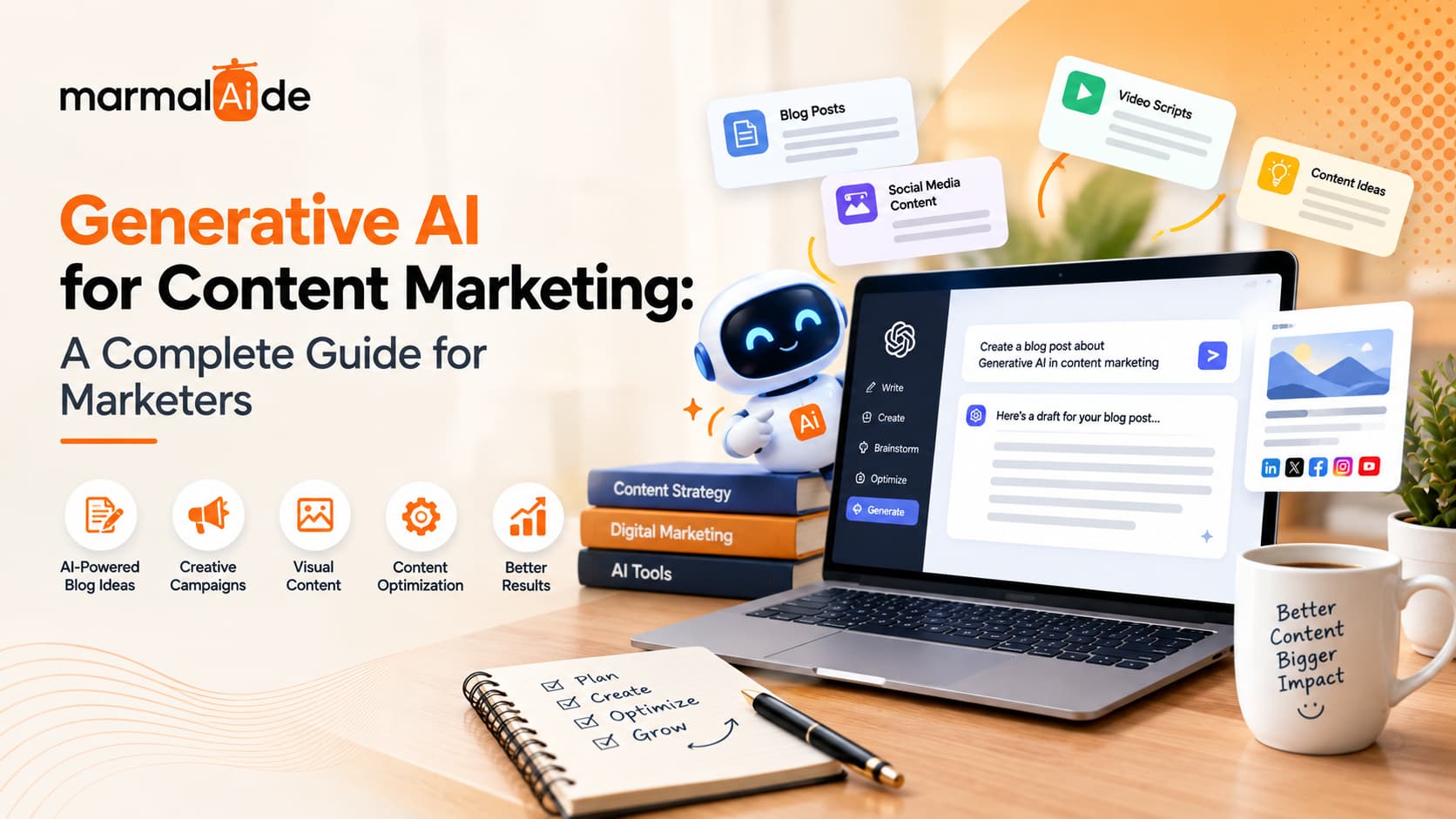
Content marketing has always been a cornerstone of digital strategy, but producing high-quality, consistent content at scale remains a challenge for many brands. Generative AI for content marketing is changing how teams approach this challenge by accelerating content creation, personalization, optimization, and distribution. In this guide, we’ll explore how generative AI is reshaping content marketing, where it delivers the most value, and how businesses can use it to build a faster, more scalable content workflow in 2026.
The Content Marketing Challenge
Traditional content creation is expensive and time-consuming. Whether you’re managing social media, blog posts, video scripts, or email campaigns, the process typically involves:
- Brainstorming sessions with multiple stakeholders
- Research and planning phases
- Writing and editing cycles
- Design and production work
- Multiple rounds of revisions
For most brands, this translates to weeks of work and thousands of dollars in agency fees or in-house labor costs.
How Generative AI Changes the Game
Generative AI tools can now produce high-quality marketing content in minutes, not weeks. Here’s what’s possible:
Content Ideation & Strategy: AI can analyze your brand voice, audience demographics, and market trends to suggest content ideas that resonate with your target market.
Rapid Content Production: From blog posts to social media captions, AI can generate multiple variations of content, allowing your team to choose the best options or blend them together.
Personalization at Scale: AI enables brands to create personalized content experiences for different audience segments without multiplying production costs.
Multi-Format Content: A single piece of core content can be transformed into blog posts, social media snippets, email newsletters, and video scripts—all optimized for their respective platforms.
How to Use Generative AI in Content Marketing
The most effective way to use generative AI content marketing is to treat it as part of your workflow—not as a replacement for your marketing team.
A practical AI-powered content workflow looks like this:
- Research your audience and search intent: Identify what your audience is searching for, the questions they have, and the topics that matter to their buying journey.
- Create content briefs and outlines: Use AI to turn your research into structured briefs, outlines, key talking points, and content angles.
- Create the first draft: Generate an initial version of the content using your brand guidelines, audience information, and campaign objectives.
- Add expertise and original insights: Bring in expert opinions, customer examples, proprietary data, case studies, and real-world experience. This is where human input makes AI-assisted content more valuable and differentiated.
- Fact-check and edit: Review claims, statistics, sources, tone, and accuracy before publishing. AI-generated content should not be published without appropriate human review.
- Optimize for search and conversions: Refine headings, internal links, search intent, calls to action, and on-page elements based on the goal of the content.
- Repurpose across channels: Turn the finished content into social posts, email campaigns, video scripts, ads, or other formats suited to different platforms.
- Measure and improve: Track engagement, rankings, conversions, and other relevant performance metrics. Use those insights to improve future content.
The goal isn’t to publish more AI-generated content. It’s to build a faster content workflow that combines AI efficiency with human expertise, originality, and editorial judgment.
Real-World Applications of Generative AI content marketing
Social Media Teams: Generate 30 days of social content in hours, complete with platform-specific formatting and hashtag optimization.
Growth Marketing Teams: Create A/B test variations of landing page copy, email subject lines, and ad copy to optimize conversion rates faster.
Brand Teams: Maintain consistent brand messaging across all channels while scaling content production without losing quality.
Here’s a tip:
Don’t just use AI-generated content as-is. The best results come from using AI as a starting point—have your human team review, refine, and add brand personality to the output. This hybrid approach gives you the speed of AI with the authenticity of human creativity.
Generative AI Content Marketing Workflow
Generative AI works best when it becomes part of a repeatable content marketing workflow. Instead of using AI to create content from start to finish, marketing teams can use it at different stages to move from an initial idea to measurable results faster.
1. Idea
Start with a business objective, audience need, customer question, or content opportunity. AI can help expand these inputs into relevant topics and content angles.
2. Research
Analyze audience questions, search intent, competitors, industry trends, and existing content. AI can help organize research and identify useful themes, but important facts and sources should still be verified.
3. Content Brief
Turn the research into a clear content brief covering the target audience, search intent, key topics, messaging, structure, and desired action.
4. AI Draft
Use generative AI to create the initial draft based on the approved brief and brand guidelines. This can significantly reduce the time spent getting from an outline to a workable first version.
5. Human Review
Review the draft for accuracy, originality, brand voice, and usefulness. Add expert insights, original examples, customer experiences, and proprietary information that AI cannot provide on its own.
6. SEO and Conversion Optimization
Optimize the content for the intended search query and business goal. Refine headings, internal links, calls to action, metadata, and opportunities to answer related user questions naturally.
7. Distribution and Repurposing
Turn the finished content into formats for other channels, such as social posts, email newsletters, video scripts, or ad copy. Each version should be adapted to the audience and platform rather than simply duplicated.
8. Performance Analysis
Track relevant metrics such as organic traffic, engagement, conversions, rankings, and leads. Use these insights to identify what worked and improve the next content cycle.
The goal is not to automate content creation completely. It is to create a faster, repeatable workflow where AI handles time-consuming tasks while marketers remain responsible for strategy, expertise, quality, and final decisions.
The Cost & Time Advantage of using Generative AI for content marketing
One of the biggest advantages of generative AI in content marketing is the ability to reduce the time and effort required to produce and iterate on content.
Instead of starting every asset from scratch, marketing teams can use AI to accelerate research, ideation, drafting, personalization, and content repurposing. This makes it easier to create and test more variations within the same campaign.
The impact can include:
- Faster content production: Move from an idea or brief to a first draft more quickly.
- More efficient iteration: Create multiple versions of headlines, messaging, CTAs, and creative concepts without rebuilding each asset from scratch.
- Lower production workload: Automate repetitive tasks so marketers can spend more time on strategy, creative direction, and optimization.
- More opportunities to test: Produce more content variations and learn which messages perform best with your audience.
- Faster campaign execution: Reduce bottlenecks between planning, production, review, and distribution.
The real advantage isn’t simply producing content more cheaply. It’s building a more efficient content operation where teams can create, test, learn, and improve at a faster pace.
Generative AI and the Future of Search
Search is evolving beyond traditional blue-link results. AI-powered experiences such as Google AI Overviews can summarize information from multiple sources and help users explore topics directly within Search.
For content marketers, this doesn’t mean abandoning SEO. The fundamentals still matter: create useful content that clearly satisfies search intent, use descriptive headings, maintain a logical site structure, and make important information easy for search engines to understand.
At the same time, marketers should focus on creating content that provides something beyond generic information. Original research, expert insights, first-hand experience, useful examples, and proprietary data can make content more valuable and differentiated.
The goal is to create content that works for both audiences: people looking for reliable answers and search systems looking for useful sources to understand and surface in AI-powered results.
Why Choose Marmalaide for Your Gen AI Content Needs
At Marmalaide, we combine generative AI with the expertise of experienced marketers and filmmakers to help teams produce and iterate on content more efficiently.
For example, a growth marketing team can start with a single campaign concept and turn it into multiple creative assets—such as ad variations, social content, landing-page copy, and video concepts. The team can then test different messages, hooks, and formats, identify what performs best, and use those insights to develop the next round of creative.
This approach helps marketing teams move from one idea to multiple testable assets without treating every new variation as a completely new production project.
Marmalaide supports different content needs across teams:
- Growth Marketing Teams: Create and test content variations designed around campaign and conversion goals.
- Social Media Teams: Develop platform-specific content and creative variations for ongoing publishing.
- Brand Teams: Scale content while maintaining consistent messaging and brand voice.
The goal is not simply to generate more content. It is to help teams create, test, learn, and iterate faster.
Explore – Marmalaide Case Studies
Conclusion
Generative AI isn’t replacing human creativity—it’s amplifying it. By automating the repetitive aspects of content creation, AI frees your team to focus on strategy, creativity, and optimization. The brands that adopt Gen AI for content marketing now will have a significant competitive advantage in 2026 and beyond.
Ready to transform your content production? Explore how Marmalaide can help your team create more content, faster, and at a lower cost.
Explore generative AI content marketing strategies that help businesses create scalable, engaging, and effective content while improving marketing efficiency.
FAQs on Generative AI for content marketing
How is generative AI used in content marketing?
Generative AI can help marketers research topics, generate content briefs, draft copy, create variations, personalize messaging, and repurpose content across multiple channels. Human review is still important for accuracy, originality, and brand voice.
Can generative AI replace content marketers?
No. Generative AI can automate many repetitive content tasks, but marketers are still needed for strategy, creative direction, fact-checking, brand positioning, and performance optimization.
Is AI-generated content good for SEO?
AI-generated content can perform in search when it is useful, accurate, original, and created to satisfy users. Simply generating large amounts of low-value content is not a reliable SEO strategy and can conflict with Google’s spam policies.
How can marketers use AI without losing brand voice?
Give AI clear brand guidelines, examples of existing content, audience information, and tone requirements. Then have a human editor review the output before publishing.
What types of content can generative AI create?
Generative AI can assist with blog posts, social media content, email campaigns, ad copy, landing-page variations, video scripts, content briefs, and content repurposing.
What is the best way to use generative AI for content marketing in 2026?
The strongest approach is a human-AI workflow: use AI for research, ideation, drafting, personalization, and repurposing, while humans handle strategy, expertise, fact-checking, originality, and final approval.