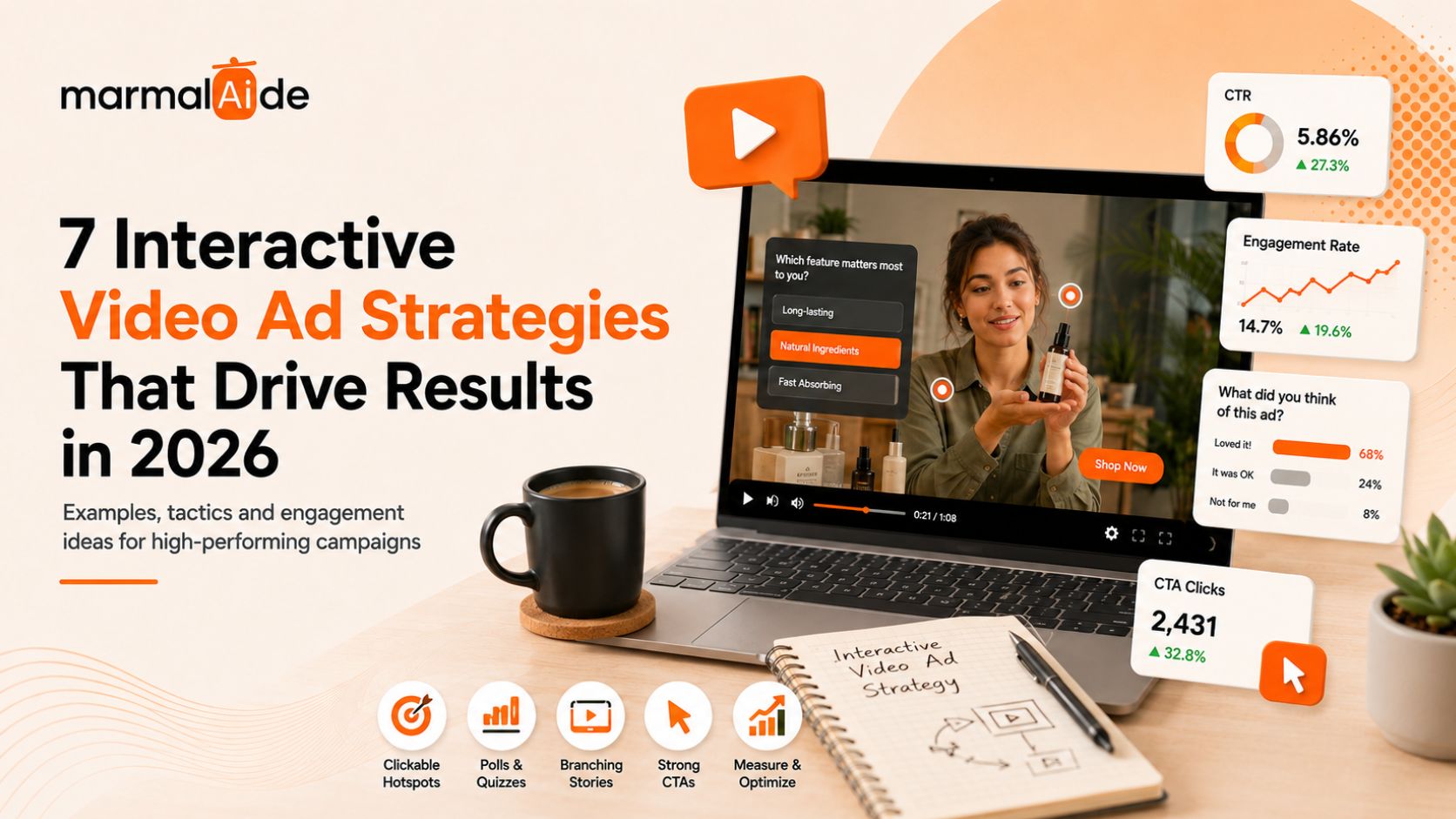
Most video ads ask viewers to do one thing: watch. Interactive video advertising changes that by giving viewers something to do within the ad itself. They can click a product, explore a feature, answer a question, choose what happens next, or move directly towards a CTA.
That shift matters because attention alone does not tell you what a viewer wants. Interactive video ads can turn engagement into measurable actions and useful audience signals, helping brands create a more active path from watching to considering and converting.
The key is choosing interactions that add value instead of making the experience harder to follow. This article explores the formats, benefits, examples, and strategies behind effective interactive video advertising.
What Is Interactive Video Advertising and How Does It Work?
Interactive video advertising is a video ad that lets viewers take actions within the viewing experience. Instead of only watching, viewers can click, choose an option, answer a question, explore a product, submit information, or respond to a call to action. These interactions are added to the video through clickable elements, overlays, forms, branching paths, or other interactive features. The exact experience depends on the campaign objective and where the ad appears.
What Can Viewers Do in Interactive Video Ads?
Interactive video ads can let viewers:
- Click: Select a button, hotspot, product, or CTA.
- Explore: Open product details, features, or additional information.
- Choose: Select an option that changes the next part of the video.
- Answer: Respond to a quiz, poll, or survey.
- Submit information: Fill out a form or request more details.
- Take action: Visit a website, sign up, book an appointment, or make a purchase.
The interaction should have a clear purpose. A product ad might use clickable hotspots to help viewers explore features, while a lead-generation ad might use a form or “Get a Quote” CTA.
What Are the Benefits of Interactive Video Advertising?
The main benefit of interactive video advertising is that it connects viewing with action. Viewers can explore, respond, or move towards a conversion while the ad is still part of their experience, giving brands more opportunities to engage and learn from those actions. Here are the main benefits of interactive video advertising:
1. Active Viewer Participation
Interactive video ads ask viewers to do something. A product hotspot, quiz, choice, or CTA can make the experience more engaging than a standard video.
2. Better Product Consideration
Viewers can access useful information when they show interest. This makes interactive video useful for products or services that need more explanation before a purchase decision.
3. Clearer Intent Signals
A view tells you that someone watched. An interaction can tell you what caught their attention. Clicks, product selections, and responses provide more specific behavioral signals.
4. Direct Paths to Action
Interactive elements can connect the ad to a relevant next step. Depending on the campaign, viewers can learn more, request information, sign up, or shop.
5. Support Across the Funnel
Interactive video can serve different objectives. Amazon Ads reports lifts in brand awareness and purchase intent for certain interactive video formats, showing that the format can support both upper- and lower-funnel goals.
What Are the Different Interactive Video Ad Formats?
Interactive video ad formats differ mainly in the action they ask viewers to take. Some help viewers explore products, while others let them choose a path, answer questions, or move directly towards a CTA.
Here are the most useful formats:
| Format | How It Works | Best For |
| Shoppable videos | Viewers click featured products to explore or shop. | Ecommerce |
| Clickable hotspots | Tappable areas reveal information, links, or product details. | Product discovery |
| Branching videos | Viewers choose an option and follow a different video path. | Storytelling |
| Quizzes and polls | Viewers answer questions or share preferences during the video. | Engagement and research |
| Lead forms | Viewers submit details within the interactive experience. | Lead generation |
| Interactive demos | Viewers explore specific features, functions, or use cases. | Product education |
| Gamified videos | Viewers complete challenges or make choices to progress. | Campaign engagement |
The format should follow the campaign goal. Use shoppable videos when the priority is product discovery or sales. Choose branching videos when different viewer choices need to lead to different content. Quizzes and forms work better when you need responses or lead information.
Also Read: AI Video Ads for Shopify Brands
How Do You Build an Interactive Video Advertising Strategy?
Start your interactive video advertising strategy with the outcome you want, not the interactive feature you want to use. Once the goal is clear, choose the interaction, message, and CTA that make the next step easy for the viewer.
Follow these steps to build an interactive video advertising strategy:
1. Define the Desired Action
Start with the end point. Do you want viewers to explore a product, submit their details, request information, or make a purchase?
2. Build Around Viewer Intent
Identify what the audience already knows and what they need to decide next. The video should answer that need before asking for an action.
3. Match the Interaction to the Goal
Do not add interactivity just because the format allows it. A hotspot, product link, quiz, or branching path should have a clear job within the experience.
4. Design a Short, Simple Journey
Keep navigation obvious and limit unnecessary steps. Viewers should know what to click and what will happen next.
5. Make the CTA Specific
Use a CTA that describes the next action. Learn More, Shop Now, and Get Started are clearer than generic prompts.
6. Test the Experience
Test the complete experience before launch. Then track interactions, clicks, leads, or conversions against the campaign goal. Use the results to refine the next version.
7. Measure What Matters
Track the metrics tied to your objective. For a sales campaign, that may be product interactions and conversions. For lead generation, focus on form completions and qualified leads.
What Are Some Interactive Video Advertising Examples?
Interactive video advertising examples can range from choose-your-own-story experiences to product discovery tools. What makes them effective is not the number of interactive elements, but how naturally those elements support the viewer’s next decision. Here are a few examples for you:
Branching Storytelling: Netflix’s Black Mirror: Bandersnatch
Black Mirror: Bandersnatch is a well-known example of branching video. Viewers made choices during the story, and those decisions determined which part of the narrative they saw next. It showed how interactive video can give audiences control while keeping them engaged with the content.
Dual-Narrative Advertising: Honda’s The Other Side
Honda designed The Other Side around two versions of the same story. Viewers could switch between the narratives, revealing the different sides of the Civic Type R. The interaction was directly connected to the campaign message, making the format part of the storytelling rather than an extra feature.
Personalized Product Discovery: Maybelline
Maybelline’s Lipstick Finder combined personalized recommendations with virtual try-on to help shoppers make a more informed product choice. The campaign recorded a 63% increase in conversion rate in India, alongside more than 1.6 million product-detail-page visits.
Together, these examples show three practical uses of interactive video: guiding a story, communicating a product idea, and helping viewers make a purchase decision.
Where Can Brands Use Interactive Video Ads?
Interactive video ads can support different stages of the customer journey, from product discovery and lead generation to education and event promotion. The best use case depends on what you want viewers to do after engaging with the video. Here’s a table below for understanding where you can use it:
| Use Case | Viewer Action | Primary Goal |
| Ecommerce & Retail | Explore products, features, and offers | Product discovery & sales |
| Lead Generation & Sales | Submit details, enquire, book, or request a quote | Lead capture & conversion |
| Education & Training | Answer questions, take quizzes, or choose content paths | Learning & engagement |
| Recruitment & Employer Branding | Explore roles, teams, and workplace content | Candidate engagement |
| Events & Customer Experiences | Choose sessions, view highlights, or access more information | Engagement & discovery |
You can also use interactive ads on social media to encourage viewers to tap, explore, respond, or move towards a CTA. They can be adapted to different placements and audience behaviors across social platforms.
How Much Do Interactive Video Ads Cost?
There is no standard price for interactive video advertising. The total cost depends on the video production, level of interactivity, number of creative versions, technology requirements, and media spend. Interactive features can add production work, while the ad placement itself may use different pricing models such as CPM, CPV, CPCV, or cost per engagement.
The table below shows what affects the cost:
| Cost Factor | What Can Affect the Cost |
| Video Production | Concept, scripting, filming, animation, editing, and post-production requirements. |
| Interactive Features | Simple CTAs or hotspots generally require less work than branching paths, forms, quizzes, or complex experiences. |
| Creative Variations | Multiple hooks, messages, audiences, formats, or aspect ratios increase production requirements. |
| Technology | Interactive tools, integrations, hosting, analytics, and technical implementation can add to the budget. |
| Media Spend | The cost of distributing the finished ad depends on the platform, audience, placement, and buying model. |
| Testing & Optimization | Creating and testing multiple versions can increase upfront costs but may help identify stronger-performing creative. |
If you’re planning your budget, our guide to AI Video Ads for Shopify Brands can help you understand how to create variations for different hooks, formats, and campaign goals. Keep production and media costs separate to see where your budget is going and plan your campaign more confidently.
How Can Marmalaide Help You Create Video Ads for Interactive Campaigns?
Creating one video ad is only the starting point. The bigger challenge is producing enough creative variations to test different hooks, messages, formats, audiences, and placements. Marmalaide combines filmmaker-led creative direction with generative AI to produce video ads, UGC-style ads, static and motion creatives, carousel ads, and campaign variations. Its team manages the process from concept and scripting through production, editing, review, and delivery.
For an interactive video advertising campaign, Marmalaide can help create:
- Video ads built around different campaign messages and creative angles
- UGC-style ads for creator-led product and brand storytelling
- Product and explainer videos that support interactive experiences
- Multiple hooks, messages, CTAs, and creative concepts for testing
- Product and SKU variations for different campaigns and offers
- Audience and market variations for more targeted messaging
- Platform adaptations for Meta, Instagram, TikTok, YouTube, LinkedIn, and display
- Static creatives, carousel ads, and video cutdowns for multi-format campaigns
Marmalaide offers subscription plans with full creative services for ongoing production. This gives marketing teams a way to produce and test more creative without managing a separate production workflow for every variation.
Ready to Test Video Creative at a Smaller Scale?
Marmalaide’s $1,999 Pilot lets you test its production workflow without starting with an ongoing plan. You receive a 30-second master commercial, two 10–15-second cutdowns, two static ads or posts, plus campaign and channel adaptations. The package gives your team a practical way to assess the creative output and production process before scaling to a larger volume of assets.
Start with the Marmalaide Pilot
FAQs
Can interactive video ads work without sound?
Yes. Interactive video ads should remain understandable even when viewers watch without sound. Clear on-screen text, visual cues, captions, and recognizable CTAs can help communicate the message and interaction.
Do interactive video ads work on mobile devices?
They can, but the experience needs to be designed for smaller screens and touch interactions. Buttons and clickable features should be easy to see and use without covering important parts of the video.
Can interactive video ads be personalized?
Yes. Interactive experiences can use viewer choices, responses, location, product preferences, or other available data to deliver more relevant content. The level of personalization depends on the technology and data available to the campaign.
Do interactive video ads slow down a website?
They can if the experience is poorly implemented or relies on heavy assets. Optimized video files, efficient loading, and a well-built interactive layer can help reduce performance issues.
Can interactive video ads be used for A/B testing?
Yes. Brands can test different creative elements, such as hooks, CTAs, interactive prompts, product presentations, or video paths, and compare the results against the campaign objective.