How do you create a business video that looks professional while still communicating a clear business goal? Without the right planning, even well-produced footage can lose focus, use resources inefficiently, or fail to connect with the intended audience.
That is where business video production comes in. It combines strategy, scripting, production, editing, and finishing to create videos for marketing, sales, product education, internal communication, and brand building. The strategy can differ based on the type of video, audience, platform, and production requirements.
This article covers the business video production process, types of business videos, business video production costs, pricing factors, and best practices. You’ll also learn when to work with a business video production agency and what to consider when choosing a production partner.
Key Takeaways
- Business video production covers the planning, creation, editing, and delivery of videos for marketing, sales, education, training, and brand communication.
- Video formats vary by business goal, from product demos and explainers to testimonials, brand films, ads, training content, and founder videos.
- A typical production workflow moves from defining the objective and developing the script to production, editing, review, and delivery.
- Production costs depend on scope, including the production method, crew, creative work, post-production, deliverables, and revisions.
- Better business videos stay focused: lead with the main message, address a clear audience need, show rather than over-explain, and end with a relevant next step.
What Is Business Video Production?
Business video production is the method of creating video content for a specific business purpose, such as marketing, sales, customer education, or internal communication. It covers the work involved in developing the idea, producing the footage or visuals, editing the content, and preparing the final video for use.
A business video can take different forms depending on its purpose and audience. Common uses include:
- Product videos: Show how a product works, highlight features, or demonstrate its use.
- Explainer videos: Simplify a product, service, process, or technical concept.
- Brand videos: Communicate a company’s story, values, or positioning.
- Testimonial videos: Use customer experiences to provide social proof.
- Training videos: Help employees learn processes, tools, or company policies.
- Advertising videos: Promote products or services across paid and organic channels.
The scope of professional business video production can range from a short social media video to a larger brand film. The required crew, equipment, locations, animation, editing, and number of final versions will depend on the project.
What Are the Types of Business Videos?
Businesses use different video formats for marketing, sales, product education, customer communication, and internal training. The main types of business videos production include brand films, product demos, explainer videos, testimonials, training videos, advertisements, and founder-led content.
1. Corporate and Brand Videos
Corporate videos introduce the company, its work, values, or story. They can help businesses communicate their identity to customers, employees, investors, or other stakeholders.
2. Product and Demo Videos
Product videos show a product in use and explain its features or functions. A demo can also walk viewers through a specific task, workflow, or use case.
3. Explainer Videos
Explainer videos break down products, services, or processes that may take longer to explain through text alone. They often combine narration with animation, screen recordings, live footage, or graphics.
4. Testimonial and Customer Story Videos
These videos feature customers discussing their experience with a product or service. A customer story can cover the original problem, how the product was used, and the outcome.
5. Training and Internal Videos
Training videos help employees learn procedures, software, tools, and workplace processes. Companies can also create videos for onboarding, policy updates, and internal communication.
6. Social Media and Advertising Videos
Short business videos can promote products, services, offers, or campaigns across social and paid media. Each version can be adapted to the platform, audience, duration, and placement.
7. Founder and Thought Leadership Videos
Founder-led content puts company leaders at the center of the message. These videos can cover industry insights, company stories, product ideas, or expert perspectives.
What Is the Business Video Production Process?
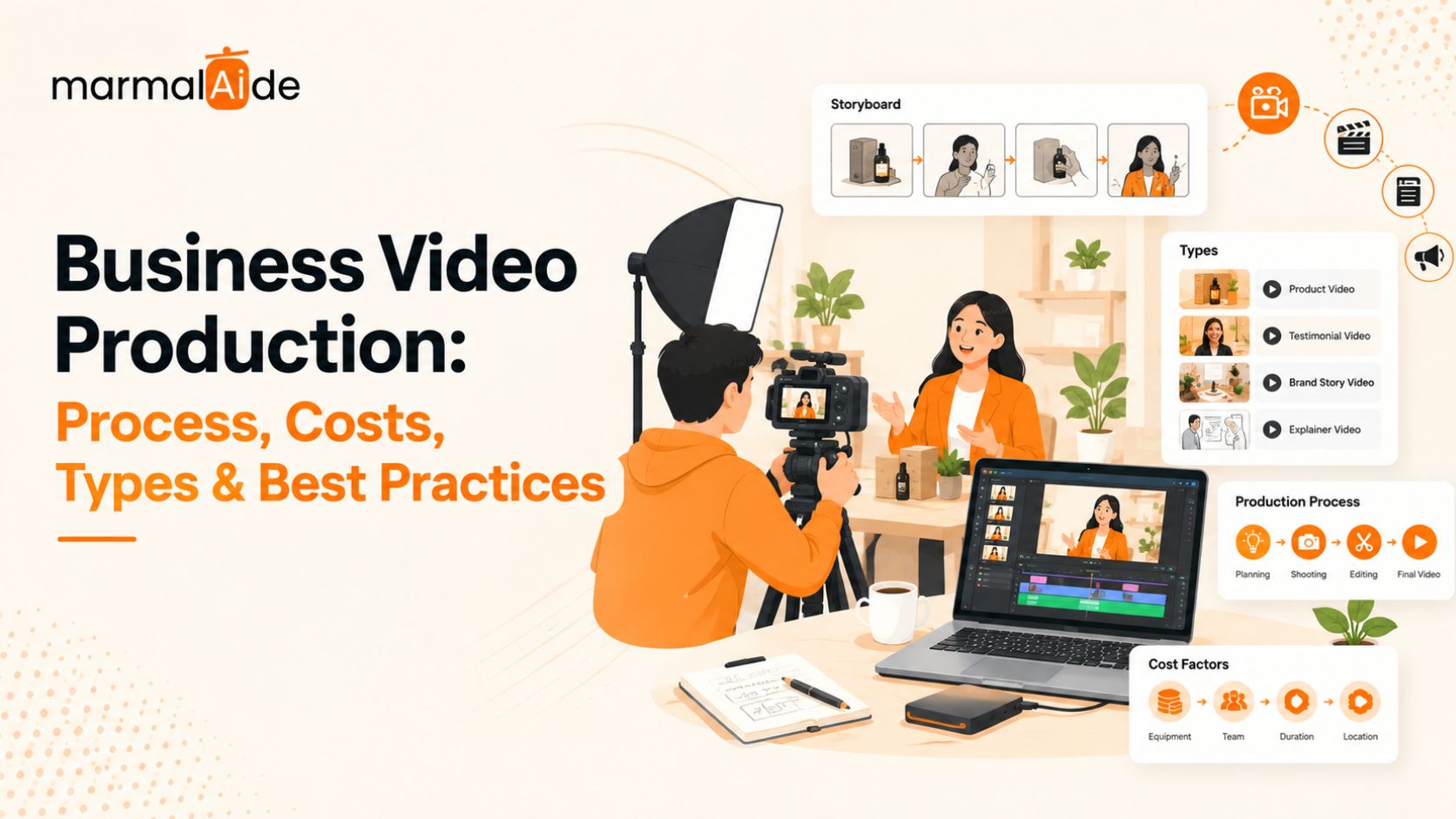
The business video production process takes a video from an initial brief to a finished, channel-ready asset. It usually covers six stages: defining the objective, developing the concept, planning production, creating the video, editing, and final approval.
1. Set the Objective
Define what the video needs to accomplish before developing the creative. Set one primary goal, such as generating leads, explaining a product, supporting sales, or training employees.
2. Develop the Concept and Script
Build the idea around the objective and target audience. The script should establish the key message, structure, visuals, narration, and CTA before production starts.
3. Plan the Production
Decide how the video will be created and what the project requires. Depending on the format, planning may include storyboards, shot lists, locations, talent, equipment, animation, or digital assets.
4. Produce the Video
Create the footage or visual content based on the approved plan. This may involve live-action filming, animation, screen recordings, AI-generated content, or a combination of production methods.
5. Edit and Finish
Assemble the material into the final story and refine the presentation. Editing can include sound design, music, graphics, captions, color correction, animation, and visual effects.
6. Review and Deliver
Review the finished video against the original brief and make the required revisions. Once approved, export the final files in the formats and aspect ratios required for each channel.
How Much Does Business Video Production Cost?
There is no fixed rate for business video production. Costs change with the type of video, production setup, creative requirements, post-production work, and the number of assets you need.
Instead of estimating a price from video length alone, look at the resources required to produce the final deliverables.
Key Business Video Production Cost Factors
- Creative development: Research, concept development, scripting, and storyboarding.
- Production setup: Crew, equipment, studio or location hire, sets, props, and talent.
- Visual production: Live-action footage, animation, motion graphics, VFX, screen recordings, or AI-generated visuals.
- Post-production: Editing, sound, music, color correction, graphics, captions, and finishing.
- Deliverables: Multiple durations, formats, aspect ratios, languages, or campaign versions.
- Revisions: The number of review and revision rounds included in the project.
How to Plan Your Budget
Start by listing the exact assets you need and where you will use them. A single website video has different requirements from a campaign that needs several short ads, platform formats, and audience variations.
Ask providers to break down their business video production pricing by scope and deliverables. This makes it easier to compare proposals without focusing only on the headline cost.
Also separate production from distribution. Your video production budget covers creation, while media spend covers paid placement and promotion.
When Should You Hire a Business Video Production Agency?
A business video production agency makes sense when the demands of video production exceed your team’s existing resources. The decision usually comes down to production volume, specialist expertise, project complexity, and how much work your team can realistically manage.
Consider an Agency If You:
- Produce videos regularly: Ongoing campaigns may require more production capacity than an internal team can provide.
- Need specialist expertise: Directing, cinematography, animation, sound design, editing, and VFX may require skills your team does not have.
- Need several assets from one campaign: A single concept may need different lengths, formats, hooks, CTAs, or audience versions.
- Have a major launch coming up: Product launches and brand campaigns can require dedicated creative and production support.
- Want fewer production handoffs: One partner can manage scripting, production, editing, revisions, and final delivery.
- Need to scale output without hiring: An external team can add production capacity without creating a permanent in-house video department.
What an Agency Should Bring
Do not choose a production partner based only on its portfolio. Check whether it understands your business objective, can explain its creative approach, provides clear deliverables, and has a defined review and revision process.
Also confirm who handles the script, creative direction, production, editing, and final delivery. Clear responsibilities make the working relationship easier to manage.
How Do You Choose a Business Video Production Partner?
A suitable production partner should match your video requirements, working style, and campaign timeline. Before signing, compare these practical details:
| Factor | Questions to ask |
| Portfolio | Does the previous work show the quality and video formats you need? |
| Creative support | Does the team develop the concept and script, or only produce from an approved brief? |
| Production | What parts of filming, animation, AI generation, sound, and editing does the team handle? |
| Versions | Are different lengths, aspect ratios, CTAs, or audience versions included? |
| Revisions | How many feedback and revision rounds are part of the agreed scope? |
| Turnaround | When does production start, and when will the final assets be delivered? |
| Ownership | Who owns the finished videos and the underlying creative assets? |
| Commercial terms | What does the quoted price include, and what would cost extra? |
What Are the Best Practices for Business Video Production?
The best practices for business video production focus on the message, viewer, and story rather than production elements alone. Keep the video focused, make the message easy to grasp, and give viewers a reason to keep watching.
Lead With the Main Message
Put the most important information early in the video. Do not make viewers wait through a long introduction before they understand what the video offers.
Build Around One Audience Problem
Start with a specific question, need, or problem that matters to the intended viewer. Shape the rest of the video around answering or addressing it.
Show the Product or Idea in Action
Use demonstrations, examples, screen recordings, animation, or relevant footage to make the message easier to understand. Showing the point often works better than adding more explanation.
Keep Every Scene Purposeful
Each scene should move the message forward. Remove shots, dialogue, and graphics that repeat information or do not add context.
Write Natural Scripts
Use language that sounds like something a real person would say. Avoid long sentences, unnecessary jargon, and overly promotional wording.
Hold Attention With Progress
Give viewers new information, a demonstration, example, or development as the video moves forward. Do not stretch one point across several scenes.
End With a Useful Next Step
Finish by telling viewers what they can do next. The action might be visiting a product page, booking a demo, contacting the business, or learning more about the topic.
How Can You Get More From Your Business Videos?
One business video can support several campaigns and channels when you plan for reuse from the start. You can turn a core video into shorter edits, platform-specific versions, audience variations, and localized content.
- Create multiple lengths: Turn a longer video into shorter clips for social media, ads, landing pages, or email campaigns.
- Create platform-specific formats: Adapt the same content for vertical, square, and landscape placements instead of using one format everywhere.
- Test different hooks and CTAs: Create variations with different openings or calls to action while keeping the core message consistent.
- Adapt for different audiences: Change examples, product details, or messaging to make the video more relevant to specific customer groups.
- Localize successful content: Extend high-performing videos into new markets with subtitles, dubbing, translated scripts, or regional adaptations.
- Repurpose long-form content: Turn webinars, interviews, product demonstrations, and founder videos into shorter clips built around individual points.
How Can You Create Business Videos With Marmalaide?
Marmalaide creates business videos using filmmaker-led direction and generative AI. The team develops the concept, writes the script, produces the video, and handles editing and quality review, so businesses can take a video from brief to finished asset through one production workflow.
Marmalaide can help you create:
- Product explainers that show how a product works
- AI avatar explainers for landing pages and product education
- Animated and motion-led videos for complex ideas
- Product videos for launches and campaigns
- Founder and brand story videos
- Multiple hooks, CTAs, formats, and audience versions from one concept
- Localized videos with subtitles, dubbing, and regional adaptations
For ongoing production, Marmalaide offers subscription plans with dedicated scriptwriting, directing, editing, GenAI video production, and campaign adaptations. Its Pilot also provides a one-time starting project before moving into a recurring production model.
Start With One Video and Scale From There
If you want to test Marmalaide before committing to ongoing production, its $1,999 Pilot gives you several creative assets from one project. The Pilot includes a 30-second master video, two 10–15-second cutdowns, and two static ads.
You can use the Pilot to assess the creative quality, workflow, and fit for your marketing needs before moving to a recurring production plan.
FAQs
What should a business video brief include?
Include the objective, target audience, key message, format, channels, duration, deliverables, timeline, and brand requirements.
How long should a business video be?
The ideal length relies on the purpose and platform. Keep the video focused and remove content that does not support the main message.
Should businesses create different videos for each platform?
The main video can stay the same, but you may need different durations, aspect ratios, captions, hooks, or CTAs for each platform.
Can one business video have multiple versions?
Yes. You can create different lengths, hooks, CTAs, formats, audience versions, or language adaptations from one core concept.
What is the difference between a business video and a commercial?
A business video is a broad category that includes explainers, demos, training videos, testimonials, brand videos, and advertisements. A commercial specifically promotes a product, service, or brand.
Can businesses update an existing video?
Yes. Existing footage can be re-edited, reformatted, localised, or combined with new footage when the original material still fits the current message.
What should businesses check before approving a video?
Check the facts, product details, branding, captions, audio, CTA, spelling, file format, and platform requirements.