“Great product. Great service. Highly recommend.” It sounds positive, but it gives a potential buyer little reason to choose your brand. What problem did the customer face? Why did they choose your product? What changed after they used it?
Good testimonial video production answers these questions through a customer’s real experience, not rehearsed praise. The goal is to give viewers specific details they can relate to and use when making a purchase decision.
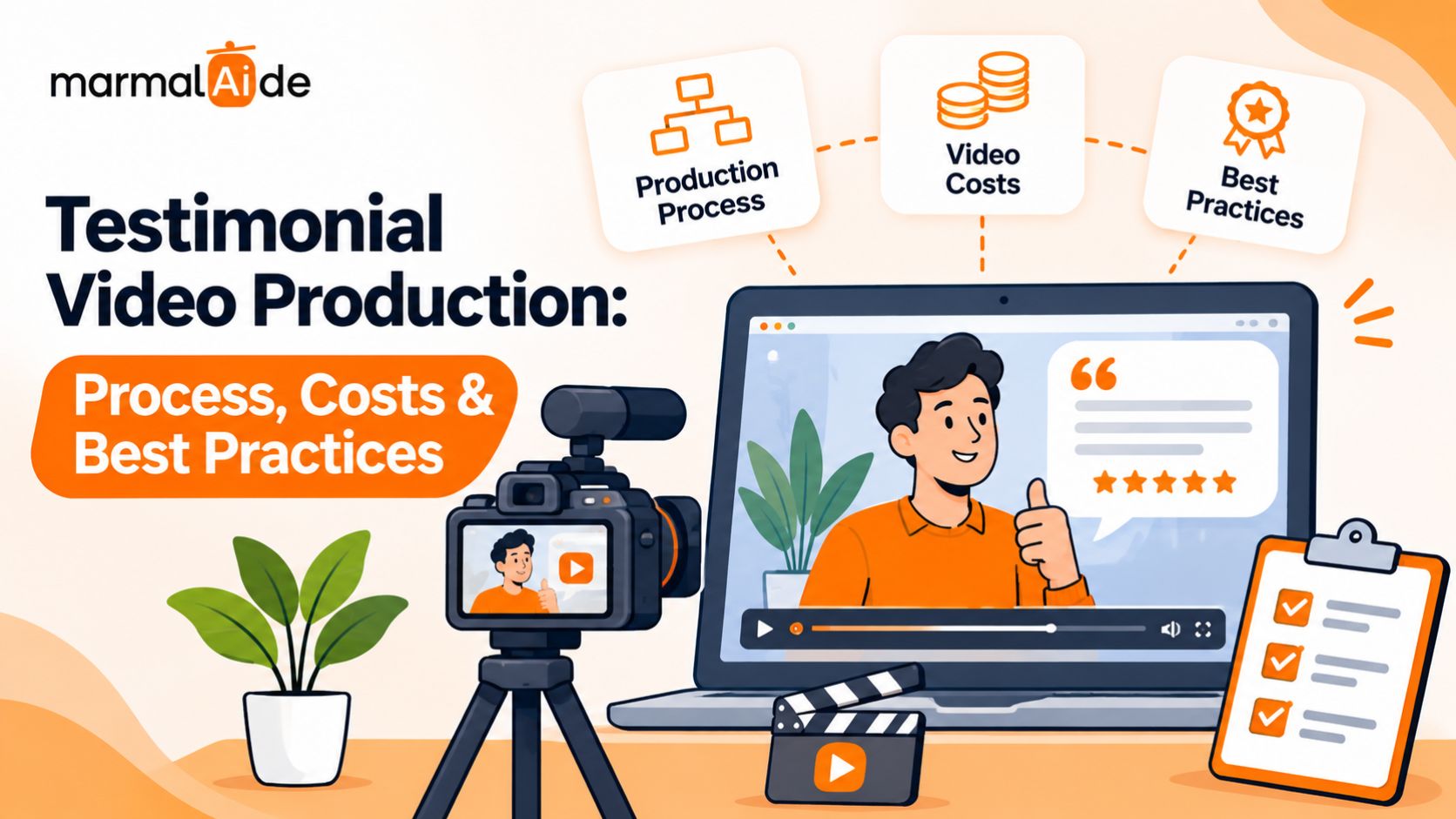
This article covers the testimonial video production process, what affects testimonial video cost, and how to create customer stories that build trust and support conversions.
What Is Testimonial Video Production, and How Does It Build Trust?
Testimonial video production involves recording and editing a customer’s real experience into a video for marketing or sales. The strongest videos explain the customer’s original problem, their decision, and the outcome they can substantiate.
Building trust with testimonial videos starts with useful details, not enthusiastic adjectives. Compare these statements:
“The platform is excellent. The team is amazing.”
“Our team used to compile reports from several spreadsheets. The platform brought those reports into one workflow.”
The second statement gives viewers a concrete experience to consider. They can judge whether the problem resembles their own.
Customer testimonials can help businesses:
Address objections that sales copy may not resolve.
Show how customers use a product in real situations.
Give prospects context for evaluating a purchase.
Provide sales teams with relevant customer evidence.
However, a testimonial is not proof of every claim a brand makes. A customer’s individual result does not guarantee the same outcome for everyone. Building trust with testimonial videos requires accurate claims, appropriate context, and permission to use the customer’s story.
How to Create a Video Testimonial: The Production Process
The testimonial video production process moves from customer selection and interview planning to filming, editing, and approval. A clear brief keeps the story focused and reduces avoidable reshoots.
1. Choose a customer with a specific story
Start with the audience you want to reach, then find a customer whose experience speaks to that audience’s needs. A useful story might explain a difficult implementation, a product comparison, or a measurable improvement. Don’t select a customer solely because their company has a recognizable name. If they can only offer general praise, the video has little to say.
2. Set the goal and prepare interview questions
Decide what the viewer should understand after watching. A product-page testimonial may need to address ease of use, while a B2B case study may focus on implementation or business results.
Ask questions that encourage detailed answers:
What problem were you trying to solve?
What alternatives did you consider?
Why did you choose this product?
What changed after you started using it?
How did you measure the result?
Use follow-up questions to uncover specifics. Don’t give customers a script to memorize. You want their account, not your sales copy in someone else’s voice.
3. Secure consent before recording
Explain where the video will appear and how the team may edit and distribute it. Get written permission covering the intended channels, paid advertising, usage period, and identification requirements. Ask about sensitive information before filming, especially for B2B customers who may need internal approval to discuss their results.
4. Choose the recording setup
Choose in-person filming when the story needs detailed product footage or a controlled environment. Remote recording suits customers in different locations, while customer-recorded videos can work for simpler campaigns with smaller budgets. For professional testimonial videos, prioritize clear audio, suitable lighting, and a distraction-free background. A costly camera won’t fix muffled dialogue.
5. Record the interview and supporting footage
Let customers answer naturally. Give them time to think, and ask follow-up questions when an answer lacks context. Record supporting footage that illustrates the story: the customer using the product, demonstrating a workflow, or showing the environment they describe. Avoid visuals that imply results or activities the customer never experienced.
6. Edit, verify, and approve the final video
Build the edit around the most useful customer statements. Remove repeated points and long introductions. Keep the sequence easy to follow: problem, decision, experience, and outcome. Verify statistics and performance claims before publication. Send the final cut for customer review, especially if the edit combines statements recorded at different points in the interview.
How Much Does Testimonial Video Production Cost?
Testimonial video cost depends on the filming setup, crew, location, editing requirements, and number of final assets. A remote interview costs less than an on-location production involving travel, multiple cameras, extensive B-roll, and several cutdowns.
| Production method | Indicative cost | Typical scope |
| DIY or remote platform | 25–250 per month | Recording tools and basic collection workflows |
| Freelancer or small agency | 2,000–5,000 per video | Focused interviews and professional editing |
| Full-service production | 5,000–20,000+ per video | Crew, locations, detailed post-production, and multiple deliverables |
These estimates come from different service models, so compare the actual deliverables rather than the headline price. Ask whether scripting, travel, captions, revisions, usage rights, and additional edits are included.
What affects testimonial video cost?
Four factors account for much of the price difference:
Filming logistics: Crew size, location access, travel, and shoot duration.
Post-production: Editing, sound correction, color grading, graphics, and revisions.
Number of deliverables: One master video costs less to finish than a master plus multiple social edits.
Project coordination: Scheduling customers, securing approvals, and managing multiple stakeholders can add time.
How can you reduce testimonial video cost?
Prepare the interview questions in advance, batch customer interviews when practical, and agree on the deliverables before filming. Avoid paying for a full reshoot because the team changed the message after recording.
If you need a larger volume of marketing videos, Marmalaide’s guide to video content on a budget explains how AI-assisted production can reduce some traditional production costs. It is most relevant when you need campaign adaptations or additional creative assets, rather than a substitute for a real customer’s testimony.
What Are the Best Practices for Professional Testimonial Videos?
The best testimonial video best practices focus on natural answers, relevant evidence, clear audio, and concise editing. Production polish helps viewers follow the story; it cannot make a vague or unsupported claim convincing.
Lead with a useful detail. Open with the customer’s problem, decision, or verified outcome instead of a long company introduction.
Let customers speak naturally. Use follow-up questions to get detail rather than asking them to repeat promotional language.
Capture relevant B-roll. Show the product or process the customer discusses.
Use accurate captions. Check names, product terms, figures, and punctuation against the recording.
Keep one clear story. Remove details that don’t help viewers understand the customer’s experience.
Check claims before publication. Confirm measurable results and explain the context behind them.
For example, if a customer says a process became faster, ask what changed and how they assessed the improvement. Don’t turn that answer into a percentage unless the business can substantiate the figure. These testimonial video best practices also help editors preserve the customer’s meaning. The final video can be concise without making the experience sound more dramatic than it was.
Can AI Help With Testimonial Video Production?
AI can help edit, translate, caption, and adapt approved customer footage. AI-generated testimonial-style ads are a different format: brands must not present fictional speakers or invented experiences as genuine customer endorsements.
Keep these formats distinct:
| Format | What it involves | What to check |
| Genuine customer testimonial | A real customer shares their own experience | Consent, factual accuracy, and context |
| AI-assisted testimonial | AI adapts approved footage, captions, or translations | Meaning, voice, and customer approval |
| AI testimonial-style ad | A synthetic presenter delivers a brand-created message | Clear presentation and no false implication of a real customer experience |
The distinction matters for advertising compliance. The US Federal Trade Commission’s guidance on consumer reviews and testimonials explains how deceptive endorsements can violate its rules. Brands should also check requirements in other markets where they advertise.
Marmalaide’s AI ad creative production services include AI video ads, UGC-style ads, and campaign variations. These can support creative testing, but synthetic advertising should never replace genuine customer evidence when a campaign claims to show a real customer’s experience.
Where Should You Use Testimonial Videos?
Place testimonial videos where they answer a buyer’s question. A longer customer story can explain a complex B2B decision, while a short clip can address one objection in a paid campaign.
| Channel | How to use the video |
| Website or landing page | Address a concern that may prevent conversion |
| Product page | Show how a customer uses the product |
| Paid social | Test a specific customer insight or benefit |
| Email campaign | Share relevant proof with prospects |
| Sales presentation | Support a discussion with a real customer experience |
One interview can produce several edits, provided each version preserves the customer’s meaning. Adapt the opening, duration, captions, and aspect ratio to the placement rather than publishing the same cut everywhere. Marmalaide’s guide to Gen AI video content for growth marketing explains how teams can adapt video creative for different campaign requirements.
How Do You Measure High-Converting Testimonial Videos?
High-converting testimonial videos help viewers take a meaningful next step. Measure performance against the campaign goal rather than judging success by views alone. Track the metrics that match the placement:
Completion rate: Shows how many viewers watch the video through to the end.
Click-through rate: Measures how often viewers click the next step.
Conversion rate: Shows whether the video supports sign-ups, enquiries, or purchases.
Lead quality: Indicates whether the content attracts suitable prospects.
Sales feedback: Shows whether the video helps address recurring objections.
Test one variable at a time. For example, compare two openings while keeping the audience, offer, and landing page consistent. This gives you a clearer view of which change influenced performance. Marmalaide’s performance creative strategy guide explains how to test creative decisions against measurable campaign goals.
How Can Marmalaide Support Your Testimonial Video Production?
Marmalaide combines generative AI with human creative direction to help marketing teams produce video ads and campaign assets. Its team supports the process from concept development and scripting to production, editing, and delivery through its AI video production services.
For marketing teams, Marmalaide can create:
AI UGC ads for paid social and product promotions
Product and explainer videos for launches and customer education
Founder and brand story videos for brand-led campaigns
Video cutdowns and creative variations for different placements
Static ads and carousel creatives for multi-channel campaigns
Marmalaide offers subscription plans with full creative services for ongoing production. This gives marketing teams a managed way to produce campaign assets without coordinating separate resources for every stage.
Want to Test Marmalaide Before Scaling?
Marmalaide’s $1,999 Pilot includes a 30-second master commercial, two 10–15-second cutdowns, and two static ads or posts. It also includes adaptations for different channels, campaigns, SKUs, and geographic targets. The Pilot lets your team assess the creative output and production process before moving to ongoing production.
Start with the Marmalaide Pilot
FAQs
Can you use a testimonial from a former customer?
Yes, if the testimonial accurately reflects the customer’s experience. Identify them as a former customer if their current relationship with your brand could affect how viewers interpret the endorsement.
What should you do if a customer makes a false claim in a testimonial video?
Verify the claim before publishing the video. Ask the customer to correct inaccurate details, or remove the disputed statement if you can do so without changing the meaning of their experience.
Should B2B testimonial videos include a customer’s job title and company?
Yes, when those details help potential buyers assess the customer’s experience. A job title, company name, and industry can establish context for viewers evaluating a similar product or service.
Can you use one customer testimonial for different target audiences?
Yes, if the customer’s experience applies to each audience. Create separate edits that highlight relevant use cases, but don’t alter the customer’s statements or imply results they didn’t report.
What makes a B2B testimonial credible without specific ROI figures?
Specific examples of business improvements can make a testimonial credible without revenue figures. A customer might describe fewer manual tasks, faster processes, or reduced errors. Include measurable results only when you can verify them.