We had a call last month with a founder who’d just spent $38,000 on a commercial. Great crew, great location, great final cut. It got outperformed on paid social by a video one of his own customers shot in her kitchen with a ring light from Amazon. He wasn’t upset about it. He was confused. “How does that even make sense?” It makes sense once you’ve made enough video for enough brands to see the pattern up close, which, frankly, is most of what we do here at Marmalaide.
Scroll through any feed for thirty seconds, and you’ll see it. An example would be a shaky, handheld clip of someone unboxing a skincare order. No studio lighting. No script that sounds like a script. Yet it makes the audience watch the content faster than the polished ad running right above it.
That’s the pull of the UGC video, and it’s why brands of every size are modifying their entire content calendars around it. We aren’t going to give you another surface-level explainer that tells you UGC is “authentic” and leave it there. We’re going to walk through what a UGC video actually is, what are the different types of UGC style videos that brands use, and how you can produce it without burning your quarter’s budget on trial and error.
What Is a UGC Video, Really?
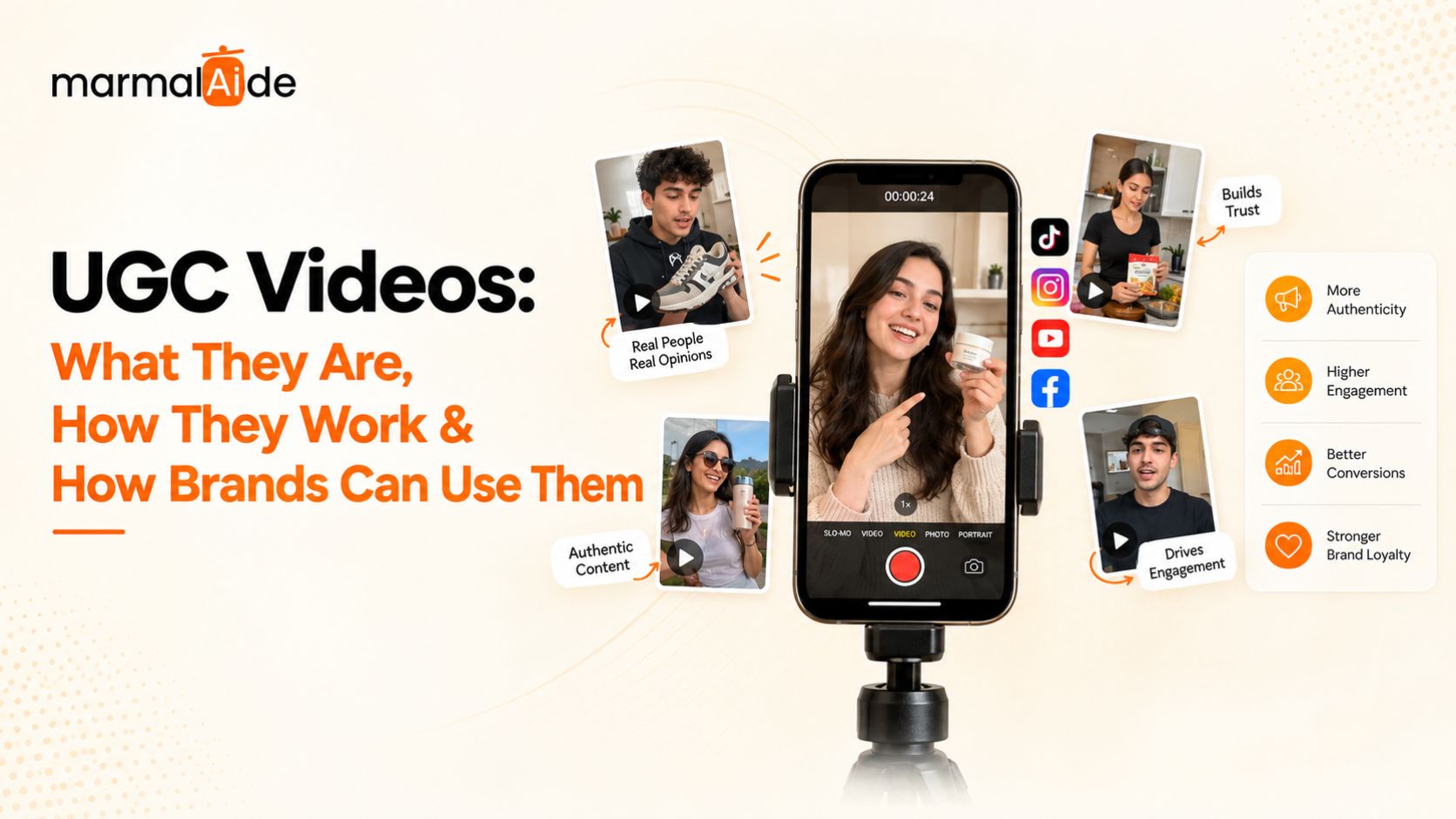
UGC, short for user-generated content, gets thrown around loosely, everything from a genuine customer clip to a fully AI-produced ad designed to look organic. But in practice, it is a video made by a real person (customer, fan, everyday user), not your creative or marketing team. It usually has no brand-side script, or agency storyboard. Shot on a phone and shared because someone genuinely wants to talk about a product, service, or experience. Just someone’s honest take, filmed the way people actually film things, which is to say, imperfectly.
It’s the imperfection that does more work than most marketers give it credit for. Unstable frames, slightly awkward pauses, natural lighting instead of a three-point setup, all of that reads as proof. It tells the viewer “this wasn’t paid for,” even when, further down the funnel, it eventually is.
Most teams do not notice that a UGC video and a UGC-style video are not the same thing
- UGC videos are unprompted, unpaid (or lightly incentivized), and created by someone with no obligation to your brand.
- UGC-style videos are commissioned. You or a production partner directs them, but they’re built to carry the same handheld, native, low-polish feel.
Most companies use both formats for video advertising strategy, on purpose, because real submissions alone can’t cover every product launch, market, or campaign deadline.
Classic examples include:
- Customer filming an honest first impression after opening a package
- User recording a quick tutorial on how they use an app or tool
- Shopper posting a “get ready with me” video that features a product mid-routine
What separates a UGC video from a traditional commercial is authorship and intent. Traditional ads are written, storyboarded, and produced by or for the brand. UGC videos start as personal content and are then licensed, reposted, or repurposed by the brand into paid or organic campaigns. The brand doesn’t control the first draft, and that lack of control is exactly what makes it believable.
How Do UGC Videos Work?
UGC video content moves through four stages before it becomes part of a brand’s marketing:
- Creation: A customer, fan, or creator films a clip, usually driven by genuine interest, a request from the brand, or a small incentive like a discount, a barter collab, or a feature on the brand’s page.
- Sourcing: Brands find this footage by monitoring branded hashtags, mentions, and tags; running a dedicated submission campaign; or working with a marketplace that connects them to creators who film UGC-style content on request.
- Consent and rights: Before any clip goes into a paid campaign, the brand needs explicit permission to reuse it. Most teams underestimate this step and skip it, turning a great asset into a legal headache.
- Editing and distribution: Finally, the raw clip gets trimmed, captioned, and formatted for the platform it’s headed to, then posted as an organic post, a paid social ad, a product page asset, or an email feature.
Many brands mess up the last step. Sourcing footage is one thing; turning a folder of raw clips into something publish-ready, on-brand, and formatted correctly for every placement is a production job that dedicated AI UGC video editors and production partners exist to close.
Types of UGC Videos
Not all UGC video content looks or performs the same. Here are the formats brands lean on most:
Unboxing and first-impression videos
Someone, usually a customer, opens a package on camera, and reacts live to the product, no retakes. It works especially well for physical products where packaging and first-touch experience matter.
Testimonial and review videos
User speaks directly to camera about their experience, what problem the product solved, and whether it lived up to expectations. This format translates most directly to businesses, where the “problem solved” narrative maps onto a sales conversation almost word for word.
Tutorial or how-to videos
Real users show exactly how they actually use the product, which doubles as organic education for prospective buyers.
Day-in-the-life videos
Creator weaves the product naturally into a broader routine or lifestyle clip, which tends to feel the least like an ad.
Before-and-after videos
Especially common in beauty, fitness, and home categories, these show a visible transformation tied to the product and tell the story faster than any copywriter could
Employee and founder-generated videos
One of the most underused categories, where your own team, filmed in the same unpolished way, explaining a decision or a product update.
UGC-style ads
Scripted and produced content, sometimes shot with real creators and sometimes AI-generated, deliberately styled to match the aesthetic of organic UGC even though the brand commissioned it. Use it when you need volume and consistency that organic submissions can’t guarantee on a deadline.
This category is where most of the confusion around the term “UGC” comes from.
UGC-Style Videos: Where “Authentic” Gets Produced
Genuine user-generated videos are unpaid, unprompted, and shot by someone with no compulsion to the brand. UGC-style videos are different: they’re commissioned, scripted, and produced, but intentionally designed to carry the same handheld, honest, native-feeling aesthetic. Neither is dishonest. Both run side by side, because organic UGC alone can’t be scaled or scheduled the way a campaign calendar demands.
| Format | Who creates it | Control level | Best used for |
| Authentic UGC | Real customers, unprompted | Low | Social proof, organic reposts |
| UGC-style ads | Brand-commissioned creators or AI production | High | Scalable paid social campaigns |
| Influencer content | Paid creators with an existing audience | Medium | Reach and third-party credibility |
| Traditional branded video | In-house or agency production | Full | Brand awareness, high-polish placements |
Understanding where a piece of content sits on that spectrum is more important than the label. If you’re weighing UGC-style ads against other types of video advertising, the format you choose should match the platform, the funnel stage, and how much creative control your campaign actually needs.
Why UGC Video Content Works So Well
Wyzowl’s 2026 State of Video Marketing report found that 91% of businesses now use video, especially short-form type for marketing, and 82% of marketers say video delivers a good return on investment. Buried a little further in the same data: user-generated content made the top five list of formats marketers plan to invest more in for 2026, ranking right alongside short-form and long-form video.
According to Backlinko’s UGC statistics roundup, 93% of marketers who use user-generated content say it performs notably better than traditional branded content, and 79% of consumers say UGC directly influences them into getting their hands on a product. Even Bazaarvoice’s Shopper Experience Index reports that 65% of Americans rely on user-generated content to make purchasing decisions, and 55% of shoppers hesitate to buy a product when no UGC is available.
On the trust side, Nielsen’s Global Trust in Advertising study found that 88% of consumers trust recommendations from people they know above every other form of marketing message, by a wide margin over any paid format. A UGC video isn’t a personal recommendation in the strictest sense, but it borrows the same credibility because it looks and sounds like one.
And on the product page itself, where the actual buying decision happens, Salsify’s 2026 Consumer Research report found that 57% of shoppers say ratings, reviews, and user-generated content are the elements they look at before completing a purchase. Not the copy. Not the hero image. The proof that someone else already bought it and didn’t regret it.
See the pattern across all studies: it’s the same. Audiences trust people who look like them more than they trust brands talking about themselves. UGC video content isn’t outperforming branded video because it’s trendy. It’s outperforming it because buyers have gotten very good at spotting the difference between a brand talking and a person telling the truth, and they act differently depending on which one they’re watching.
UGC Video Examples for Brands
Seeing how the format plays out by industry makes the strategy easier to copy:
- DTC skincare or supplements: A real customer films a 20-second unboxing followed by a week-two “does it actually work” follow-up, run as a two-part paid social sequence.
- SaaS and B2B: A customer walks through a specific workflow win on camera, turned into a short testimonial that closes with a demo CTA, similar to the lead-generation approach brands use across other video ad formats.
- Apps and mobile products: A creator records a genuine “get ready with me” moment that naturally features the app mid-use, then the brand repurposes it as a vertical ad for YouTube Shorts and similar short-form placements.
- Events and launches: Attendee-shot footage from a product launch or conference booth becomes a highlight reel that promotes next year’s event, especially when paired with a fast recap turnaround.
- eCommerce product pages: Short testimonial or unboxing clips embedded directly on the product detail page, addressing the exact hesitation Bazaarvoice’s data points to.
Each of these works because the video answers a real question a buyer already has, not because it hits a length requirement or a brand style guide.
User-Generated Content Branding: Building It Into Your Strategy
Most common mistake teams make is they treat UGC as a one-off tactic and not as a pillar they need to establish their brand. User-generated content has four working parts:
- Clear ask. Tell customers exactly what kind of video you want, whether that’s a review, a tutorial, or a day-in-the-life moment, and make submitting one effortless.
- Consent and rights process. Build permission collection into the submission flow itself so legal review isn’t a bottleneck after the fact.
- Repurposing plan. Decide where each piece of UGC will go live: organic social, paid ads, email, or product pages, so nothing sits unused in a folder.
- Production layer for gaps. Authentic submissions won’t cover every product, platform, or campaign moment. That’s where UGC-style production fills the gap without breaking the aesthetic consistency your brand has built.
When done in the right way, UGC branding doesn’t replace your creative identity. It becomes part of it, giving prospective customers proof that real people stand behind what you’re selling.
How to Create a UGC Video, Step by Step
Whether you’re working with real customers or producing UGC-style content from scratch, the process follows the same core steps:
Step 1: Define the goal and platform first
If your UGC video is built for a TikTok feed, it needs a different hook, pace, and length than one built for a landing page, even if they’re about the same product.
Step 2: Cast the right voice
Source an actual customer, recruit a creator whose tone fits your audience, or brief a production partner on the on-camera persona you want.
Write a natural brief, not a script.
Give talking points and a problem to solve, not word-for-word lines. Overly polished, rehearsed dialogue breaks the format’s credibility.
Shoot with a native aesthetic
Vertical framing, handheld movement, natural light, and imperfect audio all signal authenticity, even in produced content.
Edit for the first three seconds
Add captions, a strong hook, and perfect pace built for sound-off viewing, since most social video is watched muted.
Lock down consent
Get written or in-app permission before any clip enters a paid campaign.
Produce more than one cut
Run variations with multiple hooks, lengths, and CTAs from the same core footage, then double down on what performs.
Getting stuck at step three or seven: writing content that sounds authentic, and producing enough variations actually to test is often the point where a scrappy in-house effort becomes a production block.
Where Marmalaide Fits Into This
We built our entire business around this part of the process. Instead of stopping at raw footage or a single finished cut, Marmalaide’s filmmaker-led, human-reviewed AI workflow turns a brief, a product description, or real customer footage into finished, on-brand UGC-style video, ready for paid social, product pages, or organic distribution.
Brands including Paramount Global, Genexa, and Santa Monica Brew Works already run their UGC and brand video content production through Marmalaide. And the numbers speak for themselves: Santa Monica Brew Works cut $50,000 out of its production costs, Cadastral reduced spend by more than 65%, and Sevaro’s UGC-driven holiday campaign generated 2x the engagement.
If you’d rather see the work before getting a subscription plan, our $1,999 Pilot gets you a full production package built by the same team: one 30-second master video, two short cutdowns, and two static assets. Want to start even smaller? QuickFix packages begin at $399 for a single, fast-turnaround UGC-style video, no long-term commitment required.
Stop choosing between “cheap and forgettable” and “expensive and slow,” get started with Marmalaide.
Ready to streamline your UGC ad creation? Explore how Marmalaide’s AI UGC agency helps you create engaging video ads with creative direction and test-ready variations.
Frequently Asked Questions
Is a UGC video the same as an influencer video?
No, a UGC video is typically created by an everyday customer with no existing audience or formal brand deal. Influencer content, by contrast, comes from a creator paid specifically for their reach and credibility. Both can use a similar aesthetic, but their sources and intent differ.
Do brands need permission to use UGC video content in ads?
Yes. Even if a customer posted a video publicly, running it in a paid campaign requires creator’s explicit consent. Most brands collect this through a submission form, a direct message agreement, or a dedicated UGC platform that logs rights at the point of upload.
Can UGC-style videos be produced without real customer footage?
Yes. Many brands commission creators or use AI production to generate UGC-style videos that carry the same authentic, handheld aesthetic without relying on organic submissions. This is especially useful for new products that don’t have a customer base to source footage from yet.
How long should a UGC video be?
Most high-performing UGC videos run between 15 and 60 seconds for social placements, though testimonial or tutorial formats built for a product page can run longer. The right length depends on the platform and how much the video needs to explain.
Where should brands publish their UGC videos?
UGC video content performs well across paid social ads, organic feeds, product detail pages, and email campaigns. The format and edit should change based on the placement, even when the underlying footage stays the same.