
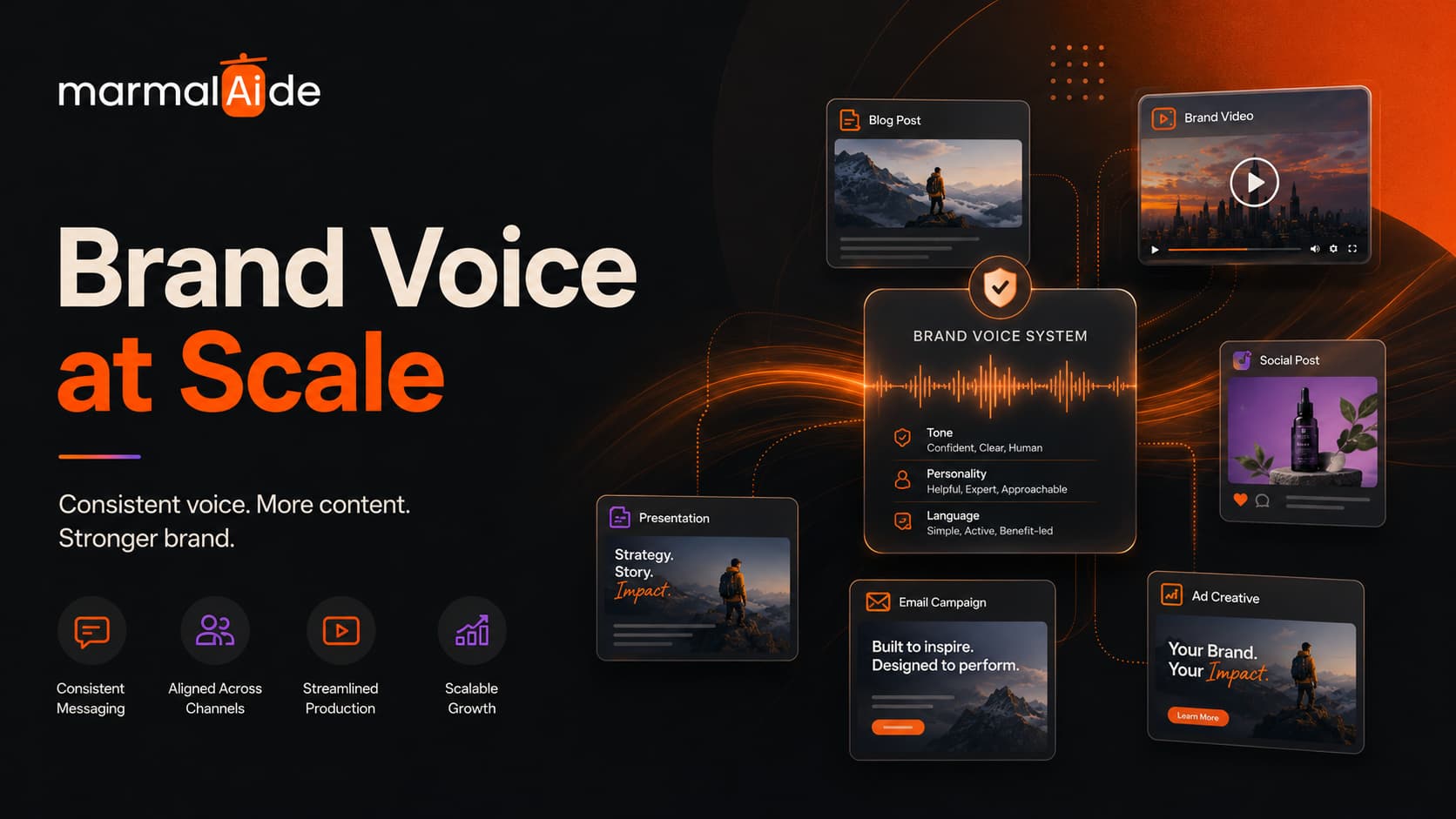
One of the biggest concerns brands have about using AI for content is: “Will it sound like a robot?” or “Will it lose our brand voice?” These are valid concerns. The good news? When implemented correctly, generative AI can actually help you maintain and scale your brand voice more consistently than ever before. Here’s how.
Generative AI makes it possible to scale content production faster than ever, but producing more content can create a new challenge: how to maintain brand voice across every piece of content. As teams use AI to create blog posts, social content, emails, ads, and other marketing assets, keeping a consistent tone and personality becomes increasingly important.
The key is not to choose between AI efficiency and brand authenticity. With clear brand voice guidelines, AI trained on existing content, and human oversight, brands can scale production while keeping content consistent, recognizable, and true to their identity.
This guide explains how to maintain brand voice when using generative AI, including how to train AI on your existing content, create an effective brand voice guide, and maintain quality as production scales.

What Is Brand Voice?
Brand voice is the consistent way a brand communicates with its audience across every channel. It includes the tone, language, vocabulary, personality, and values that shape how a brand sounds in its content.
A strong brand voice helps build recognition and trust while making content feel consistent, even when it is created by different people or with AI. For example, a brand may use a professional and authoritative voice, while another may be friendly, conversational, and playful.
When using generative AI, defining your brand voice clearly gives AI the context it needs to create content that sounds like your brand rather than generic AI-generated content..
The Brand Voice Challenge
Every brand has a unique voice—the way it communicates, the tone it uses, the values it expresses. Maintaining this voice is critical for:
- Building brand recognition and trust
- Creating emotional connections with audiences
- Differentiating from competitors
- Ensuring consistency across all channels
But here’s the problem: as you scale content production, maintaining voice consistency becomes harder. Different writers have different styles. Outsourced agencies may not fully understand your brand. Rushed content often loses personality.
How AI Preserves and Scales Brand Voice
Modern generative AI can be trained on your brand’s existing content to learn and replicate your voice. Here’s the process:
Voice Training: Feed the AI your best brand content—blog posts, social media, emails, etc. The AI learns your tone, vocabulary, values, and communication style.
Consistent Output: Once trained, the AI generates new content that matches your established voice, ensuring consistency across all channels.
Scalable Authenticity: You can now produce 10x more content without diluting your brand voice—because the AI is generating content in your voice, not a generic AI voice.
Quality Control: Your team reviews and refines AI output, adding the final human touch that makes content feel authentic.
How to Build a Brand Voice Guide for AI
A clear brand voice guide gives AI the context it needs to create content that sounds like your brand rather than generic AI output. Keep it practical and specific.
- Define your tone: Specify whether your brand should sound professional, conversational, playful, authoritative, or aspirational.
- Set vocabulary rules: List words and phrases to use, preferred terminology, and language to avoid.
- Document your values: Explain the ideas, principles, and qualities your content should consistently communicate.
- Provide examples: Include examples of content that represents your brand voice and explain what makes each example on-brand.
- Set review guidelines: Define what your team should check before AI-generated content is published, including tone, accuracy, brand consistency, and messaging.
The more specific the guide, the easier it is for AI to reproduce your brand voice consistently across different content formats and marketing channels.
Use Positive and Negative Examples to Teach AI Your Brand Voice
A brand voice guide tells AI what your brand should sound like. Examples make those rules easier to apply.
Create two small libraries:
On-brand examples
Include examples that demonstrate:
- Preferred tone and sentence structure
- Typical vocabulary
- How your brand explains complex ideas
- How CTAs are written
- How your brand communicates with customers
- Examples of strong headlines, social posts, emails, and ads
Off-brand examples
Show AI what to avoid:
- Words or phrases that sound too corporate
- Overly promotional language
- Generic AI phrases
- Tone that is too formal or casual
- Claims the brand would not make
- Messaging that conflicts with brand positioning
For example:
| On-brand | Off-brand |
| Clear and direct | Overly corporate |
| Helpful and conversational | Excessively promotional |
| Specific product language | Generic marketing language |
| Confident but measured | Unsupported superlatives |
How to Maintain Brand Voice With Generative AI
The most reliable approach is to build brand voice into the content workflow rather than trying to fix off-brand content after it has been generated.
1. Define the voice
Document your tone, personality, vocabulary, messaging principles, audience, and words to avoid.
2. Build an approved example library
Collect your strongest brand content across blogs, emails, social posts, ads, landing pages, and other channels.
3. Create reusable AI instructions
Turn the voice rules and examples into reusable prompts, templates, project instructions, or brand-voice settings.
4. Adapt the voice by channel
Keep the core brand voice consistent, but adjust the expression for the channel. A LinkedIn post, product email, blog article, and paid ad may use different structures while still sounding like the same brand.
5. Generate and review
Use AI to create the first draft or variations, then review the output for tone, accuracy, messaging, and brand fit.
6. Record recurring corrections
If editors repeatedly change the same type of wording, add that learning to the brand voice guide, prompt, or example library.
7. Audit for voice drift
Review a sample of published AI-assisted content regularly. Look for changes in vocabulary, tone, messaging, and personality that make the brand sound different over time.
How to Maintain Brand Voice Across Different Content Channels
Brand voice should stay recognizable across channels, but the format and tone can adapt to the audience and context.
| Channel | What stays consistent | What can change |
| Blog | Core messaging, terminology, personality | Depth and structure |
| Brand personality and vocabulary | Directness and CTA style | |
| Social media | Tone and key messages | Length, format, and conversational style |
| Paid ads | Positioning and product language | Hook, urgency, and CTA |
| Landing pages | Value proposition and terminology | Conversion-focused structure |
| Video scripts | Personality and messaging | Spoken language and pacing |
For example, a B2B brand can remain professional across every channel while using a more conversational tone on social media and a more direct CTA in paid advertising.
Consistency does not mean copying the same sentences everywhere. It means maintaining the same recognizable brand personality while adapting the message to the channel.
Create AI Brand Voice Guardrails
A brand voice guide explains how your brand should sound. Guardrails define what AI should and should not produce.
Your AI brand voice guardrails can include:
- Tone rules: Define the acceptable range of tone for different content types.
- Vocabulary rules: Specify preferred product names, terminology, and phrases.
- Words to avoid: Maintain a list of words, claims, or expressions that do not fit the brand.
- Messaging rules: Define the core messages that should remain consistent across campaigns.
- Claim boundaries: Identify statements that require evidence, approval, or legal review.
- Formatting rules: Set expectations for headings, sentence length, CTAs, capitalization, and channel-specific style.
- Approval rules: Define which content can be reviewed automatically and which requires human approval.
These guardrails help turn brand voice from a subjective preference into a repeatable content standard.
The goal is not to make every AI-generated asset identical. It is to give every creator and AI workflow the same boundaries to work within.
Best Practices for Maintaining Brand Voice at Scale in Content Marketing
Maintaining a consistent brand voice becomes more challenging as content production increases. These best practices can help teams scale content without losing the personality and consistency that make their brand recognizable.
- Create one source of truth: Keep your brand voice guide, messaging guidelines, and approved examples in one place so everyone works from the same standards.
- Train AI with real brand content: Use high-quality examples from your existing blogs, emails, social posts, and campaigns to give AI a clear understanding of your voice.
- Use consistent prompts: Build reusable prompts that include your tone, vocabulary, audience, messaging, and words or phrases to avoid.
- Review before publishing: Keep human review in the workflow to check whether AI-generated content is accurate, relevant, and consistent with your brand.
- Update the guidelines: Your brand voice can evolve. Regularly review successful content and update your AI instructions as your messaging develops.
The goal is not to make every piece of content identical. It is to ensure that every piece feels like it comes from the same brand.
Watch for Brand Voice Drift
Brand voice can change gradually when multiple people, prompts, AI tools, and content workflows are involved.
Review published content regularly for:
- New phrases that were not previously part of the brand vocabulary
- Increasingly generic or promotional language
- Different tones between channels
- Inconsistent product terminology
- Changes in messaging or positioning
- AI-generated patterns that appear repeatedly
When the same correction appears repeatedly, update the source of truth rather than fixing the same issue manually every time.
This directly addresses consistent brand voice AI, brand consistency in generative AI, and scale content without losing brand voice.
How to Check AI Content for Brand Voice Consistency
Before publishing AI-generated content, review it against a simple brand voice checklist.
| Check | Question |
| Tone | Does it sound like the brand? |
| Vocabulary | Does it use the brand’s preferred terminology? |
| Personality | Does it feel distinctive rather than generic? |
| Messaging | Does it communicate the approved brand message? |
| Accuracy | Are product, company, and factual claims correct? |
| Audience | Is the language appropriate for the intended audience? |
| Channel | Does the content fit the platform where it will appear? |
| CTA | Does the call to action match the brand’s communication style? |
| Risk | Does it contain claims or wording that require additional approval? |
A useful workflow is to have AI generate the content, use a second review step to check it against the brand rules, and then have a human approve content where accuracy, reputation, or compliance matters.
This creates a quality gate between content generation and publishing rather than treating AI output as publication-ready.
Real-World Examples
Example: Scaling One Brand Voice Across Three Channels
Imagine a B2B SaaS brand whose voice is clear, practical, and confident.
The team could provide AI with:
- Three approved blog examples
- Five strong social posts
- Two customer emails
- A list of preferred product terminology
- A list of phrases to avoid
- Core messaging and positioning
AI can then use that context to create a blog introduction, LinkedIn post, and email campaign from the same campaign brief.
The content does not need to use identical wording. The goal is for all three pieces to feel like they came from the same brand.
A human reviewer then checks the drafts against the brand voice guide before publication.
What Should AI Handle and What Should Stay Human?
Maintaining brand voice does not mean asking AI to make every creative decision.
AI can help with:
- Drafting content variations
- Repurposing approved content
- Adapting content for different channels
- Generating headline and hook variations
- Applying documented terminology and style rules
- Creating first drafts from an approved brief
Humans should own:
- Brand positioning
- Major messaging decisions
- Opinions and points of view
- Sensitive claims
- Crisis or reputation-sensitive communication
- Final creative approval
- Decisions about how the brand should evolve
The strongest workflow is not AI versus humans. It is a controlled process where AI handles repeatable production work while people remain responsible for strategy, judgment, and final approval.
The Competitive Advantage
Brands that master AI-powered content with consistent voice gain significant advantages:
- Faster market response: Launch campaigns in days, not weeks
- More content testing: Try more variations to find what resonates
- Better brand recall: Consistent voice builds stronger brand recognition
- Lower production costs: Scale without proportionally increasing costs
Why Marmalaide Understands Brand Voice
At Marmalaide, we work with brand teams to understand their unique voice and values. Our approach ensures that:
- Every piece of content reflects your brand identity
- Scaling production doesn’t mean sacrificing authenticity
- Your team maintains creative control while benefiting from AI efficiency
- Content feels human-written, not AI-generated
We combine the speed of generative AI with the expertise of experienced marketers who understand what makes brands memorable.
read our guide to generative AI for brand teams
Conclusion
The future of brand marketing isn’t about choosing between AI efficiency and brand authenticity—it’s about having both. Generative AI, when properly implemented, can help you scale your brand voice across more channels, more frequently, and more consistently than ever before. The key is training the AI on your brand’s unique voice and maintaining human oversight of the output.
Ready to scale your brand voice? Explore Marmalaide and see how we help brands maintain authenticity while accelerating content production.
Discover how businesses can maintain brand safety with AI while using smarter tools for content creation and marketing growth.
FAQs
How can AI maintain a brand’s voice?
AI can learn from a brand’s existing content, including its tone, vocabulary, values, and communication style, then use those patterns to generate consistent content.
Can AI-generated content still feel authentic?
Yes. Human review and editing can refine AI-generated content and add the final creative touch needed to keep it authentic and on-brand.
What is a brand voice guide?
A brand voice guide documents a brand’s tone, preferred vocabulary, values, and communication style. It helps AI and marketing teams create more consistent content.
How does AI help brands scale content production?
AI allows brands to produce more content and creative variations faster while maintaining a consistent voice across channels.
Does using AI mean losing creative control?
No. With human oversight, teams can review, edit, and approve AI-generated content before it is published, keeping creative control with the brand.
How do you train AI to maintain a brand voice?
Give the AI structured brand voice rules, approved content examples, audience and channel context, and clear instructions about what to use and avoid. Review the output and update the examples or guidelines when recurring voice issues appear.
How do you maintain brand voice across multiple AI tools?
Use a centralized brand voice source of truth containing tone rules, approved terminology, messaging guidelines, examples, and prohibited language. Apply the same core standards across each AI tool while adapting instructions to the tool and content format.
Can AI maintain brand voice across different marketing channels?
Yes. AI can help adapt a consistent brand voice across blogs, emails, social media, ads, landing pages, and other formats. The core personality and messaging should remain consistent while structure, length, and CTA style change by channel.
What are AI brand voice guardrails?
AI brand voice guardrails are rules that define how AI-generated content should sound and what it should avoid. They can cover tone, vocabulary, messaging, claims, formatting, prohibited language, and human approval requirements.