
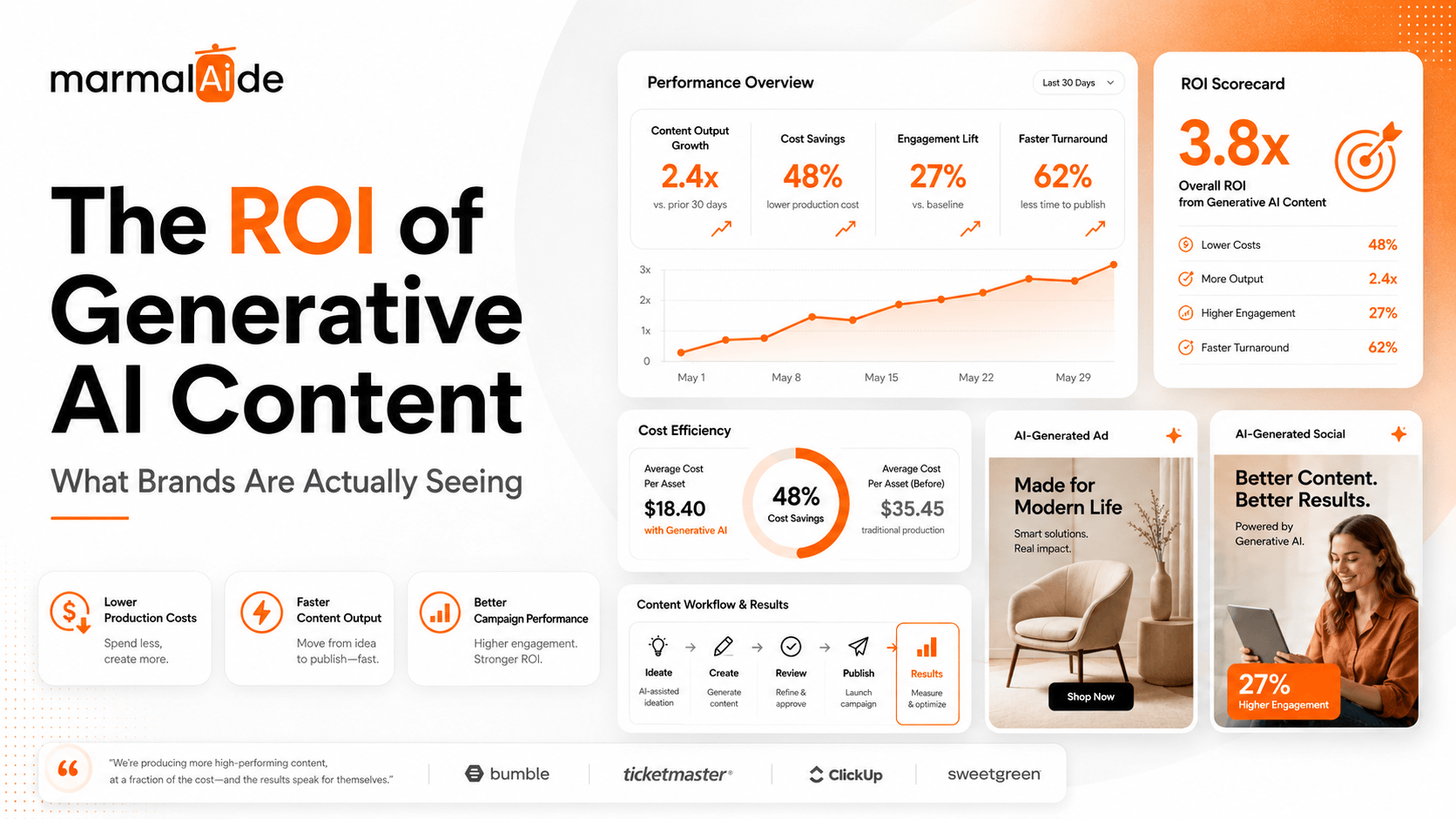
Generative AI content ROI is no longer just a question of how much businesses can save on production. For marketing teams, it is also about how efficiently they can test creative ideas, launch campaigns, adapt content for different audiences, and improve performance without increasing production overhead at the same rate.
AI-assisted content production can help brands develop more video ads, social creatives, product content, and campaign variations from a single brief. But higher output does not automatically mean higher returns. Results depend on the quality of the creative, audience targeting, distribution, campaign strategy, and how performance is measured.
So, what are brands actually seeing from generative AI content in 2026? The most useful evidence comes from measurable production savings, faster turnaround, creative testing capacity, and improvements in campaign outcomes.
In this guide, we examine the business outcomes worth tracking, explain how to evaluate AI content performance, and show how brands can assess whether AI-powered production is delivering meaningful value.
The answer might surprise you. The ROI of Generative AI Content isn’t just about cost savings—it’s about what becomes possible when you can produce content at scale.
What Is the ROI of Generative AI Content?
The ROI of Generative AI Content measures the value businesses gain from using AI-powered tools to create, optimize, and manage content compared to the investment made in AI technology, tools, and resources. It evaluates factors such as reduced content production costs, faster workflows, improved productivity, higher engagement, and better marketing outcomes.
By automating repetitive content tasks and supporting content teams with faster creation and optimization, generative AI helps brands achieve greater efficiency while maintaining content quality. The actual ROI depends on how effectively businesses integrate AI into their content strategies, workflows, and customer engagement efforts.
The Direct Cost Savings of Generative AI Content
One of the first areas businesses can evaluate when adopting generative AI is the cost of producing marketing assets.
Traditional production may involve separate budgets for concept development, scripting, filming, talent, locations, editing, motion graphics, and creative revisions. AI-assisted workflows can reduce the need for some of these activities, depending on the content format and production requirements.
The potential savings differ by asset type:
- Video ads: AI-assisted production can reduce reliance on repeated shoots when concepts, scenes, or product variations can be created without filming every version.
- Social media creatives: Teams can adapt approved concepts into different hooks, formats, messages, and campaign variations more efficiently.
- Product marketing content: Brands can develop additional product-focused assets and localized variations while retaining appropriate product and brand checks.
- Campaign adaptations: Teams can repurpose approved creative for different placements, audience segments, and campaign objectives.
How to Evaluate Your Actual Production Savings
Instead of assuming a fixed percentage reduction, compare the fully loaded cost of your existing production workflow with the cost of an AI-assisted workflow.
Include creative strategy, internal labor, external production, software, editing, quality assurance, revisions, and distribution where applicable.
For example, if a traditional workflow costs $10,000 and a comparable AI-assisted workflow costs $6,000, the production cost reduction is 40%.
The formula is:
Cost reduction (%) = [(Traditional production cost − AI-assisted production cost) ÷ Traditional production cost] × 100
This calculation helps businesses establish a defensible baseline. Actual savings depend on the complexity of the creative, the amount of human involvement, and the scope of the production project.
Where Generative AI Content Creates Business Value Beyond Cost Savings
Lower production costs are only one part of the opportunity. The larger benefit is the ability to use creative resources more efficiently and make better-informed marketing decisions.
1. More Creative Testing Opportunities
AI-assisted production can make it easier to test different hooks, messages, product demonstrations, offers, and calls to action.
Rather than committing the entire budget to one creative concept, marketing teams can develop several relevant variations and evaluate which ones perform best. Testing should change meaningful creative elements and use clear success metrics, rather than producing large volumes of nearly identical assets.
2. Faster Campaign Turnaround
Traditional production can require coordinating multiple specialists, shoots, revisions, and approvals. An AI-assisted workflow can accelerate selected stages, allowing teams to respond to campaign requirements and market changes more quickly.
Actual turnaround depends on the brief, creative complexity, review process, and delivery requirements.
3. Audience and Product Personalization
Brands can adapt creative messaging for different audience segments, products, markets, and stages of the customer journey.
For example, a DTC brand might use one approved creative concept to develop product-specific variations, while a B2B company might adapt a product explainer for different buyer concerns. Personalization is most valuable when each variation addresses a meaningful audience need.
4. Greater Content Capacity
AI-assisted workflows can help marketing teams create more usable assets from the same initial brief. This may include additional video cuts, static ads, product demonstrations, and platform-specific versions.
The objective should be to increase the supply of relevant, approved content—not simply to publish more assets regardless of quality.
5. Better Use of Marketing Team Resources
When repetitive production tasks take less time, teams can devote more attention to creative strategy, audience research, performance analysis, and campaign optimization.
The value of this change can be measured through production hours saved, reduced bottlenecks, faster approvals, and improvements in the quality of campaign decisions.
Together, these benefits create a practical pathway from production efficiency to better marketing outcomes. However, the impact on conversions and revenue must be established through actual campaign measurement.
Real-World AI Content Production Results: What Brands Can Learn
When evaluating the ROI of generative AI content, it helps to separate documented production outcomes from broader claims about marketing performance.
Marmalaide’s published portfolio and website provide examples of how AI-assisted creative production can affect production costs, creative delivery, and campaign engagement.
Production Cost Savings
Marmalaide reports a $50,000 saving compared with traditional production for a campaign film and social cutdowns for Santa Monica Brew Works. Its published DTC creative portfolio also reports 65% of budget saved for a video ad set produced for Cadastral.
These examples illustrate how production economics can change when brands use AI-assisted workflows. The actual savings for another business will depend on the production scope, creative requirements, and traditional production costs used as the comparison.
Creative Performance
Marmalaide’s public portfolio reports 2x higher engagement for multiple dynamic ad variants produced for Sevaro.
Engagement is a useful performance indicator, but it is not equivalent to revenue or overall ROI. To assess the commercial impact, brands should also examine qualified leads, conversion rates, customer acquisition costs, and attributable revenue.
What These Results Mean for Other Brands
The relevant lesson is not that every company should expect the same percentages. It is that AI-assisted production can create opportunities to reduce production overhead, develop more creative variations, and evaluate campaign performance more efficiently.
Before adopting a similar workflow, businesses should establish their own production cost baseline, document the assets delivered, and agree on how success will be measured.
For reliable comparisons, case studies should identify the project scope, baseline, measurement period, and methodology behind each reported outcome.
Publishing requirement: Obtain approval for these case-study claims and link to the relevant portfolio pages where possible. Do not describe the examples as representative industry averages or claim that they prove a specific annual ROI.
E-commerce Brand:
- Reduced content production costs by 65%
- Increased social media posting frequency by 300%
- Improved engagement rates by 35%
- Increased conversion rates by 18%
- Annual ROI: 450%
SaaS Company:
- Reduced video production costs by 75%
- Increased video content output by 400%
- Improved demo request rates by 28%
- Reduced sales cycle by 2 weeks
- Annual ROI: 520%
B2B Service Provider:
- Reduced blog production costs by 70%
- Increased blog publishing frequency by 250%
- Improved organic traffic by 42%
- Improved lead quality by 15%
- Annual ROI: 380%
These aren’t outliers. These are typical results from brands using AI strategically.
How to Measure the ROI of Generative AI Content in 2026
Businesses need a consistent measurement framework to determine whether AI-assisted content production is improving marketing performance.
The right metrics depend on whether the objective is to reduce production costs, increase creative testing, generate leads, or improve sales.
Track Production Efficiency
Start with the operational metrics:
- Cost per approved creative asset
- Time from brief to final delivery
- Number of usable assets produced per campaign
- Number of revision cycles
- Production hours saved
These metrics reveal whether AI is improving the efficiency of the content production process.
Track Campaign Performance
Next, evaluate how the resulting content performs in its intended channel.
- Engagement rate and video completion rate
- Click-through rate
- Landing-page conversion rate
- Qualified leads or demo requests
- Customer acquisition cost
- Revenue attributed to the campaign
Use metrics that match the campaign objective. For example, a brand awareness campaign and a direct-response advertising campaign should not be evaluated using exactly the same success criteria.
Connect Production Savings With Business Results
Lower production costs are valuable, but they do not automatically translate into increased profit.
Suppose an AI-assisted workflow saves $4,000 in production costs. If the team reinvests those savings in additional creative testing, it should separately track the resulting production investment and any incremental business value.
Compare the results against a reasonable baseline and account for other factors, including media spend, audience changes, seasonality, and campaign offers.
The strongest evidence of improved ROI comes when a business can demonstrate both operational efficiency and meaningful performance outcomes without compromising creative quality.
Here’s a tip:
Don’t just measure cost savings. Measure the full impact: increased content volume, improved engagement rates, faster time-to-market, better conversion rates, and improved team productivity. The real ROI comes from what becomes possible, not just what you save.
The Cost of Inefficient Content Production
The decision to adopt AI-assisted content production should not be based on the assumption that competitors are automatically producing more content at a lower cost. It should be based on the limitations and opportunities within your own production workflow.
When creative production becomes a bottleneck, marketing teams may struggle to:
- Launch new creative concepts quickly enough for campaign requirements.
- Develop enough meaningful variations to test different messages.
- Adapt assets for new products, audiences, and platforms.
- Keep pace with changing campaign priorities.
- Allocate sufficient time to performance analysis and optimization.
AI-assisted production may help address these challenges by accelerating selected production tasks and making creative adaptations more manageable.
However, adopting AI also introduces considerations around quality control, brand consistency, factual accuracy, and workflow integration.
The business case should therefore compare the cost of the current process with the full cost and measurable benefits of a proposed AI-assisted workflow. This provides a stronger basis for investment than assuming that adopting AI will automatically create a competitive advantage.
How Marmalaide Helps Brands Improve AI Content Production ROI
For brands that need a steady supply of video ads and marketing creative, the challenge is not simply generating content. It is producing assets that are aligned with the brand, ready for campaigns, and practical to test at scale.
Marmalaide combines generative AI with creative direction from marketers, filmmakers, and editors to support the production of video and static creative for brand, social, and performance marketing.
Creative Direction Beyond AI Generation
The production process starts with the campaign brief, audience, messaging, and creative objectives. Scripts, concepts, visual direction, and editing help turn AI-generated material into finished assets that meet the intended campaign requirements.
More Variations From a Single Concept
Brands can develop alternative hooks, product variations, calls to action, and platform-specific versions from an approved creative direction. This helps marketing teams prepare different assets for testing without treating every variation as an entirely new production project.
A Workflow Designed for Marketing Teams
Marmalaide supports the process from briefing and concept development through production, editing, review, and delivery. This gives brands a more coordinated way to develop campaign-ready creative.
Evaluate Results Against Your Own Baseline
The potential value of an AI production partner should be assessed against the brand’s existing costs, turnaround times, asset requirements, and performance goals.
Relevant measures include cost per approved asset, delivery time, the number of usable variations, creative engagement, and downstream conversion performance.
For DTC and e-commerce teams that need continuous product and campaign creative, explore Marmalaide’s AI creative studio for DTC brands.
For broader video requirements, including product videos, explainers, and performance ads, see Marmalaide’s AI video production services.
How to Build a Business Case for AI-Powered Content Production
Before investing in AI-powered content production, marketing leaders should evaluate whether the proposed workflow can improve efficiency and contribute to business objectives.
Use this five-step framework:
- Document current costs: Include production, editing, internal labor, external partners, and revisions.
- Identify production bottlenecks: Determine which formats, tasks, and approval stages consume the most time and resources.
- Define measurable targets: Set realistic objectives for cost per asset, turnaround time, creative output, and campaign performance.
- Run a pilot: Test an AI-assisted workflow on a defined campaign or content format and compare the results with a relevant baseline.
- Evaluate and scale: Expand the workflow when the evidence supports its value, while maintaining brand standards and quality controls.
A structured pilot makes it easier to determine whether AI-assisted production is appropriate for your team, where it creates the most value, and which results justify further investment.
If your team needs campaign-ready video and static creative without managing every production stage internally, explore Marmalaide’s AI-powered production services to understand the available options.
Explore what to consider when you choose an AI content partner for marketing success.
Ready to see the ROI for your brand? Learn how Marmalaide helps growth marketing teams, social media teams, and brand teams produce more content, faster, and cheaper—with proven results.
Discover how to calculate the ROI of generative AI content marketing for your campaigns.
Conclusion: Measure What AI Content Actually Delivers
Generative AI content can help brands reduce production friction, develop creative variations, and respond to campaign requirements more efficiently. Its business value, however, depends on how effectively those capabilities translate into better workflows and measurable marketing outcomes.
The most useful approach is to start with a clear production baseline, test AI-assisted workflows against defined objectives, and measure both efficiency and campaign performance.
For brands that need ongoing creative production, Marmalaide combines AI-assisted workflows with human creative direction to help teams develop and adapt marketing assets for their campaigns.
Ready to evaluate your next campaign? Explore Marmalaide’s AI video production services and assess how AI-assisted creative production could fit your team’s requirements.
FAQs: The ROI of Generative AI Content
What is the ROI of Generative AI Content?
The ROI of Generative AI Content measures the value businesses gain from using AI tools for content creation compared to the investment made. It includes cost savings, increased content output, improved efficiency, faster production, and better marketing results.
How much cost can brands save with Generative AI Content?
Brands can reduce content production costs significantly by using generative AI. Depending on the workflow and content type, businesses can save around 60–80% on content creation expenses compared to traditional production methods.
Does Generative AI Content improve marketing performance?
Yes, when used strategically, generative AI content can improve marketing performance by enabling faster testing, better personalization, higher content volume, and optimization based on audience insights.
How does Generative AI Content help brands create more content?
Generative AI allows marketing teams to automate repetitive tasks and speed up content creation workflows. Many brands can produce 3–5x more content using the same resources while focusing more on strategy and optimization.
How should businesses measure the ROI of Generative AI Content?
Businesses should measure ROI beyond cost savings by tracking metrics such as content production speed, engagement rates, conversion rates, website traffic, lead generation, customer acquisition costs, and overall team productivity.
What are the risks of not adopting Generative AI Content?
Not adopting generative AI can put brands at a competitive disadvantage. Companies using AI can produce more content, test ideas faster, respond quickly to market trends, and build stronger audience connections at a lower cost.
What results can brands expect from generative AI content in 2026?
Results vary depending on the content format, production workflow, campaign objectives, and quality controls. Businesses may improve production efficiency, turnaround times, and creative testing capacity. Improvements in engagement, leads, or revenue should be validated using actual campaign data rather than assumed in advance.
How can brands measure the ROI of AI-generated marketing content?
Brands can measure AI content ROI by comparing the business value generated with the total investment in producing and distributing the content. Relevant metrics include cost per approved asset, production time, engagement, conversions, qualified leads, customer acquisition costs, and attributable revenue.
Does generative AI content improve conversion rates?
Generative AI can help marketing teams test different creative concepts, messages, and calls to action. This may help identify stronger-performing assets, but conversion improvements are not guaranteed. Results depend on the audience, offer, landing page, distribution strategy, and execution of the tests.
How does AI-assisted content production benefit DTC and e-commerce brands?
AI-assisted production can help DTC and e-commerce brands create product videos, social ads, UGC-style creative, and variations for different products and campaigns. These capabilities can support creative testing and reduce dependence on repeated production cycles, while human review helps maintain product accuracy and brand consistency.
Is an AI content production agency better than using AI tools in-house?
The right approach depends on the team’s expertise, capacity, content requirements, and budget. In-house tools offer direct control over production, while an AI content production agency can provide creative strategy, scripting, production, editing, and quality review. Businesses should compare the total cost, turnaround time, quality, and resources required for each option.