
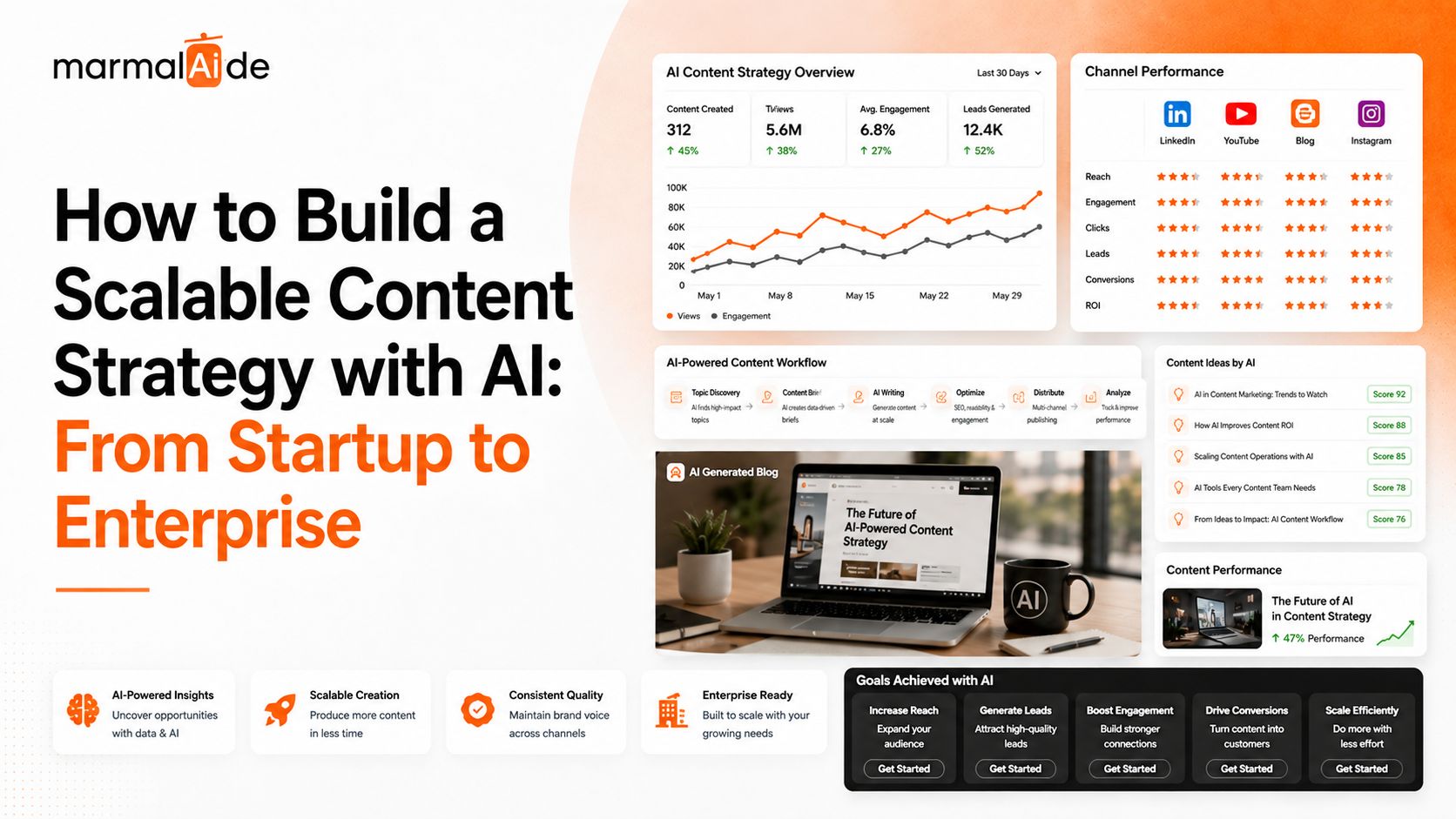
Scalable Content Strategy with AI is helping businesses meet growing content demands without significantly increasing marketing costs. One of the biggest challenges growing companies face is scaling their content production while maintaining quality and efficiency. You may start with a lean marketing team creating great content, but as your business grows, the demand for content across new products, markets, and channels increases rapidly.
This is where generative AI provides a strategic advantage. Instead of simply automating content creation, businesses can use AI to build a scalable content strategy with AI that supports long term growth, improves consistency, and enables teams to produce more content without expanding resources at the same pace.
The Content Scaling Problem
Let’s be honest: traditional content creation doesn’t scale well. Here’s why:
- Hiring costs: Adding more content creators means higher salaries, benefits, and overhead
- Quality control: More people often means less consistency
- Time to production: Coordinating larger teams can actually slow things down
- Flexibility: It’s hard to quickly pivot when you have fixed team capacity
Most companies hit a wall around 50-100 pieces of content per month. Beyond that, costs become prohibitive, or quality suffers.
The AI-Powered Scaling Solution
Generative AI changes this equation. Instead of hiring more people, you can:
- Maintain quality with experienced strategists overseeing AI output
- Increase volume dramatically without proportional cost increases
- Stay flexible by quickly adjusting content types and topics
- Reduce overhead by eliminating many traditional production bottlenecks
The key is having the right framework and the right team managing the AI tools.
How to Scale Content Strategy at Different Stages of Business Growth
A scalable content strategy should evolve as a business grows. Startups, growing companies, and enterprises have different content requirements, marketing resources, approval processes, and operational challenges.
Generative AI can support each stage by making content production more efficient, but the strategy should match the company’s current needs and resources.
1. Content Strategy for Startups
Startups usually operate with limited marketing budgets and small teams. Their primary challenge is building brand awareness, establishing credibility, and generating early demand without investing heavily in content production.
An AI-assisted content strategy can help startups:
- Develop a consistent brand voice and messaging framework.
- Create educational blog and website content.
- Repurpose existing content into social media posts.
- Produce product explainers and launch videos.
- Create campaign variations without organizing multiple production shoots.
- Maintain a regular publishing schedule with limited resources.
At this stage, prioritize a small number of high-value content formats and channels. Avoid trying to maintain a presence everywhere before establishing what works.
2. Content Strategy for Growing Businesses
As a business expands, its content requirements become more complex. Marketing teams need to support additional products, campaigns, customer segments, and distribution channels.
An AI-powered content strategy can help growing businesses:
- Build repeatable content production workflows.
- Develop campaign-specific content calendars.
- Adapt messaging for different audience segments.
- Repurpose high-performing content across channels.
- Produce more creative variations for marketing campaigns.
- Establish standardized review and approval processes.
The focus should shift from individual content creation to building a repeatable production system that can support increasing demand.
3. Content Strategy for Enterprise Businesses
Enterprise organizations often manage multiple brands, product categories, business units, regions, and marketing teams.
Their biggest challenge is scaling content while maintaining governance, brand consistency, and approval standards.
An enterprise AI content strategy should include:
- Centralized brand guidelines and messaging frameworks.
- Standardized AI content workflows across teams.
- Role-based review and approval processes.
- Content localization for different markets.
- Shared content libraries and reusable creative assets.
- Governance policies for AI-generated content.
- Performance reporting across campaigns and channels.
Enterprise teams should also define which content activities can be automated, which require human approval, and which need specialist review.
Choosing the Right Scaling Approach
| Business stage | Main challenge | Strategic priority |
| Startup | Limited resources | Build a consistent content foundation |
| Growing business | Increasing production demand | Create repeatable workflows |
| Enterprise | Operational complexity | Standardize governance and production |
The goal is not to produce the same volume of content at every stage. It is to build a content operation that can expand without creating unnecessary costs, inconsistent messaging, or operational complexity.
Building Your Scalable Content Strategy: A 5-Phase Approach
Phase 1: Audit and Strategy (Weeks 1-2)
Before implementing AI, understand your current state:
- What content are you currently producing?
- What’s working? What’s not?
- Where are your biggest content gaps?
- What does your audience actually want?
This foundation is critical. AI will amplify your strategy—good or bad. So get the strategy right first.
Phase 2: Establish Brand Guidelines (Weeks 2-3)
Document everything about your brand’s voice and style:
- Brand voice and tone guidelines
- Key messaging pillars
- Target audience personas
- Content style preferences
- Visual identity guidelines
- Approved sources and references
These guidelines become the “instructions” for your AI content creation. The more detailed and clear, the better the output.
Phase 3: Pilot and Test (Weeks 4-6)
Start small. Pick one content type (like blog posts or social media) and one channel. Create 10-20 pieces using AI with human oversight. Measure:
- Time to production
- Quality metrics
- Audience engagement
- Cost per piece
Use these learnings to refine your process before scaling.
Phase 4: Implement and Optimize (Weeks 7-12)
Expand to additional content types and channels. Establish your production workflow:
- Who approves content?
- What’s the review process?
- How do you handle revisions?
- How do you measure success?
Build systems and processes that can handle higher volume without sacrificing quality.
Building an AI-Powered Content Production Workflow
A scalable content strategy requires a repeatable production workflow. Without clear processes, increasing content volume can lead to duplicated work, inconsistent messaging, unnecessary revisions, and approval delays.
An AI-powered workflow helps marketing teams organize content production from initial planning to final distribution.
1. Content Planning and Topic Research
Begin by identifying content opportunities based on business objectives, customer questions, industry trends, and keyword research.
Create a centralized content calendar that defines:
- Content topic and target audience
- Primary marketing objective
- Content format and distribution channel
- Target keyword or campaign theme
- Publishing deadline
- Assigned owner
AI can assist with topic ideation, research organization, and content briefs, while marketers validate relevance and search intent.
2. Content Brief Development
Create standardized briefs for each content format.
A content brief should include the intended audience, key message, required information, brand voice, content structure, and desired action.
This ensures that different creators and AI tools work from the same strategic direction.
3. AI-Assisted Content Production
Use AI to accelerate repetitive production activities, including:
- Initial content drafts
- Social media copy variations
- Video scripts and storyboards
- Email content variations
- Content repurposing
- Campaign messaging adaptations
AI-generated material should be treated as a working draft rather than automatically approved final content.
4. Human Review and Quality Assurance
Every asset should pass through a defined review process before publication.
Reviewers should check:
- Factual accuracy and supporting sources
- Brand voice and messaging consistency
- Originality and usefulness
- Audience relevance
- SEO requirements where applicable
- Visual and creative quality
- Legal and compliance requirements
Assign clear responsibility for final approval to prevent content from moving between teams without ownership.
5. Distribution and Content Repurposing
Once approved, adapt content for relevant marketing channels.
For example, a single campaign concept can support:
- A long-form blog article
- LinkedIn thought leadership posts
- Social media creatives
- Email campaign messaging
- Short-form video scripts
- Product or landing page content
Each adaptation should be tailored to the audience and channel rather than simply copying the same message everywhere.
6. Performance Tracking and Optimization
Monitor how content performs after publication.
Use performance insights to identify successful formats, topics, messaging, and distribution channels.
Update the content calendar and production playbook based on what generates meaningful audience engagement and business outcomes.
A Repeatable AI Content Workflow
Research → Plan → Brief → Create → Review → Publish → Measure → Optimize
Documenting this workflow helps teams maintain consistency as production requirements grow. It also makes it easier to identify bottlenecks and determine which tasks should be automated, delegated, or handled by experienced professionals.
Phase 5: Scale and Evolve (Ongoing)
Once you’ve proven the model works, scale aggressively. You can now produce:
- 10x more content
- At 70-80% lower cost
- With the same or better quality
- With faster turnaround times
Here’s a tip:
Create a content playbook that documents your successful content formats, topics, and workflows to support your scalable content strategy with AI. This playbook becomes the reference guide for AI powered content creation, helping your team produce consistent and high quality content across every channel. The more specific and detailed your playbook is, the more effective your scalable content strategy with AI becomes. Review and update it regularly based on performance, audience feedback, and changing business goals to keep your content strategy effective over time.
The Role of Human Expertise in AI-Powered Content
This is crucial: AI doesn’t replace human expertise. It amplifies it. Your strategy, your brand voice, your understanding of your audience—these still come from humans. AI handles the execution at scale.
The best content strategies combine:
- Strategic thinking (human)
- Creative direction (human)
- Content production (AI-assisted)
- Quality review (human)
- Performance analysis (human + AI)
How to Scale Content Production Through AI-Powered Content Repurposing
One of the most efficient ways to scale content production is to create multiple useful assets from a single core content idea.
Instead of developing every blog post, social media update, video, and email campaign independently, businesses can use AI-assisted workflows to adapt existing content for different audiences and distribution channels.
This approach reduces repetitive production work while helping marketing teams maintain a consistent message across platforms.
1. Start With High-Value Core Content
Identify existing content that provides useful information or supports an important marketing objective.
Examples include:
- Industry research and reports
- Blog articles and educational guides
- Product announcements
- Customer case studies
- Webinars and presentations
- Product demonstrations
- Campaign videos
Prioritize content that has demonstrated audience interest or supports important business objectives.
2. Convert One Content Asset Into Multiple Formats
Use AI to identify the most valuable ideas and adapt them into relevant formats.
For example, a single long-form blog article can become:
- Multiple LinkedIn posts
- An Instagram carousel
- Short-form video scripts
- Email newsletter content
- Social media captions
- Short educational graphics
- A video presentation outline
The objective is to adapt the original information rather than duplicate it across channels.
3. Customize Content for Each Platform
Every platform has different audience expectations and content requirements.
For example:
LinkedIn: Focus on professional insights, industry perspectives, practical lessons, and business challenges.
Instagram: Convert useful information into visual storytelling, carousels, and short-form videos.
YouTube: Develop longer educational videos, product demonstrations, and detailed explanations.
Email: Use the strongest insights to create relevant newsletter content and campaign messages.
AI can help develop these adaptations, but each version should be reviewed to ensure it feels natural to the platform.
4. Build a Content Repurposing Calendar
Include repurposing activities in your content calendar.
For every core content asset, identify the additional formats, distribution channels, publishing dates, and responsible team members.
This makes repurposing a repeatable part of the production process rather than an occasional activity.
5. Measure the Value of Repurposed Content
Monitor the performance of each adapted asset.
Evaluate reach, engagement, website visits, video retention, clicks, and conversions where relevant.
Use these insights to identify which formats and distribution channels deserve more production resources.
Example: One Campaign, Multiple Content Assets
A product launch campaign could generate:
| Original asset | Repurposed content |
| Product launch video | Short-form video variations |
| Product announcement | LinkedIn and social posts |
| Product blog | Educational email content |
| Product demonstration | Short video clips |
| Customer case study | Social proof creatives |
AI-powered repurposing helps businesses increase the usefulness and distribution of existing content while reducing the need to develop every asset independently.
For more ideas, explore how businesses can use AI-powered social media content creation to adapt core content for different platforms.
Content Governance and Quality Control When Scaling With AI
Producing more content is only valuable when the quality and consistency of that content meet business standards.
As organizations increase AI-assisted content production, they need clear governance processes to protect brand identity, maintain accuracy, and ensure that every asset meets the intended requirements.
1. Establish Centralized Brand Guidelines
Create a shared reference document that includes:
- Brand voice and tone
- Approved messaging and positioning
- Audience personas
- Product and service information
- Visual identity standards
- Preferred terminology
- Restricted claims and messaging
- Approved sources and references
This gives internal teams and external production partners a consistent foundation for creating content.
2. Define Content Ownership and Approval Responsibilities
Every content asset should have a clearly assigned owner.
Define who is responsible for strategy, creation, editing, fact-checking, compliance review, and final approval.
For enterprise teams, approval responsibilities may differ across regions, departments, and product categories.
A clear ownership structure prevents unnecessary delays and reduces the risk of inconsistent publishing.
3. Introduce Human Review at Critical Stages
AI can accelerate content production, but important decisions still require human judgment.
Review content for:
- Factual accuracy
- Brand alignment
- Originality and audience value
- Product and service accuracy
- Copyright and licensing concerns
- Regulatory and compliance requirements
- Visual consistency
The level of review should reflect the risk and complexity of the content.
4. Create Reusable Content Templates
Standardized templates help teams maintain consistency across different content formats.
Develop templates for blog briefs, social media campaigns, email copy, video scripts, product messaging, and campaign creatives.
Templates reduce repetitive work and make it easier to onboard new contributors.
5. Maintain a Centralized Content Library
Organize approved brand assets, messaging frameworks, content templates, campaign references, and reusable creative materials in a shared location.
This helps teams avoid recreating existing assets and makes it easier to adapt successful content for new campaigns.
6. Review and Update Governance Guidelines Regularly
Brand messaging, product information, market requirements, and AI capabilities change over time.
Review governance documentation periodically and update it based on production feedback, campaign performance, and business requirements.
A strong content governance framework allows businesses to scale AI-assisted content production without sacrificing brand trust, accuracy, or consistency.
Real-World Example: Scaling a B2B SaaS Content Marketing Team
Consider a growing B2B SaaS company that wants to increase its content production without hiring a large marketing team.
The company currently has a small growth marketing team responsible for brand awareness, product education, lead generation, and campaign execution.
As the business expands, it needs to create more content across multiple channels.
Monthly Content Requirements
Its content requirements include:
- 4 blog articles per week
- 20 social media posts per week
- 2 email campaigns per week
- 1 customer case study per month
- 4 video scripts per month
This represents approximately 16 blog articles, 80 social media posts, 8 email campaigns, 1 case study, and 4 video scripts each month.
The challenge is not simply creating more assets. Each format requires different research, creative direction, editing, approvals, and distribution.
How an AI-Assisted Workflow Helps
The company introduces a structured AI-assisted content workflow.
Content research: AI supports topic research, content briefs, and initial ideation.
Content production: AI helps develop first drafts, social media variations, email copy, and video scripts.
Content repurposing: Existing articles, product updates, and campaign assets are adapted into additional content formats.
Human review: Experienced marketers validate messaging, accuracy, brand voice, and audience relevance.
Distribution: Approved content is scheduled and published across relevant channels.
Performance optimization: The team reviews results to identify which topics and formats deserve additional investment.
What the Company Should Measure
Instead of assuming that higher output automatically means better performance, the company should compare:
- Average production time per approved asset
- Total monthly content production cost
- Content approval and revision rates
- Organic traffic and keyword performance
- Social media engagement
- Qualified leads generated
- Content-assisted conversions
This approach helps the business understand whether AI is actually improving its content operation.
The Key Takeaway
AI-assisted content production can help a lean marketing team manage a broader content workload, but success depends on clear workflows, experienced oversight, appropriate tools, and realistic production planning.
The goal is to build a repeatable content operation that grows with the business rather than simply increasing the number of assets published each month.s nearly impossible. With AI-assisted content creation and experienced strategists, it’s completely manageable.
How Marmalaide Helps Businesses Scale AI-Powered Creative Production
Building a scalable content strategy requires the right combination of planning, creative expertise, production workflows, and technology.
Marmalaide helps brands scale their marketing creative production by combining generative AI with experienced filmmakers, marketers, and creative professionals.
Instead of relying entirely on traditional production processes, businesses can develop more campaign-ready creative assets through AI-assisted workflows.
How Marmalaide Supports Scalable Creative Production
1. Creative Strategy and Direction
Marmalaide’s creative team develops concepts and scripts based on campaign objectives, brand positioning, and audience requirements.
2. AI-Assisted Video Production
Businesses can produce brand films, product videos, promotional content, and performance advertising creative without depending on traditional filming for every asset.
3. Multiple Creative Variations
A single campaign concept can be adapted into different hooks, messaging, calls to action, formats, and audience variations.
4. Consistent Brand Quality
Experienced filmmakers, marketers, and editors review creative assets to maintain visual consistency, messaging accuracy, and production quality.
5. Scalable Creative Delivery
Marmalaide supports ongoing production requirements through flexible creative production and subscription options designed for startups and growing marketing teams.
Whether you are a startup launching your first campaign or an established brand managing multiple products and marketing channels, Marmalaide helps make creative production more flexible and scalable.
Scale Your Marketing Creative Without Scaling Production Complexity
If your marketing team needs more video ads, social media creatives, product videos, or campaign variations, explore how Marmalaide combines AI-powered production with human creative direction.
Explore Marmalaide’s AI creative production services to see how your team can produce more campaign-ready creative with less traditional production overhead.
Ready to Scale Your Marketing Content Production?
As your business grows, your creative production requirements grow with it. Producing more campaign assets, adapting content for different platforms, and testing new creative approaches can put additional pressure on internal marketing teams.
Marmalaide combines generative AI with experienced filmmakers, marketers, and editors to help brands produce professional-quality video and static creative at scale.
Whether you need product videos, brand films, AI UGC-style ads, social media creatives, or multiple campaign variations, Marmalaide helps streamline production from concept to final delivery.
KPIs to Measure the Success of a Scalable Content Strategy
A scalable content strategy should be evaluated through more than the number of assets produced each month.
As businesses expand their content operations, they need to understand whether production is becoming more efficient, whether quality is being maintained, and whether content is contributing to marketing and business objectives.
Here are the key performance indicators to monitor.
1. Content Production Efficiency
These metrics help determine whether AI is reducing production bottlenecks.
Track:
- Number of approved assets produced per month
- Average production time per asset
- Cost per approved content asset
- Average number of revision cycles
- Time from brief to publication
- Production capacity per team member
Compare performance before and after implementing AI-assisted workflows.
2. Content Quality and Brand Consistency
Higher output should not result in inconsistent or low-quality content.
Monitor:
- Content approval rate
- Percentage of assets requiring major revisions
- Factual accuracy and quality review results
- Brand guideline compliance
- Content originality and usefulness
- Feedback from internal stakeholders
These indicators help identify whether production efficiency is being achieved without compromising quality.
3. Organic Search Performance
For SEO-focused content operations, monitor:
- Organic clicks and impressions
- Relevant keyword visibility
- Organic sessions
- Search click-through rate
- Engaged organic sessions
- Organic conversions
Use Google Search Console and Google Analytics 4 to understand which content assets are contributing to search visibility and website performance.
4. Audience Engagement
Evaluate how audiences interact with content across different channels.
Depending on the format, monitor:
- Social engagement rate
- Shares and saves
- Email click-through rate
- Video watch time
- Audience retention
- Returning visitors
Compare performance by content format and distribution channel rather than relying on total engagement alone.
5. Lead Generation and Business Outcomes
Ultimately, content should contribute to relevant business objectives.
Track:
- Qualified leads generated
- Content-assisted enquiries
- Landing page conversion rate
- Cost per qualified lead
- Marketing-attributed revenue
- Sales opportunities influenced by content
These metrics help businesses understand whether their increased production capacity is generating meaningful business value.
Building a Content Scaling Scorecard
| Measurement area | Core KPI | What it tells you |
| Efficiency | Cost per approved asset | Production cost efficiency |
| Productivity | Assets approved per month | Production capacity |
| Quality | Major revision rate | Content quality |
| SEO | Organic clicks | Search performance |
| Engagement | Engagement rate | Audience response |
| Conversion | Qualified leads | Lead generation |
| Revenue | Attributed revenue | Business contribution |
Review these indicators monthly or quarterly, depending on your production cycle.
The objective is to build a content operation that becomes more efficient as it grows, without sacrificing quality or losing alignment with business goals.
Getting Started
If you’re ready to build a scalable content strategy, here’s what to do:
- Audit your current content operation
- Define your content goals for the next 12 months
- Identify your biggest content gaps
- Explore how AI can help you fill those gaps efficiently
- Partner with experts who understand both strategy and AI
Learn more about building your scalable content strategy at Marmalaide
The future of content marketing isn’t about having the biggest team. It’s about having the smartest strategy and the right tools to execute it at scale.
Conclusion
Building a scalable content strategy with AI is no longer just an option for fast growing businesses. It is becoming the foundation for sustainable content marketing success. By combining AI powered content creation with clear brand guidelines, strategic planning, and human expertise, businesses can increase content output, reduce production costs, and maintain consistent quality across every channel. Whether you are a startup looking to expand your reach or an enterprise managing multiple campaigns, a well planned scalable content strategy with AI helps you create content faster, respond to market changes, and achieve long term marketing growth without increasing operational complexity.
FAQs
What is a scalable content strategy with AI?
A scalable content strategy with AI is a structured approach that uses artificial intelligence and human expertise to create, manage, and optimize large volumes of content while maintaining quality, consistency, and brand voice.
How does AI help businesses scale content production?
AI speeds up content research, drafting, editing, and repurposing, allowing businesses to produce more blogs, social media posts, emails, and marketing assets without significantly increasing costs.
Can startups benefit from a scalable content strategy with AI?
Yes. Startups can use AI to compete with larger companies by producing consistent, high quality content, improving efficiency, and reaching more audiences with limited marketing resources.
Does AI replace human content creators?
No. AI supports content creation by automating repetitive tasks, while humans provide strategy, creativity, brand messaging, fact checking, and final quality review.
What types of content can be created using AI?
AI can assist in creating blog posts, website content, social media posts, email campaigns, video scripts, product descriptions, case studies, and marketing copy while maintaining brand consistency.
How can Marmalaide help build a scalable content strategy with AI?
Marmalaide helps businesses develop a scalable content strategy with AI by creating brand guidelines, managing AI powered content production, maintaining quality through expert review, and optimizing content performance for long term growth.