
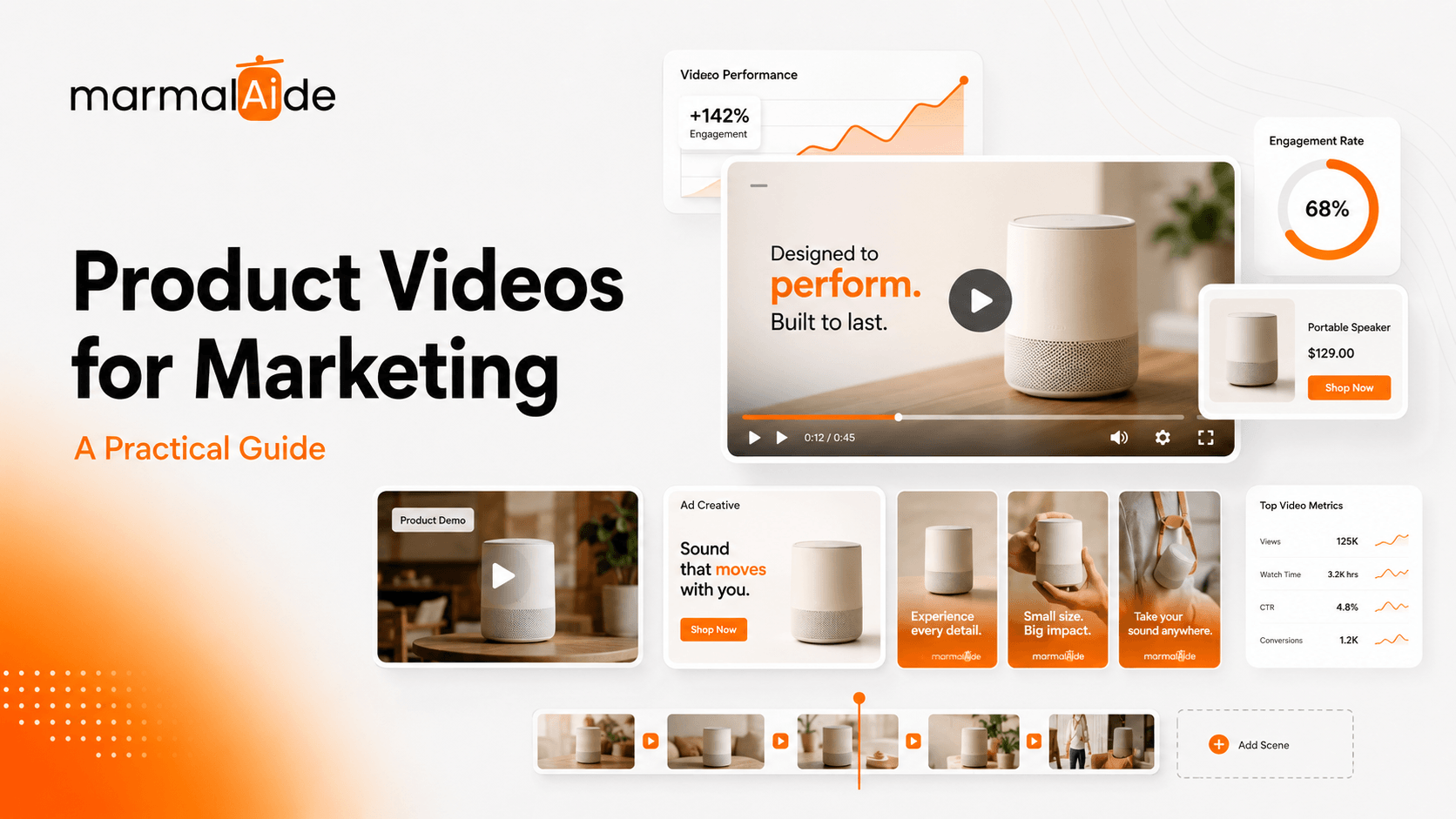
Product videos for marketing are video assets that show a product in action to drive awareness, consideration, and purchase. Video accounts for 82% of all internet traffic (Cisco), and shoppers who view product video are up to 144% more likely to add to cart (Invesp). An effective video production process starts with a clear conversion goal, matches format to funnel stage, and prioritizes production velocity over one-off perfection.
Key Takeaways
- Video accounts for 82% of all global internet traffic, confirming the projection in Cisco’s Annual Internet Report.
- Shoppers who watch a product video are up to 144% more likely to add it to their cart (Invesp, 2025).
- AI-powered tools have reduced the median video production cost from $4,200 to $2,500 per finished minute in 2026.
- Dollar Shave Club’s $4,500 product video generated 12,000 orders in 48 hours and led to a $1 billion acquisition by Unilever.
- Including the word “video” in an email subject line increases click-through rates by 65% and reduces unsubscribes by 26% (Campaign Monitor).
Why Do Product Videos Drive More Sales Than Other Content?
Product videos outperform static content because they answer the buyer’s core question: “What will using this actually look like?” Text describes features. Images show surfaces. Video shows the product working in a real scenario, which collapses the distance between interest and purchase.
- Video now accounts for 82% of all internet traffic, a figure first projected by Cisco and confirmed by multiple industry trackers through 2026.
- 94.6% of online adults watched online video in the past 30 days, according to DataReportal’s Digital 2026 overview.
- The average person spends 100 minutes per day watching online video. Your buyers are already video-native. They compare products, evaluate solutions, and form brand opinions primarily through video.
- Sites using video achieve an average conversion rate of 4.8%, compared to 2.9% for those without (WebFX). Landing pages with embedded video convert up to 86% higher. For marketing teams evaluating where to invest next, product videos for marketing consistently deliver the highest return per dollar across content formats.
What Does the Video Production Process Look Like?
The video production process has three phases, and understanding each helps marketing teams plan timelines and budgets accurately.
Pre-production covers everything before content creation begins. Define the video’s conversion goal (demo signups, paid ad clicks, landing page lift), write the script, build storyboards, and assemble brand assets. For most product videos, this phase determines 80% of the outcome. A weak script cannot be rescued in editing.
Production is where the video gets made. Traditional workflows require locations, talent, lighting, and audio equipment. AI-enhanced workflows like Marmalaide’s video production service use generative AI for scene creation, lip-syncing, and composition, directed by a human filmmaker. This compresses weeks into days.
Post-production includes editing, color grading, sound design, and platform-specific formatting. The video production process steps that matter most here are versioning (creating multiple cuts for different channels and aspect ratios) and performance review (tracking which versions drive conversions).
What Are the Most Effective Types of Product Videos?
Not every product video serves the same funnel stage. Adobe’s full-funnel video marketing framework maps specific formats to customer journey stages: awareness, consideration, conversion, and loyalty. The most effective types, ordered by buying intent:
Product demos show the product in action. These convert highest at the bottom of the funnel because the viewer is already evaluating solutions. For SaaS products, a 60-second walkthrough of a core workflow often outperforms a feature list.
Explainer videos simplify a complex product into a clear value proposition. These work best on homepages and paid landing pages, where reducing cognitive load directly increases conversion.
Testimonial and case study videos let customers make the argument for you. A buyer explaining results on camera is harder to dismiss than a written quote.
Short-form social ads drive top-of-funnel awareness. Video production for social media marketing requires native formatting: vertical for Instagram Reels and TikTok, square or horizontal for LinkedIn, and under 30 seconds for paid placements. Marmalaide’s AI UGC packs produce conversion-ready social ads starting at $399.
Founder and brand story videos give early-stage companies a human face. Atlassian’s research on video marketing found that people recall 95% of a message delivered via video, compared to 10% from text. Founder stories convert that recall into brand affinity.
How Are Leading Brands Using Product Videos to Drive Results?
The strongest case for product videos comes from brands that tracked business impact, not just view counts.
Dollar Shave Club produced a 90-second product video for $4,500 in 2012. The founder walked through the value proposition with humor and directness. Within 48 hours, the video generated 12,000 paying subscribers and crashed the website. The video has accumulated over 26 million views. Unilever acquired the company for $1 billion in 2016, a transaction directly traceable to the brand equity that single video built.
Dropbox launched with a simple demo video showing files syncing across devices. That video drove the waitlist from 5,000 to 75,000 signups overnight. No paid media. No influencer campaign. One product video that showed, rather than described, what the product did.
Marmalaide works with brands including Paramount Global, BrightFarms, and Genexa, producing AI UGC ads, product launch videos, and paid social creatives. The workflow delivers output 65% faster and 85% more cost-effectively than traditional production, according to Marmalaide’s published benchmarks. Founder Eric Rich, a Forbes-recognized filmmaker with a decade directing commercials, leads a team of filmmakers and marketers that scripts, directs, and edits every video.
How Is AI Changing the Video Production Process?
AI has compressed video production process steps from months to days. The shift is structural, not experimental. AI tools have cut the median cost per finished minute from $4,200 to $2,500. But cost is not the primary advantage. Creative testing velocity is.
Platforms like Meta Advantage+ and Google Performance Max optimize toward the best-performing variant. A team with 20 video variants outperforms a team with 3 at the same budget. AI production makes that volume possible without scaling headcount.
Forrester’s Sharyn Leaver, Chief Research Officer, described the broader context: “Generational buying shifts, combined with the rapid rise of generative AI, are fundamentally altering the B2B buying landscape.” For marketing teams, the production bottleneck that once limited video output has largely disappeared.
Marketing for a video production company in 2026 is no longer about selling craft alone. It is about proving that craft can scale at campaign speed. Teams evaluating partners can compare options in Marmalaide’s ranking of top AI video production services or review the QuickFix packages for fixed-scope entry points starting at $399. The Pilot plan at $1,999 delivers a full production with a 72-hour SLA.
How Should Teams Measure Product Video Performance?
Most teams measure video success by views. The teams that secure ongoing budgets measure it by revenue.
A practical framework tracks three layers. Engagement: completion rate, watch time, drop-off points. Conversion: CTR to demo or product page, form fills, attributed purchases. Revenue: influenced pipeline, deal velocity for video-exposed prospects, cost per acquisition by channel.
Interactive content generates 2x more conversions than passive content, according to Forrester Research. Adding clickable CTAs, chaptering, and in-video polls transforms product videos from broadcast assets into lead intelligence tools.
For teams connecting video to pipeline, the simplest starting point is embedding video on your three highest-traffic landing pages, tracking play and completion events, and measuring the conversion lift over 30 days. That gives a defensible number to justify scaling AI video ads production across the full funnel.
Also check this guide on Brand Video Examples for marketing team
FAQs on Product Videos for Marketing
How Much Do Product Videos for Marketing Cost in 2026?
The range spans $500 for AI-generated video to $50,000+ for premium live-action. The median cost per finished minute is $2,500 with AI-enhanced production, down from $4,200 two years ago. Most businesses producing ongoing content pay $3,000 to $6,000 per month for managed services. Marmalaide’s Pilot at $1,999 delivers a fully produced video with a 72-hour SLA.
What is the ideal length for a product video?
Most marketers find videos between 30 seconds and 2 minutes most effective. For paid social, 15 to 30 seconds converts best. For product demos on a landing page, 60 to 90 seconds shows value without losing the viewer. For email, under 60 seconds, since including “video” in the subject line increases CTR by 65%.
How many product videos should a marketing team produce per month?
Teams running paid social across multiple platforms need 10-20 variants per month to feed algorithmic optimization. Teams focused on organic and landing pages can start with 2-4. The constraint is rarely budget. It is production capacity, which is why AI-directed video production has become the default for growth teams scaling creative output.
Can product videos work for complex B2B products?
Complex products benefit more from video, not less. Video shows workflows, integrations, and outcomes that screenshots cannot convey. The key is matching length to funnel stage: short clips for awareness, detailed walkthroughs for evaluation. Interactive video elements like chaptering and in-video CTAs further increase engagement for long-form B2B content.
What platforms drive the most ROI for product video?
For B2B products, LinkedIn and YouTube deliver the strongest pipeline contribution. For DTC, Instagram Reels and TikTok drive the highest engagement-to-purchase rates. The platform matters less than producing native-format content for each channel rather than repurposing one cut across all of them. Adapt aspect ratio, hook, and CTA for each platform individually.