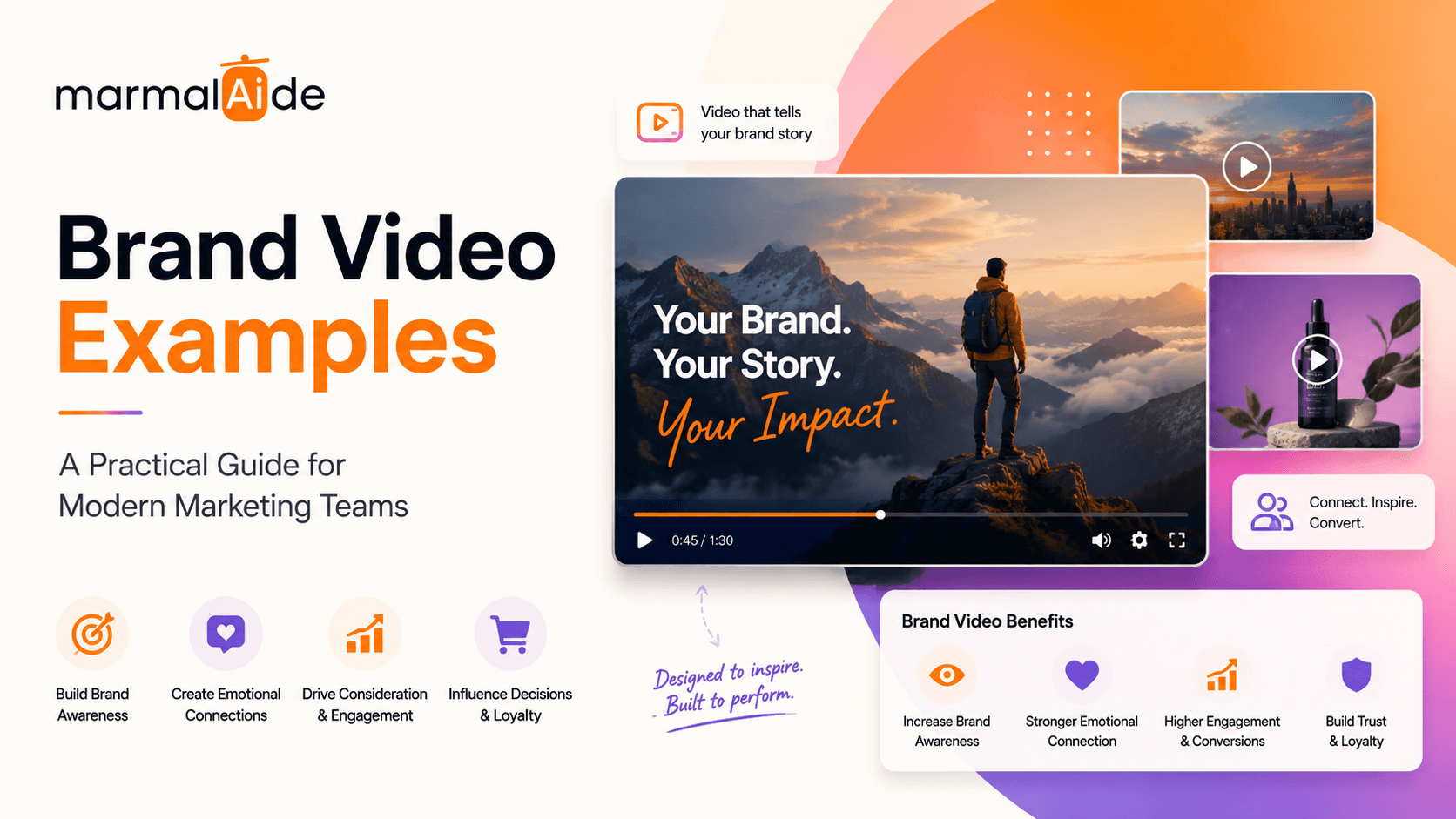
The best brand video examples share three traits: a clear point of view, a story that puts the product second, and proof that the message reached the business result it targeted. Creative quality drives 49% of brand impact across ad campaigns, more than media spend or targeting. This guide breaks down effective brand video examples from Nike, Dove, and Google, plus personal branding video examples, so marketing teams can apply the same principles to their own production.
What Makes a Brand Video Example Actually Effective?
Most brand videos fail for the same reason: they lead with the product instead of the audience. The examples that work invert that order. They start with a truth the viewer already feels, then let the brand earn its place in the story.
Kantar’s creative effectiveness research, based on its Link ad testing database of over 250,000 global ads, found that creative quality drives 49% of brand impact across campaigns, outweighing targeting and media spend combined.
Jeff Greenspoon, CEO of Kantar Americas, put it directly at the Cannes Lions Festival of Creativity: “If I had one extra dollar, I’d be putting it into creativity 10 out of 10 times.” The data backs the instinct. Spend on distribution matters less if the video itself gives no one a reason to watch.
The strongest brand video examples also share a measurement discipline. They are not judged by views alone. They are tied to a specific business outcome, whether that is online sales, brand value, or share of voice.
What Are the Best Brand Video Examples from Major Brands?
Nike’s “Dream Crazy” remains one of the most studied brand video examples in modern marketing. The 2018 campaign, narrated by Colin Kaepernick, made no reference to a specific shoe or product line. It sold a belief system: “Believe in something, even if it means sacrificing everything.” The campaign triggered public backlash and a brief stock dip, but online sales rose 31% within 72 hours of launch, nearly double the equivalent period the year before. Nike went on to post record annual revenue that fiscal year. The lesson for marketing teams: a brand video that takes a genuine position outperforms one that plays it safe, provided the position is authentic to what the brand already stands for.
Dove’s “Campaign for Real Beauty” has run continuously since 2004, making it one of the longest-sustained brand platforms in consumer goods marketing. The strategy was simple: feature real women instead of models. Two decades later, the platform delivered Dove’s highest underlying sales growth in more than a decade, generating €6 billion for Unilever in 2023 alone. The campaign shows that a brand video framework built around a single insight can compound in value for years, rather than existing as a one-off flight.
Google’s “Parisian Love” told a complete love story using nothing but search queries typed into Google’s homepage. No actors, no dialogue, no product shots beyond the search bar itself. It became Google’s first major television spot, airing during Super Bowl coverage to more than 106 million viewers. Ad-testing firm comScore later scored it in the top quintile of effectiveness among ads it had measured, citing the prominence of the product and its convenience woven directly into the story rather than announced separately. It demonstrates that a brand video does not need a large production budget to be emotionally effective. It needs a format the audience has never seen used that way before.
What Are Effective Brand Video Examples for Smaller Budgets?
Not every effective brand video example requires a Super Bowl budget or a decade-long campaign. Smaller brands and growth-stage companies can apply the same principles at a fraction of the cost.
GoPro and Apple’s “Shot on iPhone” campaigns built entire brand video libraries around real customer footage rather than professional shoots. The approach signals authenticity, which increasingly matters more to audiences than polish. According to Sprout Social’s 2026 Content Strategy Report, consumers rank human-generated content as their single highest priority from brands on social media, ahead of high-production episodic content and behind-the-scenes footage.
Marmalaide clients have applied this same principle at growth-stage budgets. Sevaro’s holiday social film delivered 2x higher engagement with zero paid spend, using the same story-driven approach as major brand campaigns but produced through Marmalaide’s AI video production workflow.
Cadastral received a full soft launch film for $3,500, saving over 65% of a standard production budget. Santa Monica Brew Works replaced a planned shoot with GenAI-generated scenes and saved $50,000, redirecting that budget toward paid distribution instead. Each project runs through Marmalaide’s team of filmmakers and marketers, who apply the same narrative discipline used by major agency brand campaigns.
For teams without a Cannes Lions budget, Marmalaide’s QuickFix packages start at $399 and apply the same narrative-first approach to short-form brand content.
What Are the Best Personal Branding Video Examples?
Personal branding video examples follow a different logic than corporate brand films, but the underlying principle is identical: authenticity outperforms polish.
Video posts on LinkedIn receive 5x more engagement than standard text or image posts, according to LinkedIn’s own marketing research. For executives and founders building a personal brand, this makes video the highest-leverage format on the platform. The most effective personal branding video examples share three traits: the subject speaks directly to camera without sounding rehearsed, the content addresses a specific problem their audience faces, and the production quality is clean without being overly polished.
Founder story videos are the clearest entry point for personal branding. A 30-to-45-second video explaining why a company exists, told by the person who built it, consistently outperforms a polished corporate explainer for early-stage brand trust. Marmalaide’s founder content format is built specifically for this use case, delivering a founder story film without requiring a professional studio setup. Teams can review Marmalaide’s full pricing structure to compare founder content against other formats.
What Are Actionable Brand Video Marketing Tips?
Five brand video marketing tips separate the examples above from videos that disappear into the feed.
Lead with a specific truth, not a category claim. “Real beauty” is specific. “Quality skincare” is a category claim every competitor could also make. The former became a two-decade platform. The latter would have been forgotten in a quarter.
Let the product earn its place in the story. In Nike’s, Dove’s, and Google’s examples, the product appears, but never as the point of the video. It appears as evidence that the brand’s stated belief is real.
Match production style to the emotional register. A raw, unpolished testimonial works for a UGC-style ad. A brand film about company values benefits from cinematic direction. Using the wrong register undercuts trust in both directions.
Measure against a business outcome, not a vanity metric. Nike tracked sales lift. Dove tracked underlying revenue growth over decades. Views and shares are diagnostic signals, not the goal.
Build for repeatability, not a single hit. Dove’s platform worked because it could be extended: Evolution, Sketches, Reverse Selfie, and The Code are all variations on the same insight, produced years apart. A brand video framework that can only be used once is a weaker investment than one built to recur.
Related reading Product Videos for Marketing
FAQs
What makes a brand video example different from a product demo?
A brand video sells belief and identity. A product demo sells functionality. Nike’s “Dream Crazy” never shows a shoe’s cushioning technology. It sells the idea that dreaming big matters, and lets the brand’s history of supporting athletes carry the credibility. Product demos and brand videos serve different funnel stages and should not be judged by the same metrics.
How long should an effective brand video be?
There is no fixed length. Nike’s “Dream Crazy” ran two minutes. Google’s “Parisian Love” ran 53 seconds. The right length is however long it takes to complete the emotional arc without padding. For social-first distribution, most effective brand video examples in 2026 run under 90 seconds to match platform-native consumption habits.
Can a small company produce brand videos in the style of Nike or Dove?
The insight matters more than the budget. A small company cannot match Nike’s production scale, but it can apply the same discipline: find one truth about the audience that competitors are not saying out loud, and build the video around that truth rather than a feature list. AI-enhanced production services now make cinematic-quality execution accessible at growth-stage budgets.
What is the difference between a brand video and a personal branding video?
A brand video represents a company or product. A personal branding video represents an individual, usually a founder or executive, and works best when it feels unscripted and direct-to-camera. Personal branding video examples perform strongest on platforms like LinkedIn, where audiences actively seek out individual perspective over corporate messaging.
How do you measure the success of a brand video?
Match the metric to the campaign’s stated goal. Awareness campaigns should track brand lift and share of voice. Sales-driven campaigns should track conversion and revenue lift, as Nike and Dove both did. Views and completion rate are useful diagnostic signals but should never be the primary success metric reported to leadership.