Social media has become an increasingly video-driven marketing environment. Brands need a steady flow of short-form videos, product demonstrations, campaign creatives, and paid social advertisements to stay visible and connect with their audiences.
However, producing video content consistently is not easy. Every new creative requires planning, scripting, production, editing, and review. For marketing teams working with limited budgets and resources, maintaining this production cycle can quickly become a bottleneck.
The challenge is not simply coming up with more content ideas. It is turning those ideas into high-quality, platform-ready video assets without continuously increasing production costs or team size.
AI-assisted video production is changing how businesses approach this challenge. By combining generative AI with creative direction, professional editing, and structured production workflows, brands can develop more video variations and campaign assets while making better use of their existing resources.
Here’s how businesses can scale social media video production without expanding their teams.
Why Scaling Social Media Video Production Is Difficult
Creating one social media video involves several stages. As the number of campaigns and platforms increases, these requirements become harder to manage.
Some of the most common production challenges include:
1. Increasing Demand for Fresh Creative
Social media campaigns require regular creative updates. Brands need different hooks, product demonstrations, storytelling approaches, and visual concepts to maintain audience interest.
Producing every asset from scratch increases the workload for internal marketing teams.
2. Time-Consuming Production Processes
Traditional video production can involve scripting, location planning, filming, talent coordination, editing, and multiple rounds of revisions.
Even relatively short videos can require considerable coordination before they are ready to publish.
3. Limited Creative Resources
Small marketing teams may not have dedicated videographers, editors, designers, and creative strategists.
When the same people manage campaign planning, social media, and content production, creative work can become difficult to scale.
4. Difficulty Producing Multiple Creative Variations
A single campaign may require several versions of the same creative.
For example, businesses may need different video openings, product angles, messaging, calls to action, and formats for different audiences.
Creating each variation manually can slow down campaign execution.
How AI Is Changing Social Media Video Production
Generative AI is introducing new possibilities for video production by helping creative teams develop concepts, generate visual assets, and explore different creative directions.
Rather than treating every video as an entirely separate production project, businesses can use AI-assisted workflows to create multiple assets from a common campaign idea.
Here are some ways AI can support the production process.
1. Faster Video Concept Development
Coming up with fresh concepts for every campaign can be challenging.
AI can help creative teams explore different storytelling approaches, visual directions, product angles, and campaign ideas.
For example, a single product launch could inspire:
- A product demonstration video.
- A problem-and-solution video.
- A customer-focused storytelling concept.
- A feature-highlight video.
- A promotional campaign creative.
Creative teams can then select the strongest concepts and develop them further.
2. Developing Scripts and Storyboards
AI can assist with developing initial video scripts, scene descriptions, dialogue, and storyboard concepts.
Instead of starting with a blank page, marketers and creative professionals can use AI-generated drafts as a starting point.
Human creative direction remains important to ensure the messaging, storytelling, and visual execution match the brand’s objectives.
3. Creating More Video Variations
One of the biggest opportunities in AI-assisted production is creative variation.
A campaign concept can be adapted into multiple versions by changing:
- Opening hooks.
- Product demonstrations.
- Visual treatments.
- Storytelling approaches.
- Messaging and calls to action.
- Video lengths and formats.
These variations give marketing teams more creative options to review and test.
4. Adapting Creative for Different Channels
A video created for one marketing channel may need adjustments before it works effectively elsewhere.
AI-assisted production can help teams explore different aspect ratios, formats, scenes, and creative approaches for channels such as Instagram, TikTok, YouTube, and paid social campaigns.
However, simply resizing or duplicating a video is not always enough. The creative should be adapted to the audience, campaign objective, and viewing experience of each platform.
5. Reducing Dependence on Traditional Production Setups
Some video concepts can be developed using AI-generated scenes and existing brand assets rather than organising a traditional shoot for every requirement.
This can give businesses more flexibility when producing product stories, promotional videos, explainer content, and campaign variations.
The appropriate production approach depends on the creative objective, brand requirements, and quality expectations.
5 Practical Ways to Scale Video Production Without Hiring More People
Using AI is only one part of the solution. Businesses also need a structured approach to managing creative production.
1. Build a Reusable Creative Framework
Instead of developing every campaign from scratch, establish reusable creative frameworks.
These can include:
- Product demonstration formats.
- Problem-and-solution storytelling.
- Customer benefit videos.
- Product feature highlights.
- Promotional campaign concepts.
- Educational video formats.
Reusable frameworks help teams maintain consistency while exploring different creative ideas.
2. Repurpose Existing Brand Assets
Businesses already have valuable marketing material, including product images, existing videos, campaign footage, customer testimonials, and brand visuals.
These assets can provide the foundation for new creative concepts.
AI-assisted production can help transform existing materials into new video formats and campaign variations, reducing the need to start every project from zero.
3. Batch Similar Production Tasks
Organise production around similar tasks rather than handling each video independently.
For example, teams can group:
- Script development.
- Creative concept reviews.
- Video production.
- Editing and revisions.
- Final quality checks.
A structured process makes production easier to coordinate and reduces repetitive work.
4. Combine AI Speed With Human Creative Direction
AI can accelerate parts of video production, but it cannot independently understand every brand’s creative objectives, audience expectations, and storytelling requirements.
Human professionals should remain involved in:
- Campaign strategy.
- Creative direction.
- Brand positioning.
- Visual storytelling.
- Content accuracy.
- Final quality approval.
This combination helps businesses benefit from AI-assisted production without compromising creative quality.
5. Create Variations Based on Campaign Performance
Once creative assets are published or used in campaigns, review their performance to identify opportunities for improvement.
Look at factors such as audience retention, engagement, click-through rates, and conversions, depending on the campaign objective.
Use these insights to develop new creative directions and test alternative messaging, hooks, and visual treatments.
The goal is to make each production cycle more informed than the previous one.
AI Video Production vs. Traditional Video Production
Both approaches have a place in modern marketing. The right choice depends on the type of content, production requirements, budget, and creative objectives.
| Factor | Traditional production | AI-assisted production |
| Concept development | Manual creative planning | AI-assisted ideation and scripting |
| Visual creation | Filming and physical production | AI-generated scenes and existing assets |
| Creative variations | Additional production and editing | Faster exploration of creative variations |
| Production resources | Crew, locations, equipment, and coordination | AI tools combined with creative professionals |
| Flexibility | Depends on production setup | Greater flexibility for suitable creative formats |
| Quality control | Human-led | Human-led review and creative direction |
AI-assisted production does not make traditional production unnecessary. Live-action shoots may still be the best choice for certain campaigns, products, and storytelling requirements.
The opportunity lies in choosing the right production approach for each creative requirement.
How Marmalaide Helps Brands Scale Creative Production
Producing more social media videos is not just about generating content faster. Brands need creative concepts that are strategically relevant, professionally executed, and aligned with their marketing objectives.
Marmalaide combines generative AI with the expertise of marketers and filmmakers to help brands produce studio-quality creative content at scale.
Rather than relying entirely on self-serve AI generation, Marmalaide brings creative strategy, scripting, direction, and editing into the production process.
Its services support different creative requirements, including:
- AI video production: Develop video assets using AI-assisted creative production workflows.
- AI UGC-style videos: Create creator-style video advertisements for paid social campaigns.
- Campaign creative variations: Explore different creative approaches and variations for marketing campaigns.
- Product and brand videos: Develop visual content for product storytelling, brand communication, and promotional campaigns.
- Creative adaptation: Develop different versions of campaign assets for various marketing requirements.
By combining AI-assisted production with human creative expertise, Marmalaide helps marketing teams increase their creative output without having to manage every production activity internally.
Explore Marmalaide’s AI-powered creative production services to understand how its production approach can support your marketing requirements.
Conclusion
Scaling social media video production does not necessarily mean hiring more people or increasing the complexity of every campaign.
Businesses can make their production processes more efficient by developing reusable creative frameworks, repurposing existing brand assets, batching production tasks, and using AI to explore new creative directions.
However, producing more videos should never come at the expense of quality or brand consistency.
The most effective approach combines AI-assisted production with experienced creative professionals who can guide the strategy, storytelling, and final execution.
With the right production workflow and creative partner, brands can develop more video assets, explore new campaign ideas, and respond to changing marketing requirements without continuously expanding their internal teams.
Also check – AI Content Marketing for Social Media Teams
FAQs
How does generative AI help with social media content?
Generative AI helps create captions, social media posts, hashtags, video scripts, content ideas, and platform specific variations, allowing teams to produce more content in less time.
Can AI create content for multiple social media platforms?
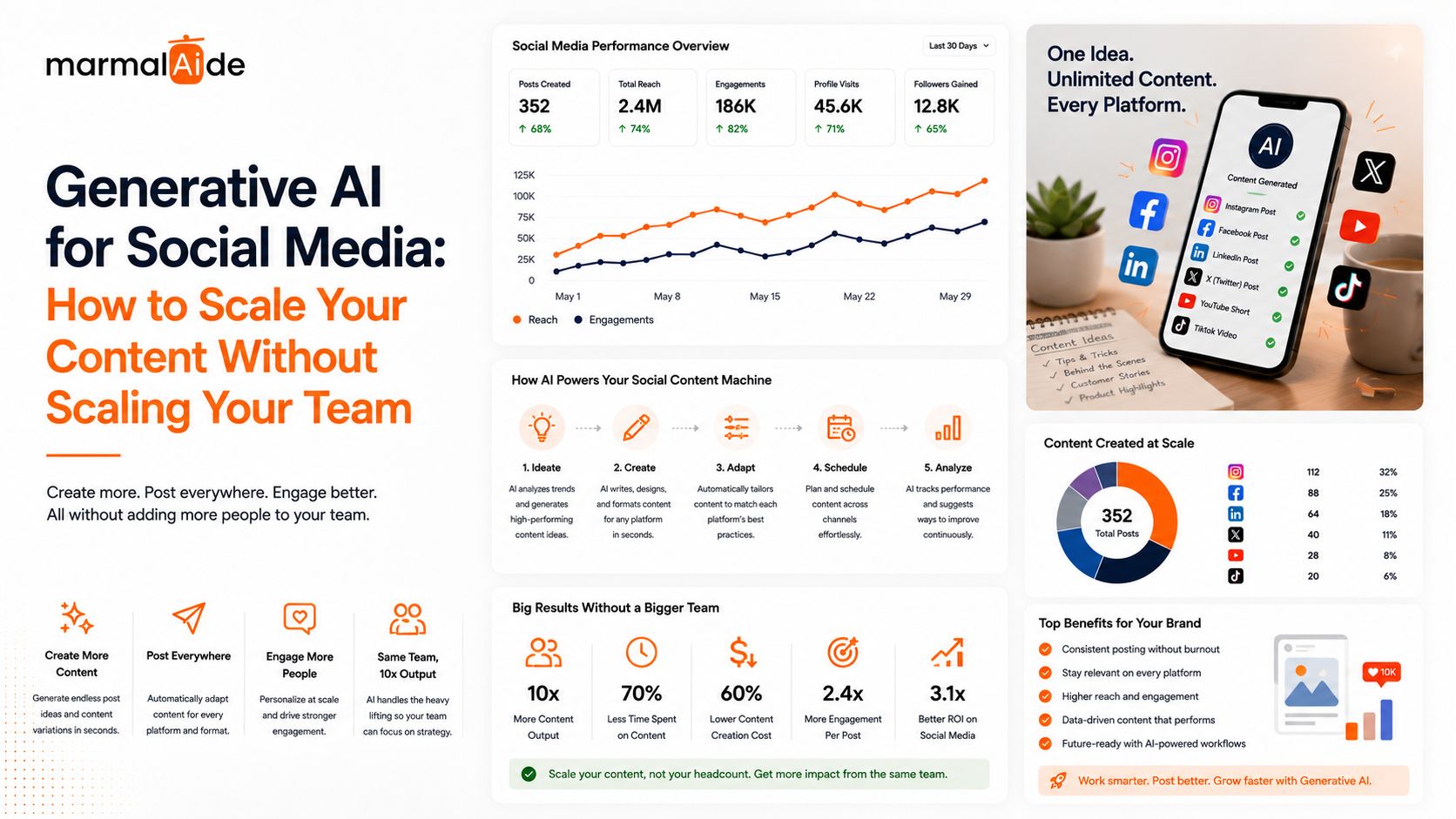
Yes. AI can generate content tailored for Instagram, LinkedIn, Facebook, X, TikTok, and other platforms while adapting the format, tone, and messaging for each audience.
Does AI generated social media content improve engagement?
AI can improve engagement by creating optimized captions, identifying trending topics, suggesting better posting times, and generating content variations that resonate with different audiences.
Is AI replacing social media managers?
No. AI supports social media managers by automating repetitive tasks, while human marketers remain responsible for strategy, creativity, community management, and brand storytelling.
Why choose Marmalaide for AI powered social media content?
Marmalaide combines generative AI with experienced marketers and filmmakers to create high quality, platform optimized social media content that helps brands grow faster while maintaining a consistent brand voice.
How can businesses scale social media video production?
Businesses can scale video production by using reusable creative frameworks, repurposing existing assets, batching production activities, and incorporating AI-assisted video creation into their workflows.
Can AI help create social media videos?
Yes. AI can assist with video concepts, scripts, storyboards, visual generation, and creative variations. Human creative direction and editing remain important for maintaining quality and brand consistency.
How does AI reduce video production time?
AI can accelerate selected production activities, including ideation, scripting, visual development, and creative variation. The actual time savings depend on the project requirements and the production workflow.
Is AI-generated video suitable for paid social advertising?
AI-generated video can be suitable for paid social advertising when the creative meets the platform’s requirements, accurately represents the product, and aligns with the campaign objective. Human review is important before launch.
What is the difference between AI video generation and AI-assisted video production?
AI video generation focuses on creating video content using AI models. AI-assisted video production can involve a broader workflow that includes creative strategy, scripting, AI-generated visuals, editing, and professional direction.
How can brands maintain quality while increasing video output?
Brands should establish clear creative guidelines, use consistent brand assets, involve experienced creative professionals, and review every final asset for accuracy, visual quality, and messaging consistency.