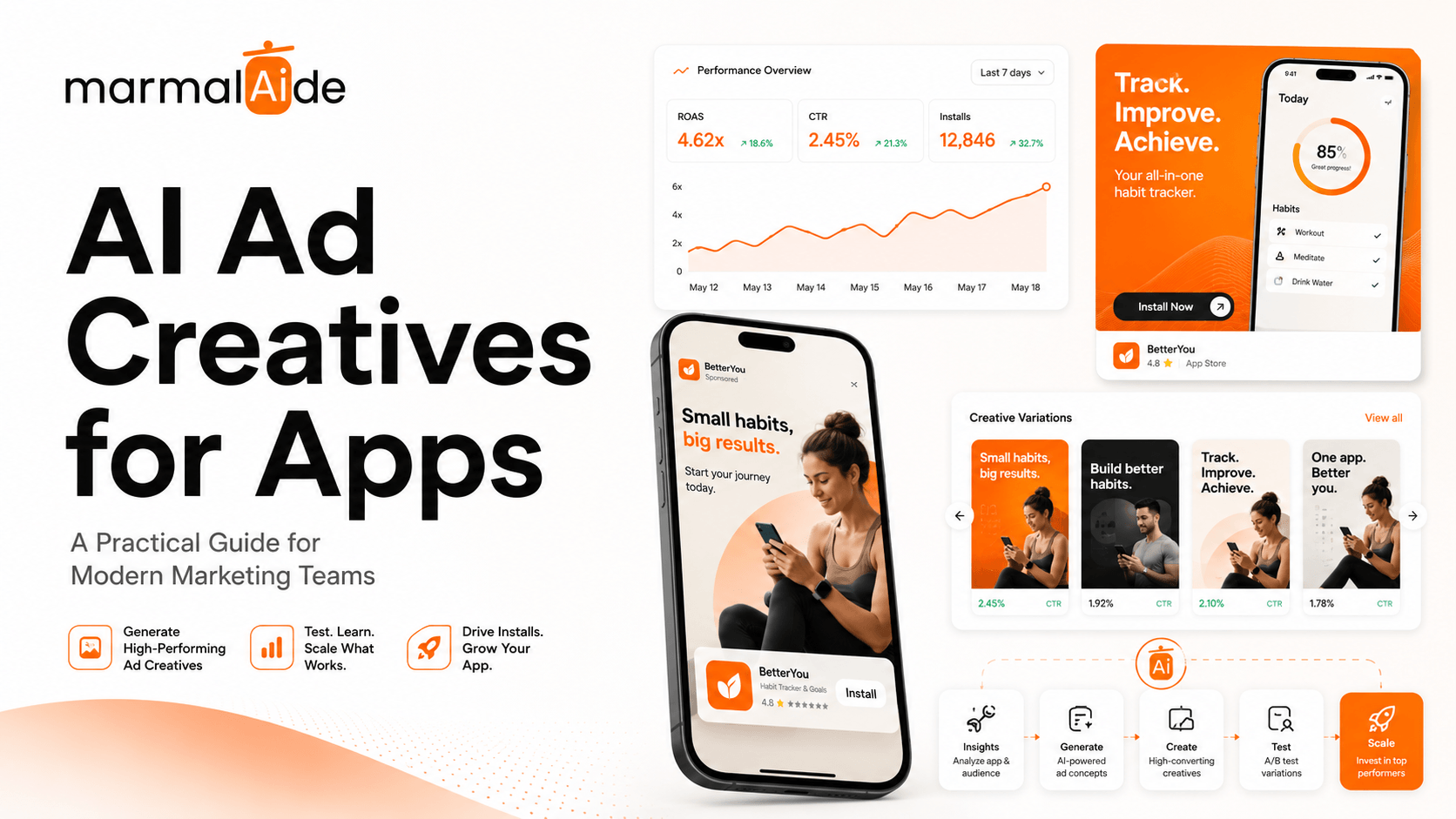
App marketing teams need a constant flow of new ad creatives to keep campaigns performing well. A single app install campaign may require multiple video variations, different hooks, and several aspect ratios to test what works best. As audiences see the same ads repeatedly, refreshing creatives becomes essential to avoid ad fatigue and maintain performance.
While many AI ad creative examples focus on ecommerce or fashion brands, promoting an app requires a different approach. This guide explores practical AI Ad Creatives for Apps, explains what makes them effective, and shows how to build a creative strategy that supports continuous testing and better campaign results.
Key takeaways
- App creative needs to show a product living inside a screen, so formats built for physical products rarely translate well.
- The winning pattern is volume paired with a single clear idea per asset, not one polished hero video.
- AI avatar explainers, UGC style testimonials, and feature spotlight cutdowns are the three formats doing most of the work for app marketers right now.
- A production pipeline that cannot keep pace with the testing calendar is usually the real bottleneck, not the creative concept itself.
Why does app marketing need a different creative approach?
Marketing an app is different from marketing a physical product. Instead of showing how a product looks, your ad needs to quickly demonstrate how the app works and why someone should download it.
An effective app ad should answer these questions within the first few seconds:
- What does the app do?
- How does it solve a problem?
- Why should someone install it instead of another app?
To communicate this clearly, app marketers often use formats that showcase the user experience, such as:
- AI avatar explainers that introduce the app and demonstrate its key features.
- User-generated content (UGC) style testimonials that make the app feel authentic and relatable.
- Screen recordings enhanced with Artificial Intelligence (AI) generated voiceovers, captions, and attention-grabbing hooks to highlight the app’s interface and benefits.
These creative formats help users understand the app’s value quickly, leading to higher engagement, more installs, and better ad performance.
Types of AI Ad creatives for apps
AI makes it possible to produce multiple ad formats quickly, helping app marketers test different creative styles without increasing production time. While new formats continue to emerge, a few have become the most popular because they consistently perform well across app install and engagement campaigns.
Some of the most widely used AI ad creative types include:
AI Avatar Product Explainers
AI avatar videos feature a virtual presenter explaining the app while real screen recordings demonstrate its key features.
Why it works:
- Clearly explains the app’s value in a short video.
- Combines a human-like presenter with a product demonstration.
- Makes it easy to test different scripts and messaging.
Best for:
- Fintech apps
- Productivity apps
- Software as a Service (SaaS) apps
User-Generated Content (UGC) Style Testimonial Ads
These ads use AI-generated creators to deliver customer-style testimonials that feel authentic and relatable.
Why it works:
- Mimics organic social media content.
- Builds trust through peer-style recommendations.
- Allows quick testing of different creators and scripts.
Best for:
- Fitness and wellness apps
- Dating and social apps
- Lifestyle apps
Feature Spotlight Videos
Feature spotlight videos highlight one app feature or one user problem instead of promoting the entire app.
Why it works:
- Keeps creatives fresh and reduces ad fatigue.
- Makes A/B testing easier.
- Helps identify which features drive the most installs.
Best for:
- App install campaigns
- Product launch campaigns
- Continuous creative testing
The AI ad creative strategy that actually works for apps
The pattern across the examples above is volume paired with a single clear idea per asset. App marketing teams that succeed with AI creative are not producing one polished hero video. They are producing many short, specific variants, each built around one hook, one feature, or one audience pain point, and testing them against each other continuously.
This only works if the production pipeline can keep up. A team stuck waiting weeks for a single video from an agency cannot run this kind of testing calendar. That gap, not the creative concept itself, is usually what holds app marketing teams back from using AI ad creative at the volume performance marketing actually rewards.
AI ad creative best practices for app marketers
The list below covers the practices that separate app install campaigns that scale from ones that plateau after the first few creative variants:
- Lead with the in-app moment, not the logo. The first frame should show what the user gets, not the brand mark. App install ads live or die on the first second.
- Match the format to the platform, not the other way around. A TikTok-style UGC ad and a Meta feed static need different pacing and different aspect ratios. Producing one asset and cropping it rarely performs as well as producing for the platform from the start.
- Refresh creative before fatigue sets in, not after. Once cost per install starts climbing on a winning ad, the fix is usually a new variant of the same concept, not a brand new idea. AI production makes this kind of fast iteration realistic instead of a quarterly event.
- Keep a real editor in the loop. AI-generated footage and AI avatars can look generic without a director’s eye on pacing, framing, and cut points. The strongest AI ad creative examples for app marketing pair the speed of AI generation with an actual creative team shaping the final cut.
Choosing the right format for your app category
The best app promo video format depends on your app category. Here are the formats that generally perform best and why.
| App category | Format that tends to perform | Why |
| Fitness and wellness | UGC style testimonial | Peer credibility matters more than polish for behavior change products |
| Fintech and finance | AI avatar explainer | Trust and clarity beat casual UGC tone for money-related decisions |
| Games | Feature spotlight cutdown | Gameplay moments sell themselves better than narration |
| Dating and social | UGC style testimonial | Authentic feeling content outperforms brand voice in this category |
| Productivity and SaaS style apps | AI avatar explainer with screen capture | Users need to see the actual interface before they trust the value claim |
Building an app ad creative pipeline that matches your testing calendar
Marmalaide pairs marketers and filmmakers with generative AI tools to produce studio-quality video ad creative for app marketing teams in hours instead of weeks. The QuickFix AI UGC Pack delivers lip-synced, conversion-ready ad variants across five SKUs, built for exactly this kind of high-volume testing. Subscription plans add a dedicated scriptwriter, director, and edit team producing new GenAI videos and static creative every month, with QuickFix credits included for fast turnaround requests between campaigns.
If your app marketing team needs a steady supply of tested, on-brand creative, browse QuickFix for a one-off production or get in touch to talk through an ongoing plan.
Explore- AI Ad Creative Production Services
FAQs on AI Ad Creatives for Apps
What are AI ad creatives for apps?
AI ad creatives for apps are video or image ads produced with generative AI tools, built specifically to market a mobile or web application. Common formats include AI avatar product explainers, UGC style testimonials, and feature spotlight cutdowns pulled from a longer product demo.
What is the best AI ad creative strategy for app marketing?
The strongest strategy pairs high creative volume with a single clear idea per asset. App marketers who succeed with AI creative produce many short, specific variants rather than one polished hero video, and refresh those variants continuously as performance data comes in.
What are AI ad creative best practices for apps specifically?
Lead with the in-app product moment rather than the brand logo, match creative format to each platform instead of reusing one cut everywhere, refresh winning ads with new variants before performance drops, and keep a real editor shaping the final cut so AI-generated footage does not look generic.
How many ad creative variants should an app marketing team be testing at once?
There is no fixed number, but platform data consistently shows campaigns running more unique creative formats per ad set outperform campaigns running only a handful. The practical target is enough variants to isolate which specific hook, feature, or angle is driving performance, which usually means several distinct concepts, not just color or headline variations on one idea.
How is app ad creative different from ecommerce ad creative?
Ecommerce creative typically centers on a physical product: how it looks, how it is used, how it compares. App creative has to visualize something that only exists on a screen, which means formats like screen capture, UI walkthroughs, and in-app moment framing matter far more than product photography style formats.
Can AI-generated app ad creative look generic or low quality?
Yes, if it is produced without real creative direction. AI-generated footage and avatars can look flat or interchangeable across brands without a director shaping pacing and tone. The strongest results pair AI production speed with an actual editor and director making the final creative decisions, rather than publishing raw AI output.