
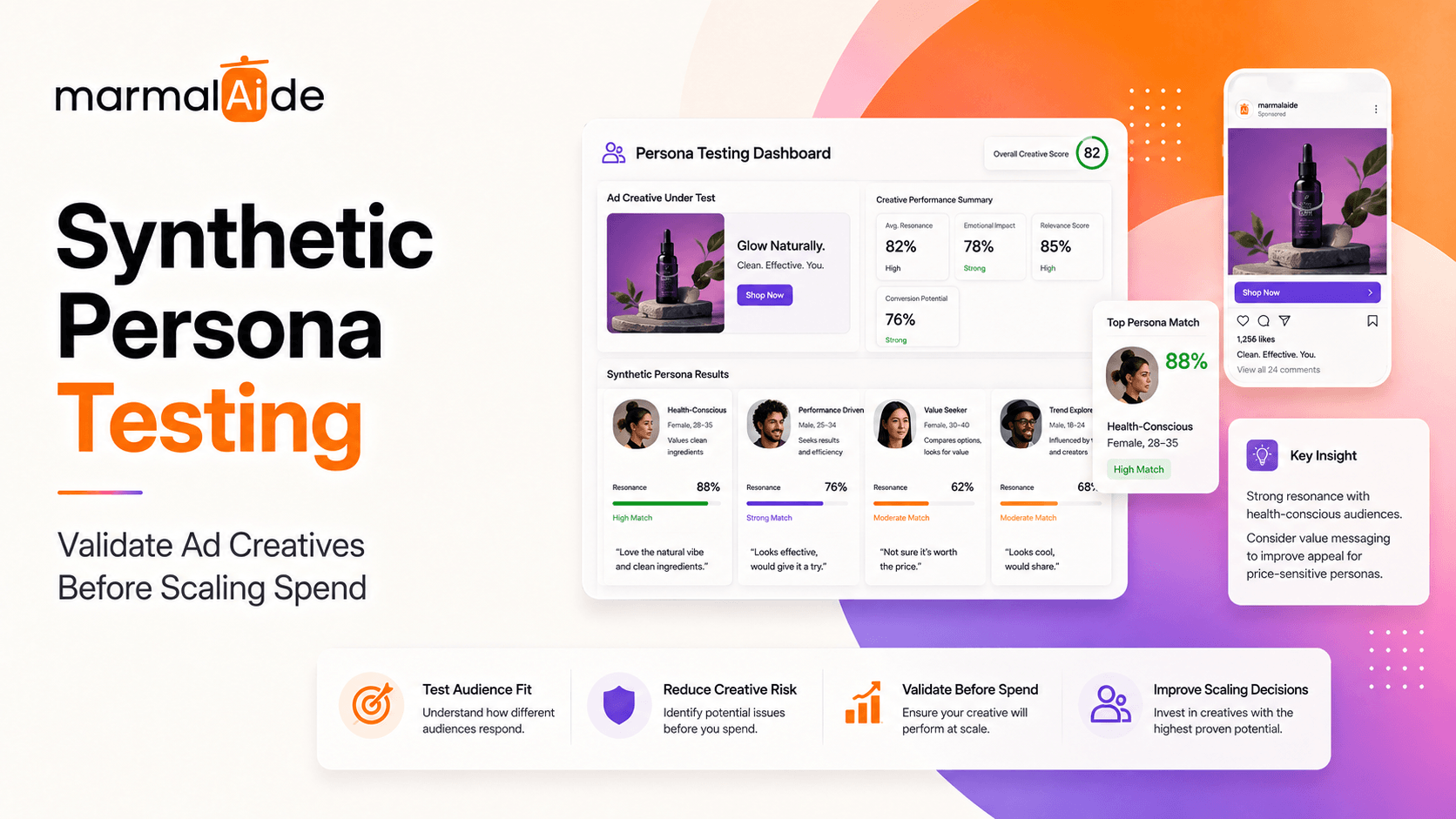
Synthetic persona testing helps marketers get feedback on ad ideas before spending money on advertising. This can save time and improve creative decisions. However, it also has limits. Research from the Nielsen Norman Group found that AI-generated audience feedback is often more positive and less detailed than feedback from real people. This behavior, known as sycophancy, means synthetic personas should not be used to make final creative decisions. They work best as an early screening tool.
In this guide, you will learn how to use synthetic persona testing effectively for ad creatives, where it can produce misleading results, and how to build a practical testing process that combines AI insights with real audience validation.
Key takeaways
- Synthetic persona testing works best as an early filter to narrow creative directions, not as a final validation step.
- The quality of a synthetic persona depends entirely on what data it is grounded in: real survey data versus a general AI model with no real data underneath.
- AI-generated feedback tends to run more favorably and be less specific than real human feedback, which can inflate confidence in a weak concept.
- The fastest gains come from pairing quick synthetic screening with a real, small-scale test before committing full budget.
What is synthetic persona testing?
A synthetic persona is an AI-generated profile designed to simulate how a specific audience segment thinks and responds.
Some platforms build these personas using real survey data collected from consumers. Others rely on a general AI model that simply role-plays as your target customer without any supporting data. This difference is important because the quality of the feedback depends entirely on what the persona is built on.
In most creative testing tools, the process is simple. You define your target audience, upload a script, storyboard, or draft ad, and ask the AI how that audience might respond. Instead of waiting weeks for a traditional focus group, you receive feedback within minutes.
Where synthetic persona testing adds real value
Synthetic persona testing is not designed to replace audience research. Its biggest strength is helping marketing teams eliminate weak ideas before investing more time and budget.
It is especially useful in the following situations:
Catching the Wrong Creative Direction Early
If multiple synthetic personas consistently misunderstand your message or focus on the wrong part of the ad, it is a useful signal that the creative needs improvement before production begins.
Comparing Multiple Creative Concepts
When deciding between several ad ideas, synthetic testing helps identify which concepts deserve further investment instead of relying only on internal opinions.
Building Better Testing Hypotheses
Synthetic feedback is most valuable when it creates questions for real audience testing rather than trying to answer them completely.
Where synthetic persona testing falls short
Although synthetic testing is useful, it also has clear limitations. Understanding these weaknesses helps prevent costly creative decisions.
The table below highlights the most common issues and why they matter:
| Failure Pattern | What It Looks Like | Why It Matters |
| Sycophancy | The persona responds positively to almost every concept. | Creates false confidence in weak creatives. |
| Shallow prioritisation | The persona likes many elements but does not explain which matters most. | Makes it difficult to identify the real performance driver. |
| No behavioral data | The persona predicts what people would do instead of what they actually do. | Real behavior often differs from stated preferences. |
| Weak performance for niche audiences | Feedback is less reliable for specialized audience segments. | Decisions become riskier when limited data supports the persona. |
Research from the Nielsen Norman Group found that synthetic personas often provide more positive and less critical feedback than real users. While real participants reported mixed opinions, AI-generated responses were generally much more favorable. This is why synthetic personas should support creative decisions rather than make them.
How to use synthetic persona testing the right way
Treat synthetic persona testing as a fast filter for narrowing options, not a substitute for watching how a real audience responds once a creative is live. The strongest version of this workflow looks like:
- Draft two or three distinct creative directions rather than one polished concept.
- Run each past a synthetic persona grounded in real data, if you have access to one, specifically to catch an obviously wrong message or tone before production spend goes into it.
- Produce the strongest one or two directions and put them in front of a small, real paid test, not just synthetic feedback, before committing full budget.
- Watch actual engagement and conversion data, not stated preference, to make the final call.
That last step is where a fast production partner matters more than the testing tool itself. Synthetic persona testing only pays off if you can act on what it tells you quickly. If narrowing from three concepts to one still means a six-week production wait before you can test the winner with a real audience, the speed advantage of synthetic testing gets erased by the production bottleneck sitting right after it.
Turning faster creative decisions into faster production
Marmalaide combines experienced filmmakers with generative AI to produce studio-quality video ads in hours instead of weeks. This makes it easier for marketing teams to move directly from testing to production without losing momentum.
Brands using Marmalaide achieve:
- Up to 65% faster project delivery
- Up to 85% more cost-effective production compared to traditional agencies
- Faster testing and iteration across multiple creative concepts
Once a winning concept is identified through synthetic testing, a small paid campaign, or both, production can begin immediately without long agency timelines.
If your team is narrowing creative directions and needs to move fast once a concept is validated, browse QuickFix for a single production or get in touch to talk through an ongoing testing and production pipeline.
Wrapping up
Synthetic persona testing can help marketers make faster creative decisions, but it should not replace real audience validation. Its biggest value is identifying weak concepts early, comparing different creative directions, and helping teams decide what to test next.
The best results come from using synthetic personas as the first step in your testing process, followed by a small real-world campaign before increasing ad spend. When AI insights are combined with actual audience behavior, marketers can reduce risk, improve creative performance, and invest with greater confidence.
Frequently asked questions
What is synthetic persona testing?
Synthetic persona testing uses AI-generated profiles, sometimes grounded in real survey data and sometimes built purely from a general AI model, to simulate how a target audience might respond to a concept, message, or ad creative, without recruiting real research participants.
Can synthetic personas replace real audience testing for ad creatives?
No. Synthetic personas tend to respond more favorably and less specifically than real people, a pattern known as sycophancy. They work best as an early filter to narrow creative directions, with real audience testing, whether a small paid test or genuine user research, still required before scaling spend behind a winner.
What is the best way to use synthetic audience testing in a creative workflow?
Use synthetic testing to compare multiple early-stage creative directions and catch an obviously wrong angle before production spend goes into it. Then validate the strongest one or two directions with real audience data, whether through a small paid test or direct user research, before committing full budget.
What is the difference between a synthetic persona and a traditional buyer persona?
A traditional buyer persona is a static document, usually built by a marketing team from research and assumptions, describing a target segment. A synthetic persona is interactive: you can ask it questions and get generated responses in real time. The key difference that determines usefulness is whether the synthetic persona is grounded in real data collected from actual consumers, or built purely from a general AI model with no real data underneath.
Why do synthetic personas tend to give overly positive feedback?
AI models are generally built to be helpful and agreeable, which shows up as a tendency to respond favorably to whatever concept or idea they are shown. This tendency, often called sycophancy, means synthetic feedback needs to be treated as directionally useful rather than a reliable final verdict on whether a creative will perform.
Are synthetic personas useful for niche or highly specific audiences?
They are less reliable for niche audiences than for broad, well documented consumer segments. A synthetic persona representing a narrow or specialized group is more likely to be built on limited real data, which increases the risk that its feedback reflects assumptions rather than how that specific audience actually behaves.