
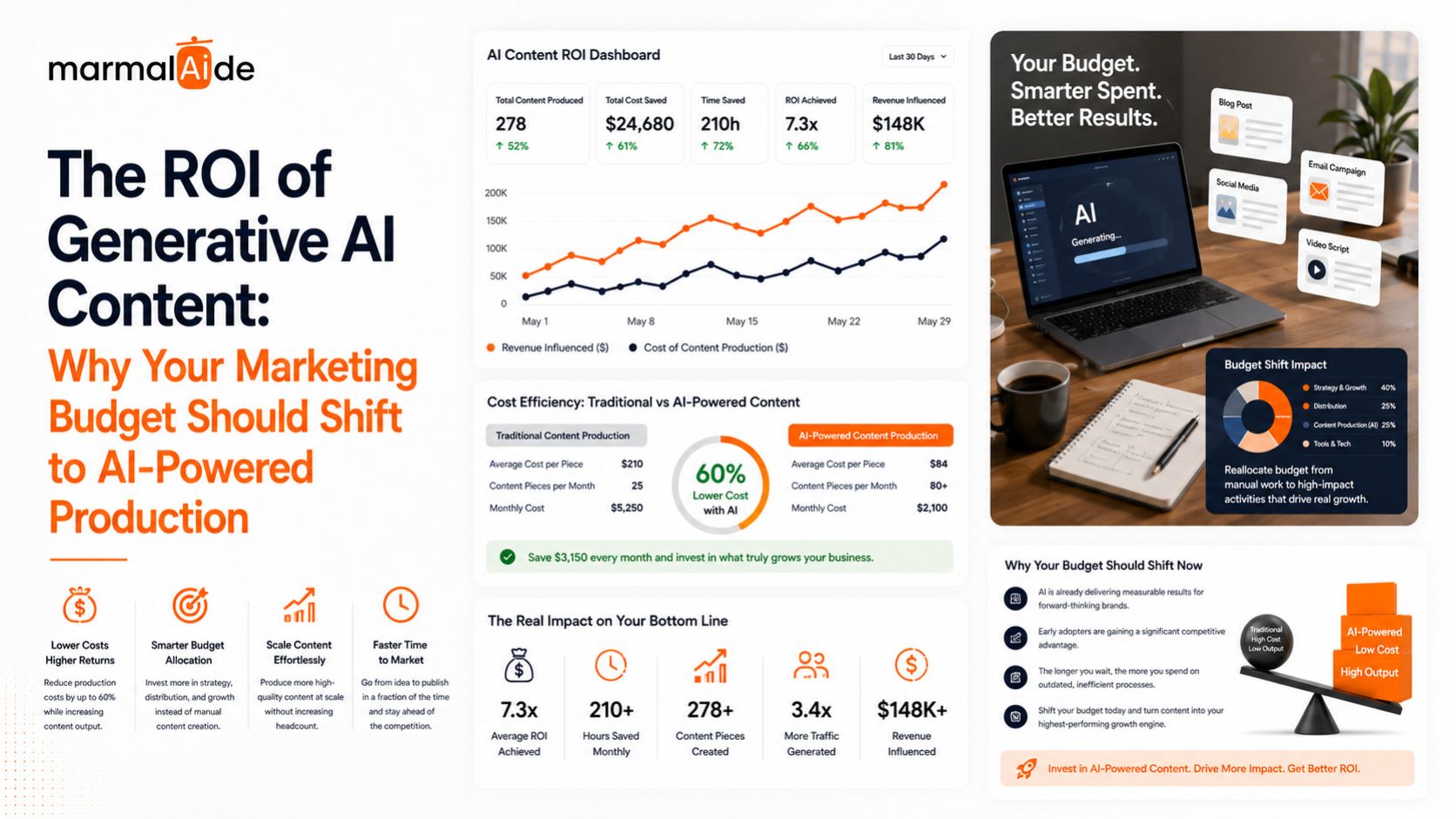
AI content production costs can quickly increase as marketing teams scale their campaigns across video, social media, email, and other channels. Traditional workflows may require separate resources for creative strategy, scripting, filming, design, editing, and revisions, making it difficult to increase output without increasing production overhead.
AI-powered content production offers an alternative by accelerating selected creative tasks and helping teams adapt approved concepts into multiple assets and formats. When combined with human creative direction and quality control, this approach can help businesses manage production budgets while maintaining brand consistency.
However, lower production costs alone do not guarantee better marketing performance. Businesses need to understand the full cost of production, identify where AI can improve efficiency, and measure whether additional creative output contributes to campaign objectives.
This guide explains how to evaluate AI content production costs, compare traditional and AI-assisted workflows, optimize marketing budgets, and decide where AI-powered production can deliver practical value.
Understanding AI Content Production Costs: The Numbers Behind AI-Powered Content
AI content production costs depend on the type of asset, creative complexity, production workflow, and level of human involvement required.
A written social post, a product demonstration video, and a multi-format advertising campaign have different production requirements. Comparing their costs without accounting for scope can lead to misleading conclusions about the value of AI-assisted production.
A more useful comparison examines the full workflow, including:
- Creative development: Research, concepts, messaging, scripts, and storyboards.
- Content production: Writing, design, AI-assisted generation, filming where needed, and asset creation.
- Editing and quality control: Fact-checking, visual review, brand alignment, and revisions.
- Campaign adaptation: Resizing, alternate versions, localization, and platform-specific edits.
- Management and delivery: Project coordination, approvals, file delivery, and any applicable software costs.
AI can accelerate some of these activities, but it does not eliminate every production expense. Human expertise remains important for creative decisions, accuracy, brand consistency, and final approval.
For marketing teams, the objective is to determine which parts of the workflow can be made more efficient while preserving the quality and usability of the finished assets.
Generative AI Content is changing the economics of content creation. Let’s talk numbers. A professional copywriter typically charges $50 to $150 per hour. A video production company may charge $5,000 to $15,000 per project, while a content agency retainer often ranges from $3,000 to $10,000 per month.
Now compare that with what generative AI can do. It can produce dozens of high quality content pieces in just a few hours at a fraction of the cost.
The ROI is not just impressive. It is transformative for businesses looking to scale content production without significantly increasing their marketing budget.
Breaking Down the Cost Comparison
Traditional Content Production:
- Blog post (2,000 words): $200-500
- Social media graphics (5 pieces): $300-800
- Video script and storyboard: $1,000-2,000
- Email campaign (5 variations): $400-800
- Total for one campaign: $1,900-4,100
AI-Powered Content Production (via Marmalaide):
- Blog post (2,000 words): $50-100
- Social media graphics (5 pieces): $75-150
- Video script and storyboard: $200-400
- Email campaign (5 variations): $75-150
- Total for one campaign: $400-800
That’s an 75-80% cost reduction. For a mid-sized marketing team producing 4 campaigns per month, that’s $57,600-157,200 in annual savings.
Traditional vs. AI-Assisted Content Production Costs
The cost of producing marketing content varies significantly by format, creative requirements, production quality, and project scope. Rather than relying on a universal price comparison, businesses should evaluate the actual cost of delivering comparable assets through each workflow.
| Cost factor | Traditional workflow | AI-assisted workflow |
| Creative development | Research, concepts, scripts, and storyboards | AI-assisted ideation and drafting with creative direction |
| Video production | Filming, crew, locations, talent, and equipment where required | AI-generated or AI-assisted visuals, with filming where appropriate |
| Design and adaptations | Individual design and editing tasks | AI-assisted variations and format adaptations |
| Quality control | Editorial review, revisions, and approvals | Human review, fact-checking, and revisions remain necessary |
| Scaling output | May require additional production time and resources | May enable additional variations with less repetitive work |
How to Calculate Your Potential Cost Savings
Start by calculating the fully loaded cost of producing a comparable set of approved assets through your current workflow. Then estimate the cost of producing the same scope using an AI-assisted workflow.
Include internal labor, external production, software, creative direction, editing, quality assurance, and revisions in both calculations.
Cost savings (%) = [(Traditional production cost − AI-assisted production cost) ÷ Traditional production cost] × 100
For example, if comparable production costs decrease from $10,000 to $7,000, the saving is $3,000, or 30%.
This is an illustrative calculation, not a claim about typical industry savings or Marmalaide’s pricing. Actual results depend on the production scope, workflow, and quality requirements.
The most meaningful comparison is the cost per approved, usable asset—not simply the cost per generated output.
How AI-Powered Production Can Improve Marketing Budget Efficiency
Reducing production overhead is only useful when the saved time and resources support better marketing operations. AI-assisted workflows can help teams allocate budgets more effectively in several ways.
Reduce Repetitive Production Work
AI can accelerate tasks such as initial scripting, creative adaptation, content repurposing, and the development of alternate concepts. Teams can then direct human effort toward strategy, review, and higher-value creative decisions.
Plan Creative Production Around Campaign Needs
Instead of commissioning every asset independently, marketing teams can plan a group of related deliverables around a single campaign brief. This may include video variations, social creatives, product demonstrations, and platform-specific formats.
Increase Creative Testing Capacity
Producing additional variations can make it easier to test different messages, hooks, and visual approaches. However, testing should be driven by a clear hypothesis and performance metric rather than by the number of assets generated.
Reduce Production Bottlenecks
A more coordinated AI-assisted workflow can help teams manage repetitive tasks and creative adaptations without restarting the entire production process for every variation.
Reallocate Resources Strategically
Production savings may create room for additional creative testing, distribution, audience research, or performance optimization. These investments should be evaluated separately to determine whether they contribute to better campaign outcomes.
AI-powered production is most valuable when it improves the relationship between production spending, usable creative output, and marketing objectives.
How to Allocate Your Marketing Budget for AI Content Production
Shifting budget toward AI-powered production does not mean moving every content activity to AI. It means identifying where AI can improve efficiency and directing resources toward the production activities that best support campaign goals.
Use this framework to guide the decision:
- Audit current spending. Review agency fees, production costs, internal labor, editing, software, and recurring creative requirements.
- Identify expensive bottlenecks. Find the content formats or workflow stages that consume disproportionate time or budget.
- Prioritize suitable tasks. Start with repetitive, high-volume activities such as creative adaptations, initial scripts, and variations of approved concepts.
- Preserve human creative oversight. Set clear requirements for brand alignment, factual accuracy, product representation, and final approval.
- Run a controlled pilot. Compare AI-assisted production with your existing process using similar deliverables and quality standards.
- Reallocate based on evidence. Expand the workflows that demonstrate measurable improvements in cost, turnaround time, or campaign performance.
The right budget allocation will differ by business. A company producing frequent performance ads may benefit from a different workflow than a business investing primarily in long-form thought leadership or complex brand films.
The goal is to build a production model that supports marketing priorities without compromising creative quality.
Example: Evaluating an AI-Assisted Content Production Budget
Consider a marketing team that regularly commissions social ads, video creatives, email campaigns, and supporting content. The team wants to increase production capacity without expanding its budget at the same rate.
Before changing its workflow, the team documents its existing production costs, turnaround times, revision cycles, and number of approved deliverables.
It then tests AI-assisted production on a defined group of assets.
What the Team Should Compare
| Measurement | Baseline | AI-assisted workflow |
| Total production cost | Record actual cost | Record actual cost |
| Approved assets delivered | Count completed assets | Count completed assets |
| Cost per approved asset | Total cost ÷ approved assets | Total cost ÷ approved assets |
| Turnaround time | Measure from brief to approval | Measure from brief to approval |
| Revision cycles | Record average revisions | Record average revisions |
| Campaign performance | Track relevant baseline metrics | Track comparable performance metrics |
How to Interpret the Results
If the AI-assisted workflow produces more approved assets at a lower average cost, the team has evidence of improved production efficiency.
If those assets also improve engagement, qualified leads, or conversions, the team can investigate whether the workflow contributes to better marketing outcomes.
The team should account for differences in creative quality, media spend, audience, campaign timing, and distribution before attributing performance changes to AI.
This approach gives marketing leaders a defensible basis for deciding whether to expand AI-assisted production, refine the workflow, or retain the existing process for particular content types.
Example: B2B SaaS Content Production Before vs. After AI Adoption
A B2B SaaS company with a monthly marketing budget of $50,000 adopted AI-powered content production through Marmalaide.
| Content metric | Before AI adoption | After AI adoption | Increase |
|---|---|---|---|
| Blog posts per month | 8 | 24 | 3× |
| Social media posts per month | 40 | 120 | 3× |
| Email campaigns per month | 2 | 8 | 4× |
| Videos per month | 1 | 8 | 8× |
| Monthly marketing spend | $50,000 | $50,000 | No budget increase |
Reported Marketing Performance Improvements
| Performance metric | Reported improvement |
|---|---|
| Website traffic | +45% |
| Qualified leads | +32% |
| Conversion rate | +28% |
| Revenue attributed to content marketing | +156% |
Note: These figures are based on the example provided. Verify the results against documented campaign data before presenting them as a real client case study. Increased content output alone does not establish causation for the performance improvements.
How Marmalaide Supports AI-Powered Content Production
For marketing teams managing frequent campaigns, the challenge is often coordinating creative strategy, production, editing, revisions, and delivery across multiple formats.
Marmalaide combines AI-assisted production with human creative direction from marketers and filmmakers to help brands develop campaign-ready visual content.
Human Creative Direction With AI-Assisted Production
AI can accelerate parts of the creative process, while experienced specialists guide concepts, messaging, visual direction, editing, and final quality checks.
This approach helps teams use AI within a structured production process rather than relying on unreviewed generated assets.
Creative Variations for Multiple Channels
Brands may need different video ads, static creatives, product demonstrations, and social formats to support their campaigns. A coordinated production workflow can help adapt approved creative concepts to those requirements.
A More Coordinated Production Process
Working with a production partner can reduce the coordination involved in managing multiple resources and production stages. The value depends on the scope of services, delivery requirements, review process, and the team’s existing capabilities.
Evaluate the Value Against Your Current Budget
Before choosing a production partner, compare the total cost of the engagement with your current production model. Consider the number of approved deliverables, creative quality, turnaround time, revision requirements, and suitability for your campaigns.
For businesses seeking external support, explore Marmalaide’s AI video production services to understand its production offering.
The objective is not simply to spend less. It is to develop a production workflow that delivers the right creative assets at a sustainable cost.

The Bottom Line
The question isn’t whether you can afford to switch to AI-powered content production. The question is whether you can afford not to.
Your competitors are already making the shift. Every month you wait is a month of lost efficiency, lost scale, and lost revenue.
Ready to transform your content ROI? Visit Marmalaide today.
Conclusion: Build a More Efficient Content Production Budget
AI-powered content production gives marketing teams new ways to manage repetitive creative tasks, develop campaign variations, and increase production capacity. Its financial value depends on the actual costs involved, the quality of the finished assets, and how effectively the workflow supports business objectives.
Before shifting a larger share of your marketing budget toward AI, establish a production cost baseline, identify suitable tasks, and test the new workflow against clear operational and campaign metrics.
For brands that need ongoing video and visual creative, Marmalaide combines AI-assisted production with human creative direction to support a more coordinated approach to content creation.
Explore Marmalaide’s AI video production services to see whether its production capabilities fit your campaign requirements.
Explore – generative AI content ROI benchmarks for brands in 2026
FAQs
Why choose Marmalaide for AI powered content production?
Marmalaide combines advanced generative AI with experienced marketers and filmmakers to create high quality, brand aligned content that delivers better marketing results while reducing production costs and timelines.
How much does AI content production cost?
AI content production costs vary according to the content format, creative complexity, software, human involvement, and number of deliverables. Businesses should compare the total cost of producing approved assets through AI-assisted and traditional workflows rather than relying on a single industry-wide price.
How can AI reduce content production costs?
AI can accelerate selected tasks such as ideation, drafting, creative adaptation, and content repurposing. These efficiencies may reduce production time and the resources required for certain deliverables. Human review, editing, creative direction, and quality assurance may still be necessary.
Is AI-powered content production cheaper than traditional production?
AI-powered production can be less expensive for some content formats and workflows, but savings are not guaranteed. Costs depend on production complexity, the amount of human input, software, revisions, and the quality requirements of the final assets.
How should businesses allocate their marketing budget for AI content production?
Businesses should begin by auditing existing production costs and identifying workflow bottlenecks. They can then test AI-assisted production on suitable tasks, measure cost per approved asset and turnaround time, and allocate additional budget to workflows that demonstrate value.
What should businesses consider when choosing an AI content production partner?
Evaluate the provider’s creative expertise, production capabilities, pricing structure, revision process, turnaround time, brand alignment, and quality controls. Compare the full cost of the service with your existing workflow and assess whether the deliverables meet your campaign requirements.