
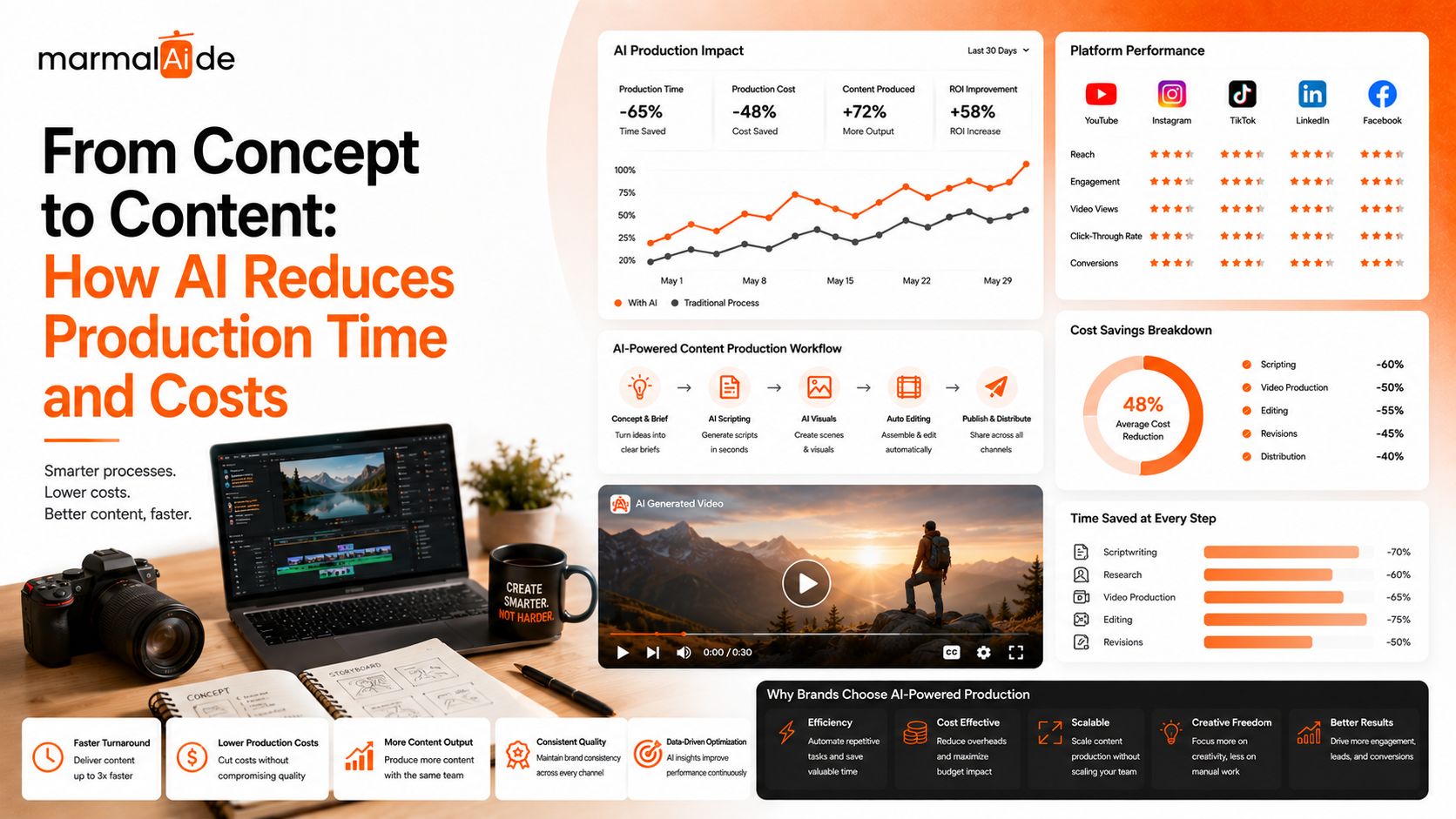
Turning a marketing idea into a finished campaign requires more than creativity. It involves research, planning, scripting, design, video production, editing, and multiple rounds of revisions. AI reduces production time by helping marketing teams streamline these activities, automate repetitive tasks, and move from initial concepts to finished content more efficiently.
A single campaign may require several deliverables, including promotional videos, social media creatives, product demonstrations, email content, and advertising variations. When every asset follows a separate production process, teams can face delays, creative bottlenecks, and increasing production costs.
AI is changing how businesses approach these workflows. From developing initial concepts and writing scripts to generating visual assets and adapting creative formats, AI-powered tools can accelerate several stages of marketing production.
However, the real advantage is not simply creating content faster. It is building a more efficient production workflow that combines AI capabilities with human creativity, strategic direction, and quality control.
Let’s explore how AI can help marketing teams move from concept to finished content more efficiently.
Why Traditional Marketing Content Production Takes Time
Before understanding how AI improves production, it is important to identify where traditional content workflows often slow down.
1. Research and Concept Development
Every marketing asset starts with an idea. Teams need to understand the target audience, campaign objectives, product messaging, and creative direction before production begins.
Developing concepts and getting them approved can involve several discussions and revisions.
2. Scriptwriting and Storyboarding
Video advertisements, product demonstrations, and promotional campaigns require scripts and visual plans.
Writers and creative teams must translate campaign ideas into clear messaging, scenes, dialogue, and visual sequences. Changes to the original concept can require additional work.
3. Visual and Video Production
Creating finished assets may involve designers, filmmakers, editors, equipment, locations, and other production resources.
The requirements vary depending on the content format. A simple social media creative may be relatively straightforward, while a professionally produced brand video may involve a much larger production process.
4. Editing and Revisions
The first version of a creative asset is rarely the final one.
Marketing teams may need to revise messaging, adjust visuals, change scenes, improve transitions, or create different versions for separate platforms.
These additional review cycles can extend production timelines.
5. Adapting Content for Multiple Channels
A single campaign may need to work across Instagram, TikTok, YouTube, LinkedIn, and other marketing channels.
Each platform has different audience expectations, content formats, and creative requirements. Producing separate assets for every channel adds another layer of work.
How AI Reduces Content Production Time
AI can support different stages of the creative process, helping teams complete repetitive tasks faster and explore more creative directions.
1. Faster Content Ideation and Research
AI tools can help marketing teams brainstorm campaign concepts, explore content angles, analyse supplied research, and develop initial creative briefs.
For example, a business launching a new product can use AI to explore different campaign directions, including:
- Product-focused storytelling.
- Problem-and-solution concepts.
- Educational content.
- Promotional campaign ideas.
- Audience-specific messaging.
Instead of developing every concept manually, creative teams can use AI-generated suggestions as starting points and select the ideas that best match their objectives.
Human review remains essential to validate the research, messaging, and relevance of the concepts.
2. Accelerating Scriptwriting and Storyboarding
Developing scripts and storyboards can be one of the more time-consuming stages of video production.
Generative AI can help create initial scripts, scene descriptions, dialogue, and storyboard concepts based on a campaign brief.
For example, a product demonstration video may require an introduction, a problem statement, product features, a demonstration, and a closing call to action.
AI can help structure these elements and generate alternative versions for creative review.
Creative professionals can then refine the scripts, improve storytelling, and ensure the final direction reflects the brand’s identity.
3. Faster Visual and Video Asset Creation
AI-powered image and video generation tools are introducing new ways to develop marketing visuals.
Depending on the project, teams can use AI to create visual concepts, background scenes, product storytelling assets, and supporting creative elements.
This can reduce dependence on traditional production resources for certain types of content.
However, AI-generated visuals are not suitable for every project. Product accuracy, realistic representation, brand guidelines, and creative quality must still be considered.
4. Creating Multiple Creative Variations
Marketing campaigns often require more than one version of an advertisement.
Teams may need different opening hooks, product angles, messaging, calls to action, or visual treatments to test different creative approaches.
AI can help generate initial variations from an approved campaign concept.
For example, a single product campaign could be developed into:
- A product demonstration video.
- A problem-and-solution advertisement.
- A feature-focused creative.
- A short promotional video.
- Different messaging variations for audience segments.
This gives marketing teams more options to evaluate without restarting the entire creative development process for every variation.
5. Simplifying Content Adaptation and Repurposing
Existing content can become the starting point for additional marketing assets.
AI can help transform a long-form video into shorter content ideas, develop social media captions from campaign messaging, and adapt approved creative concepts for different formats.
This allows teams to make better use of existing content investments while maintaining a more consistent production workflow.
6. Supporting Faster Editing and Review
AI-assisted editing tools can help with selected production activities, including transcription, subtitles, scene identification, audio cleanup, and initial video edits.
These capabilities can reduce repetitive editing work and allow creative professionals to spend more time on storytelling, visual quality, and final refinements.
The extent of the time savings depends on the footage, editing requirements, and complexity of the project.
How AI Changes Production Timelines Across Content Formats
Different marketing assets have different production requirements. AI can accelerate specific activities within each workflow, but the overall impact varies.
| Content format | AI-assisted production opportunities |
| Marketing videos | Scriptwriting, storyboarding, visual generation and editing assistance |
| Social media creatives | Concept generation, captions and creative variations |
| Blog content | Research assistance, outlining and initial drafting |
| Email campaigns | Messaging variations and subject line generation |
| Advertising creatives | Hook variations, visual concepts and campaign adaptations |
| Product videos | Script development, visual planning and selected AI-generated assets |
The most effective approach is to identify which activities consume the most time and determine whether AI can improve those specific stages.
How to Reduce Content Production Costs Through Better AI Workflows
Reducing production time can also create opportunities to manage marketing budgets more efficiently.
However, cost savings do not come from AI generation alone. Businesses should evaluate the complete production process, including software, human involvement, creative direction, editing, revisions, and final quality checks.
Here are some ways to improve production efficiency.
1. Automate Repetitive Creative Tasks
Use AI for suitable repetitive activities such as initial scripting, content variations, transcription, and format adaptation.
This allows creative professionals to focus on tasks that require strategic thinking and creative judgement.
2. Reuse Existing Creative Assets
Instead of producing every asset from scratch, identify opportunities to repurpose existing footage, product images, campaign materials, and approved brand visuals.
This can reduce duplication and make production resources more efficient.
3. Create Multiple Assets From One Campaign Brief
Plan related deliverables together rather than treating each asset as an independent project.
A single campaign brief can provide the foundation for videos, social media creatives, promotional content, and advertising variations.
4. Reduce Unnecessary Revision Cycles
Establish clear creative briefs, brand guidelines, approval processes, and messaging requirements before production begins.
AI can assist with developing initial drafts, but human review should happen at appropriate stages to avoid unnecessary rework.
5. Measure Cost Per Approved Asset
Do not evaluate production efficiency based only on how many assets AI generates.
Instead, compare the total cost of producing approved, usable content.
Consider:
- Total production expenditure.
- Number of approved deliverables.
- Production turnaround time.
- Number of revision cycles.
- Creative quality.
- Campaign performance.
This provides a more realistic understanding of whether an AI-assisted workflow is improving production efficiency.
For a deeper breakdown of the financial side, read our guide on AI content production costs and marketing budget optimisation.
Why Human Creative Expertise Still Matters in AI Content Production
AI can accelerate many production activities, but faster content generation does not automatically translate into better marketing.
Human expertise remains essential throughout the creative process.
Experienced marketers and creative professionals help ensure:
- Brand consistency: Every asset follows the brand’s tone, positioning, and visual identity.
- Strategic relevance: Content supports actual marketing objectives rather than simply increasing output.
- Creative storytelling: Campaigns communicate meaningful messages that connect with their audiences.
- Accuracy: Product details, claims, visuals, and messaging are reviewed before publication.
- Quality control: Final deliverables meet the required creative and production standards.
The most effective AI-powered production workflows combine automation with human creative direction.
How Marmalaide Combines AI With Human Creative Expertise
For businesses that need consistent marketing content, managing every stage of production internally can become challenging.
Marmalaide combines generative AI with experienced marketers and filmmakers to help brands develop creative content across different marketing requirements.
Its approach brings together creative strategy, AI-assisted production, and human expertise to support the development of campaign-ready assets.
Depending on the project, this can include:
- AI video production: Developing marketing videos using AI-assisted production workflows.
- AI UGC-style videos: Creating creator-style video advertisements for marketing campaigns.
- Creative concept development: Exploring campaign ideas and visual storytelling approaches.
- Video scripting and production: Turning campaign concepts into structured video content.
- Creative variations: Developing different versions of approved campaign concepts.
Rather than relying entirely on automated content generation, Marmalaide combines AI capabilities with creative professionals who guide the production process and review the final output.
Explore Marmalaide’s AI video production services to understand how AI-assisted production can support your marketing requirements.

Conclusion
AI is changing how marketing teams move from creative concepts to finished content. By supporting research, scripting, storyboarding, visual development, editing, and content adaptation, AI can help businesses reduce repetitive production work and improve turnaround times.
However, successful AI content production requires more than adopting new tools. Businesses need structured workflows, clear creative direction, and human quality control to ensure that faster production also delivers useful, brand-aligned content.
By combining AI-assisted workflows with experienced creative professionals, brands can make better use of their production resources, develop campaign variations more efficiently, and manage content requirements without unnecessarily increasing operational complexity.
FAQs
What is AI content production?
AI content production is the process of using artificial intelligence to create marketing content such as blog posts, videos, social media content, email campaigns, and other digital assets with greater speed and efficiency.
How does AI reduce content production time?
AI automates tasks like research, drafting, scripting, content generation, and editing, allowing marketing teams to complete projects in hours instead of days or weeks.
Can AI generated content maintain high quality?
Yes. When AI generated content is reviewed and refined by experienced marketers, it can meet professional quality standards while maintaining brand consistency and accuracy.
What types of content can AI help produce?
AI can assist with creating blog articles, website copy, social media posts, video scripts, email campaigns, product descriptions, and other marketing content.
Is AI content production cost effective for businesses?
Yes. AI significantly reduces production costs by automating repetitive tasks, helping businesses create more content while using fewer resources.
How can Marmalaide help with AI content production?
Marmalaide combines advanced AI technology with experienced marketers and filmmakers to deliver high quality, brand consistent content that helps businesses save time, reduce costs, and scale their marketing efforts.
How does generative AI reduce production time for marketing videos?
Generative AI can accelerate video concept development, scriptwriting, storyboarding, visual generation, and selected editing activities. These capabilities help creative teams reduce repetitive work and move through suitable production stages more efficiently.
How is AI impacting content production costs?
AI can help reduce certain production expenses by accelerating repetitive tasks, supporting content repurposing, and simplifying the creation of creative variations. Actual savings depend on the content format, production complexity, software requirements, and level of human involvement
Can AI produce marketing content without human involvement?
AI can generate initial content and creative assets, but human involvement remains important for strategy, brand alignment, factual accuracy, storytelling, and quality control.
How can businesses maintain content quality while using AI?
Businesses should establish clear brand guidelines, provide detailed creative briefs, review AI-generated content, verify claims, and involve experienced creative professionals in the approval process.